What NEW SCIENCE Would We Discover with a Moon Telescope?
Based on PBS Space Time's video on YouTube. If you like this content, support the original creators by watching, liking and subscribing to their content.
Long-wavelength radio signals from the cosmic dark ages are blocked from Earth because the ionosphere reflects them, creating a major observational blind spot.
Briefing
A proposed “Lunar Crater Radio Telescope” aims to turn the Moon’s far side into the quietest observing site in the solar system—opening a radio window on the universe’s “cosmic dark ages,” a period between the cosmic microwave background and the rise of the first stars. The core promise is simple: long-wavelength radio signals from that era would be impossible to study from Earth because Earth’s ionosphere reflects those wavelengths, but a far-side lunar array could listen through the near-vacuum of space and reach farther back than any existing telescope.
Earth-based radio astronomy works for wavelengths roughly from centimeters to about 10 meters, where the atmosphere is largely transparent and the ionosphere doesn’t block the signal. Beyond that, the ionosphere acts like a double-sided radio mirror: solar radiation strips electrons from atoms, and radio waves jiggling those electrons get reflected back into space. Even low-Earth orbit satellites suffer from ionospheric effects and intense human-made radio noise. The Lunar Crater Radio Telescope is designed to bypass that entire limitation by placing a large, fixed radio dish on the Moon’s far side, where the Moon blocks terrestrial interference and the Sun’s radio noise can be managed during lunar night.
The scientific target is the “cosmic dark ages,” a gap of at least ~100 million years after the universe becomes transparent at about 370,000 years old (the cosmic microwave background) and before star formation ramps up. During the dark ages, hydrogen gas cooled and emitted extremely faint 21-centimeter radiation when atomic hydrogen’s electron spin flips. On Earth, astronomers already map cold hydrogen in the Milky Way using the 21 cm line. But signals from the dark ages would be stretched by cosmic expansion: a 21 cm photon emitted when the universe was around 17 million years old would arrive with a wavelength on the order of 21 meters. Those longer wavelengths would bounce off Earth’s ionosphere—meaning the dark ages are effectively a blind spot in the accessible radio spectrum from our planet.
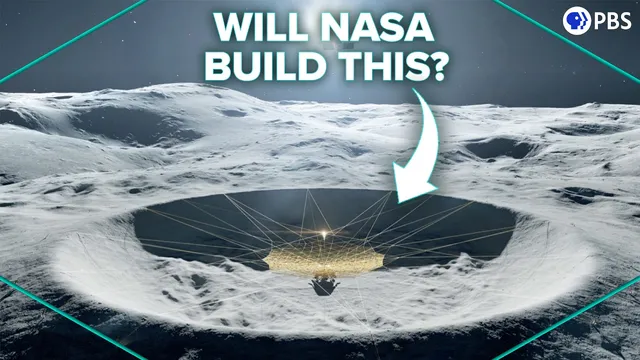
Why build something “giant” rather than a smaller lunar instrument? Resolution and sensitivity for long radio wavelengths demand a very large collecting area. For tens-of-meters wavelengths, the dish needs to be hundreds of meters across to achieve useful angular resolution. The Lunar Crater Radio Telescope is proposed as a 350-meter-diameter fixed dish—larger than Arecibo and smaller than FAST—using a mesh reflector rather than heavy glass mirrors. Radio “mirrors” can be simple wire mesh because the reflecting grid only needs to be fine compared with the wavelength.
The engineering challenge is shaping and supporting a dish that large without the massive structures used by Earth’s fixed telescopes. Earlier lunar proposals stalled because transporting the heavy support frameworks was impractical. The new plan uses a “space hammock” approach: the reflector is suspended and tuned so the hanging shape becomes a paraboloid, achieved by varying wire thickness toward the edges. The concept also anticipates lunar thermal swings, with observations planned during lunar night to keep temperature fluctuations manageable.
Installation would involve landing in the crater center, firing harpoons beyond the rim, raising a feed antenna to the focal point, and unfolding the mesh while adjusting tethers to lock in the paraboloid shape. Communication is expected to require a dedicated relay satellite, potentially in lunar orbit or near Earth–Moon L2.
Funding and feasibility work have begun: in 2020 the concept received about $500,000 from NASA’s Innovative Advanced Concepts program. Even so, NASA would still need strong justification, and the transcript notes alternative strategies—like far-side dipole antenna arrays or satellite swarms—that could complement or compete with a single giant dish. Either way, the central payoff remains: a lunar far-side radio telescope could finally probe the universe’s earliest structure formation directly, rather than relying solely on simulations.
Cornell Notes
The Lunar Crater Radio Telescope would place a 350-meter radio dish on the Moon’s far side to study the universe’s “cosmic dark ages.” Those ages—between the cosmic microwave background at ~370,000 years and the onset of major star formation—should contain faint hydrogen signals from the 21 cm line, but cosmic expansion stretches them to wavelengths tens of meters long. From Earth, the ionosphere reflects those long wavelengths, making the dark ages effectively unobservable in that radio band. A far-side lunar site avoids ionospheric reflection and shields against human radio noise, enabling deeper sensitivity. The design also tackles the hardest engineering problem—building a large parabolic reflector without massive supports—using a tethered, “space hammock” approach that can unfold into the needed shape.
Why can’t Earth-based radio telescopes observe the cosmic dark ages in the same way they observe nearby hydrogen?
What exactly is the “21 cm” signal, and why does it matter for the early universe?
How does the Moon’s far side improve radio astronomy compared with Earth or near-Earth orbit?
Why does the telescope need to be hundreds of meters across for tens-of-meters radio wavelengths?
What engineering trick lets a lunar dish become a paraboloid without massive support structures?
How would data get back to Earth from a far-side lunar telescope?
Review Questions
- What physical mechanism in Earth’s upper atmosphere prevents long-wavelength radio signals from reaching ground-based telescopes?
- How does cosmic redshift transform the 21 cm hydrogen line into wavelengths that require a very large lunar telescope?
- What problem killed earlier lunar fixed-dish proposals, and how does the Lunar Crater Radio Telescope’s tethered reflector design address it?
Key Points
- 1
Long-wavelength radio signals from the cosmic dark ages are blocked from Earth because the ionosphere reflects them, creating a major observational blind spot.
- 2
Hydrogen’s 21 cm spin-flip emission should exist during the cosmic dark ages, but cosmic expansion stretches those photons to tens-of-meters wavelengths.
- 3
A far-side lunar location can avoid ionospheric reflection and reduce human radio interference by using the Moon as a shield.
- 4
The proposed Lunar Crater Radio Telescope uses a 350-meter fixed dish because resolution for tens-of-meters radio wavelengths requires a collecting area hundreds of meters across.
- 5
Instead of heavy rigid supports, the design aims to form a parabolic reflector using a tethered “space hammock” approach with variable wire thickness.
- 6
Installation would unfold a mesh reflector in a selected far-side crater using harpoons, tethers, and a raised feed antenna.
- 7
Data transmission likely requires a relay satellite (e.g., lunar orbit or Earth–Moon L2) because the far side blocks direct communication with Earth.