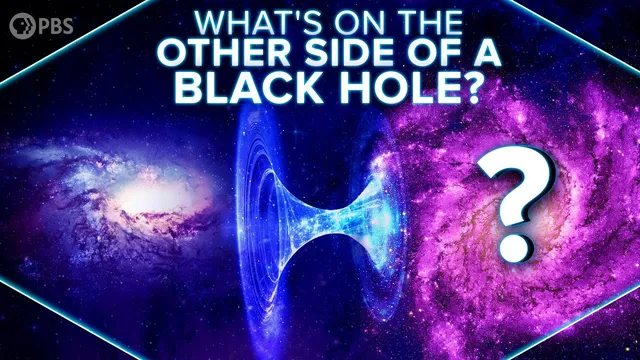
What’s On The Other Side Of A Black Hole?
Based on PBS Space Time's video on YouTube. If you like this content, support the original creators by watching, liking and subscribing to their content.
Coordinate singularities at the event horizon can be removed by changing how spacetime is labeled, turning “infinite” behavior into a smooth mapping.
Briefing
A black hole’s “point of no return” is often treated like a hard boundary, but the mathematics of spacetime mapping shows it behaves more like a coordinate glitch—one that can be smoothed out by changing how distances and times are labeled. Once that is done, the standard Schwarzschild description of an eternal black hole can be extended into a larger spacetime diagram where paths don’t simply stop at the event horizon; they can continue into regions that look like a mirror of the universe, connected through an Einstein–Rosen bridge (a wormhole-like passage). The result is a striking claim: in the idealized eternal case, black holes can appear to connect to “other sides,” including a parallel universe and a white hole region.
The key technical move is replacing ordinary coordinate systems that break down at the event horizon. In the Schwarzschild metric, the horizon is tied to a distant observer’s clock, so the moment of crossing never occurs in that coordinate time—an effect likened to Zeno’s paradox. To build a map that stays well-behaved at the horizon, physicists fuse time with a “tortoise coordinate,” producing schemes such as Eddington–Finkelstein coordinates, where the horizon singularity becomes an illusion. Kruskal–Szekeres coordinates go further by arranging light paths at 45-degree angles, making the event horizon appear as a 45-degree line in the diagram while keeping its physical size constant. Penrose diagrams then compress the entire spacetime into a finite picture by bunching space and time at infinity, clarifying which regions can exchange signals.
Those diagrams also reveal a deeper issue: some coordinate extensions are “geodesically incomplete,” meaning certain light-ray paths have no sensible origin within the chart. Extending the Schwarzschild solution maximally fills in those missing parts, producing a spacetime with additional regions. Tracing certain light rays backward leads to a white hole—time-reversed behavior of a black hole. Even stranger, tracing right-moving light rays backward from inside the black hole yields a corner that resembles the original universe but mirrored in coordinate time and space. In this idealized eternal setup, moving between the mirrored regions requires traveling faster than light: only paths shallower than 45 degrees can cross between the universes in the diagram. The narrative then describes what an infaller might “see” inside: space and time swap roles, the radial direction becomes one-way toward the central singularity, and light from both the external universe and earlier infalling matter can reach the traveler. Yet the singularity itself remains an unavoidable crushing future rather than a visible destination.
The discussion quickly pivots from diagram logic to physical plausibility. Real black holes form from collapsing stars, which means the white-hole past needed for the eternal Schwarzschild map doesn’t exist. Outgoing light rays inside a realistic collapse can be traced back to the star’s surface and interior, leaving no independent parallel universe to emerge from. Still, the wormhole idea isn’t dismissed outright: rotating black holes (described by Kerr spacetime) may admit more complex structures, including traversable wormhole scenarios, and the Einstein–Rosen bridge could—if it could be pried open—connect distant regions of our own universe.
The closing segment shifts to quantum commentary: entanglement can’t be freely maximized with many partners at once due to monogamy, but it can spread into the environment so that correlations with macroscopic observables preserve information about the initial quantum state. The segment also touches on black-hole energy limits for a “black hole bomb,” the relationship between entanglement diffusion and thermodynamic entropy, and a nod to Wojciech Zurek’s style and ideas.
Cornell Notes
Mapping a black hole’s spacetime requires coordinates that don’t break at the event horizon. Ordinary Schwarzschild coordinates make horizon crossing look impossible because time “freezes” for a distant observer, but horizon singularities can be removed using tortoise-based and horizon-regular coordinate systems such as Eddington–Finkelstein and Kruskal–Szekeres. In maximally extended Schwarzschild spacetime, Penrose/Kruskal diagrams show additional regions: a white hole (time-reversed) and a mirrored “parallel universe” region connected through an Einstein–Rosen bridge. Moving between these regions in the diagram requires faster-than-light trajectories, which is physically unattainable. Real black holes formed by stellar collapse lack the white-hole past, so the parallel-universe regions are likely coordinate artifacts rather than reachable realities.
Why does the Schwarzschild metric make it look like crossing the event horizon never happens?
How do Eddington–Finkelstein and Kruskal–Szekeres coordinates “fix” the event horizon on the map?
What does Penrose diagram compression reveal about what parts of spacetime are accessible?
What is “maximally extended Schwarzschild,” and what new regions appear?
Why does traveling to the mirrored/parallel region require faster-than-light motion in the diagram?
Why are parallel-universe and white-hole regions considered unlikely for real black holes?
Review Questions
- What coordinate choices make the event horizon look like a true singularity, and how do tortoise-based coordinates change that conclusion?
- In Penrose diagrams, how do light-ray (null geodesic) directions determine which regions are causally connected?
- Why does the existence of a white-hole region depend on assuming an eternal black hole rather than a collapsing-star origin?
Key Points
- 1
Coordinate singularities at the event horizon can be removed by changing how spacetime is labeled, turning “infinite” behavior into a smooth mapping.
- 2
Schwarzschild coordinates tie horizon crossing to a distant observer’s time, making crossing appear to never occur in that coordinate time even though it happens in proper time.
- 3
Eddington–Finkelstein coordinates use a tortoise coordinate to keep gridlines well-behaved at the horizon, while Kruskal–Szekeres diagrams place light paths at 45 degrees to clarify causal structure.
- 4
Maximally extended Schwarzschild spacetime adds regions (including a white hole and a mirrored universe) needed for geodesics to have complete origins in the diagram.
- 5
Traversing between mirrored regions in the extended Schwarzschild picture requires faster-than-light trajectories, which are physically unattainable.
- 6
Real black holes formed by stellar collapse lack the white-hole past required by the eternal Schwarzschild extension, making the “parallel universe” regions likely coordinate artifacts.
- 7
Entanglement can spread into the environment while preserving inferable correlations with macroscopic observables, linking entanglement diffusion to thermodynamic-like behavior.