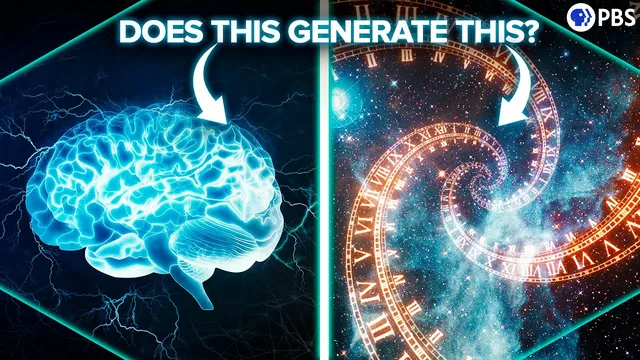
What’s Your Brain’s Role in Creating Space & Time?
Based on PBS Space Time's video on YouTube. If you like this content, support the original creators by watching, liking and subscribing to their content.
Place cells (hippocampus) fire for specific locations and remap when the environment changes, providing a location-linked code.
Briefing
The brain’s internal machinery for “space and time” looks less like a passive mirror of the universe and more like a flexible system for organizing relationships—between locations, motions, and even sequences of events. That matters because many physicists now suspect spacetime may not be a fundamental entity, and neuroscience is offering a way to test whether brains can generate “spacetime-like” structure from underlying regularities rather than from spacetime itself.
Work on navigation in mammals points to a coordinated set of neural maps. In 1971, John O’Keefe and Jonothon Dostrovsky identified hippocampal “place cells” in rats: specific neurons fire when the animal enters particular regions of an environment, then “remap” when the rat moves to a new space. Later, in 2005, Edvard and May-britt Moser discovered grid cells in the entorhinal cortex. These neurons fire not only at one location, but across multiple locations that form a repeating hexagonal grid spanning the current environment. Different grid cells correspond to different spatial scales, acting like a set of rulers that provide metric information. The firing of grid cells is thought to combine—possibly through an inverse Fourier-transform-like computation—to activate localized place cells, yielding a unique neural signature for each location.
At first glance, this resembles an “absolute” Newtonian picture: a coordinate-like grid fixed to the environment, independent of the animal’s position within it and independent of the objects inside it. But the system also depends on relational inputs. Brains update the allocentric map using egocentric information—depth perception to help construct the grid and internal signals about velocity and direction to keep the map aligned as the animal moves. The result is a space representation that feels absolute in structure while being continuously rebuilt from relationships among self-motion, sensory cues, and external layout.
Time is treated similarly. Newton’s view of time as an independent cosmic clock is contrasted with Einstein’s line that “Time is what clocks measure,” implying time emerges from matter’s behavior. Neuroscience supports the idea that humans track time without a single universal internal clock. Instead, different brain regions likely model timing across scales using rhythmic neural activity (with brain waves ranging roughly from 0.02 to 600 Hz), circadian cycles, memory dynamics, and other mechanisms. Short-interval timing is relatively consistent, while longer estimates degrade and become strongly influenced by context.
The most consequential twist comes when space and time blur inside the hippocampus. Under some conditions, hippocampal cells appear to track progression of time even when a rat runs in place, and place cells can fire for new locations or for the passage of time. During theta cycles (4–10 Hz) in the hippocampus, sequences of place-cell activity can represent the recent past and upcoming trajectory, suggesting the hippocampal code may track executed and planned paths—potentially in abstract “thought space” as well as physical space. Because the hippocampus is central to memory sequencing, the same navigation machinery may have been co-opted to organize events and relationships more generally.
The upshot: neuroscience can’t settle whether spacetime is physically real, but it shows brains are capable of generating spacetime-like structure from general-purpose algorithms that map relationships among continuous variables and sequences of events. If that’s true, then spacetime’s perceived primacy may reflect how brains partition experience—efficiently and inevitably—rather than guaranteeing that spacetime is a fundamental ingredient of reality.
Cornell Notes
Neuroscience suggests the brain builds “space and time” using neural maps and timing mechanisms that organize relationships, not necessarily by reading out a fundamental spacetime structure. Place cells (hippocampus) fire for specific locations and remap when environments change. Grid cells (entorhinal cortex) tile environments with hexagonal patterns across multiple spatial scales, providing metric-like information that helps drive place-cell activity. Timekeeping appears distributed across brain rhythms, circadian cycles, memory dynamics, and other internal processes rather than a single cosmic clock. Crucially, hippocampal activity can reflect sequences and trajectories—sometimes time progression rather than location—hinting that the same machinery may support navigation in both physical and abstract spaces.
How do place cells and grid cells work together to represent where an animal is?
Why does grid-cell activity feel “absolute,” even though it depends on relational information?
What evidence supports the idea that the brain’s sense of time is not a single “master clock”?
How can hippocampal cells represent time as well as (or instead of) space?
What does theta activity imply about how the hippocampus encodes past and future?
How does this neuroscience connect to the philosophical debate about space and time?
Review Questions
- What specific firing properties distinguish place cells from grid cells, and how do those properties change when an animal enters a new environment?
- Why might hippocampal place-cell sequences be better interpreted as tracking trajectories or sequences rather than strictly encoding physical location?
- What kinds of neural mechanisms are proposed for time perception, and how do their behaviors differ across short versus long timescales?
Key Points
- 1
Place cells (hippocampus) fire for specific locations and remap when the environment changes, providing a location-linked code.
- 2
Grid cells (entorhinal cortex) fire across multiple locations arranged in hexagonal patterns, tiling the environment at multiple fixed spatial scales.
- 3
The brain likely combines signals from multiple grid cells to drive localized place-cell activation, potentially using computations akin to an inverse Fourier transform.
- 4
Spatial representation can look environment-centered and coordinate-like, but it is continually updated using relational egocentric inputs such as velocity, direction, and depth cues.
- 5
Time perception appears distributed across multiple internal mechanisms (neural rhythms, circadian cycles, memory dynamics) rather than relying on a single master clock.
- 6
Hippocampal activity can reflect time progression and planned/executed trajectories, blurring the boundary between “space” and “time” codes.
- 7
Neuroscience supports the idea that brains can construct spacetime-like structure from general algorithms that map relationships and sequences, even if spacetime itself is not fundamental.