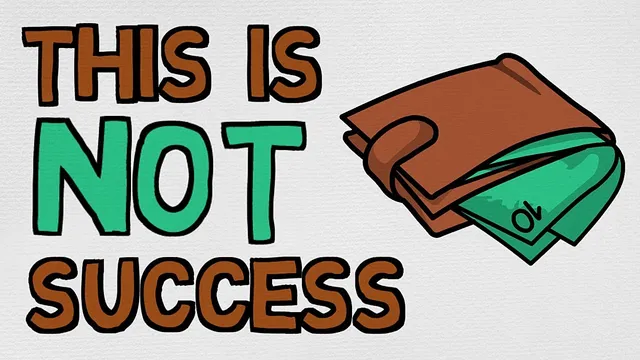
What "Success" Actually Is - And What It Isn't
Based on Better Than Yesterday's video on YouTube. If you like this content, support the original creators by watching, liking and subscribing to their content.
Success is personal: money, fame, and power are only meaningful if they match an individual’s own values.
Briefing
Success is less about money, status, or fame—and more about defining a goal that fits a person’s own values, then pursuing it without surrendering one’s life to someone else’s definition.
The argument crystallizes through the contrasting lives of two brothers, Mike and John. Mike equates success with high income and social power. After college, he lands a high-paying job as an investment banker and climbs to the top tier of his field, earning strong respect and semi-famous visibility within the investment community. The rewards are tangible: a big fancy house and a sports car. But the cost is equally concrete. His work consumes roughly 80 hours a week, leaving little room for hobbies, social life, or the energy needed to build a loving relationship. Stress from difficult clients doesn’t end when the workday ends; his mind stays on the job. Even though Mike considers the sacrifices “worth it,” the life he gains is narrow—optimized for achievement by one external metric.
John pursues a different version of success centered on passion and autonomy. He follows photography rather than chasing a high-paying corporate path. Income is modest—barely enough to live paycheck to paycheck—but his schedule is flexible because he works as a freelancer. He chooses to work no more than 20 hours per week, which creates space for relationships, leisure, and personal growth. John has a wide circle of friends, a loving girlfriend, and plans for a family. He also spends significant time reading, using books to broaden his perspective. He may lack fame and luxury, yet he reports satisfaction with his work and overall life.
The comparison forces a direct question: who is more successful, Mike or John? The answer depends on the definition. Mike would call himself more accomplished because he achieved the markers he values—income, respect, and status. John would claim the same because he achieved what matters to him—time, relationships, and fulfillment. The core takeaway is that success is personal, and people often mistake their own preferred metrics for universal truth.
Rather than treating money or prestige as the default yardstick, the message urges viewers to set goals that belong to them. It warns against pursuing someone else’s dream—such as the idea that becoming a lawyer and earning money automatically equals success—because approval-driven ambition can lead to a “highly disappointing” life. The proposed standard is straightforward: success means setting a goal and reaching it, whatever that goal is, as long as it’s chosen for oneself. When a person defines success internally and follows that path, the result is “true success.”
Cornell Notes
The transcript argues that success is not a single public scoreboard like money, fame, or power. Mike and John illustrate two different definitions: Mike chases high status through investment banking and gains income and respect, but pays with extreme hours, stress, and limited personal life. John pursues photography, earns less, yet gains control over his time, stronger relationships, and personal fulfillment through reading and shared plans for the future. The key lesson is that success is personal: people should choose goals that match their own values rather than chasing someone else’s idea of what “successful” looks like. True success comes from defining the goal for oneself and working toward it consistently.
Why does Mike’s version of success still leave him feeling incomplete?
What does John gain by choosing a different definition of success?
How does the “who is more successful?” question expose the problem with one-size-fits-all definitions?
What does the transcript recommend about pursuing goals that originate outside your own values?
What is the proposed definition of success, and how does it connect to the brothers’ outcomes?
Review Questions
- What trade-offs does Mike make to achieve his definition of success, and which parts of life does that trade-off reduce?
- How does John’s freelance schedule change what he can prioritize day to day?
- Why does the transcript argue that chasing approval can undermine “true success”?
Key Points
- 1
Success is personal: money, fame, and power are only meaningful if they match an individual’s own values.
- 2
Mike’s high-status career demonstrates how external rewards can come with extreme time demands and ongoing stress.
- 3
John’s passion-driven path shows that lower income can be offset by autonomy, free time, and stronger relationships.
- 4
The “more successful” question has no single answer when people define success differently.
- 5
Pursuing someone else’s dream—rather than your own—can lead to a disappointing life.
- 6
True success means choosing a goal for yourself and reaching it, not chasing a universal scoreboard.