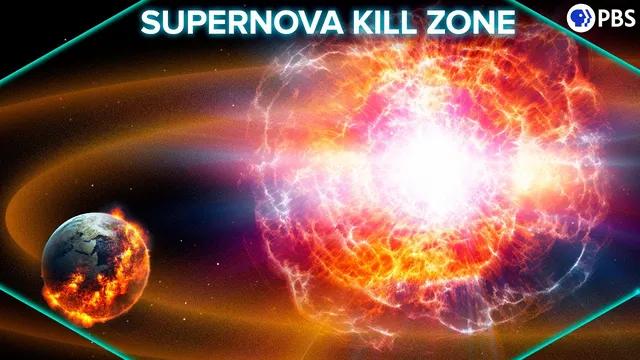
What Supernova Distance Would Trigger Mass Extinction?
Based on PBS Space Time's video on YouTube. If you like this content, support the original creators by watching, liking and subscribing to their content.
Mass-extinction risk depends on particle type and distance: cosmic rays are dangerous from roughly 30–50 light years, while ozone depletion from typical supernova radiation likely needs about 15–20 light years.
Briefing
A nearby supernova can trigger mass extinction—but the “kill zone” is surprisingly specific: cosmic rays can be lethal from roughly 30–50 light years away, while ozone-destroying ultraviolet radiation requires a closer event, about 15–20 light years for a typical core-collapse supernova. The distinction matters because it changes what “dangerous” means. A star exploding far enough away to be a bright night-sky spectacle may still be biologically irrelevant, while a less dramatic event at the right distance could reshape Earth’s atmosphere and ecosystems for thousands of years.
The most threatening pathway starts with the star’s death mechanics. Massive stars end as core-collapse (Type II) supernovae when their iron cores collapse under gravity, producing an intense burst of neutrinos that drive the explosion and fling out heavy elements. While neutrinos carry most of the energy, they pass through Earth with little effect. The real danger comes later: the expanding remnant accelerates particles via strong magnetic fields, generating cosmic rays that can penetrate the atmosphere more effectively than gamma rays. Those cosmic rays can bombard Earth for millennia, and depending on the local interstellar environment and supernova type, the mass-extinction threshold is estimated within 30–50 light years.
Light also matters, but mostly through atmospheric chemistry. A supernova can brighten by 10,000 to 100,000 times, yet Earth’s ozone layer blocks the most harmful photons. If the explosion is close enough, ozone depletion can be severe and slow to recover. Scientists estimate that destroying 30–50% of the ozone layer would be enough to drive a mass-extinction event, but that level of depletion likely requires the supernova to be within about 15–20 light years. Even then, the shock front—the physical wave from the explosion—arrives much later (hundreds to thousands of years), making the biological impact primarily a radiation and particle-chemistry story rather than a direct “blast” story.
Evidence suggests Earth has been hit before. A supernova about 2.7 million years ago is inferred from deposits of radioactive iron-60 in ocean sediments, Antarctic snow, and even lunar material. Earth also sits inside a low-density “local bubble” carved by multiple supernovae over the past ~20 million years. The Pleistocene timing aligns with the start of the Ice Age, and researchers have proposed that a supernova slightly outside the core cosmic-ray kill zone—around 50–100 light years—may have contributed to selective extinctions in shallow ocean layers via increased muon flux.
The kill zone can stretch under special circumstances. If the exploding star is embedded in dense gas, lingering X-ray emission could deplete ozone from as far as ~150 light years. A rarer alternative is a hypernova: gamma rays beamed toward Earth can cause ozone depletion from within several thousand light years, though these events are far less frequent.
Current prospects look grim only in the abstract. Betelgeuse, a red supergiant roughly 640 light years away, is unlikely to be close enough to harm Earth even if it goes supernova soon. The nearest plausible candidates are farther than the lethal range, except for IK Pegasi, which could become a Type 1a supernova if its white dwarf companion reaches the Chandrasekhar limit (1.4 solar masses). At present distance it would be within the maximum dangerous range, but the system is expected to drift hundreds of light years away over the next couple of billion years.
Putting historical, geological, astronomical, and galactic-rate estimates together, the Milky Way averages a supernova of some type about every 50 years—most far away. Direct ozone-roasting events are expected on timescales of roughly a billion years, while cosmic-ray-driven mass-extinction conditions may recur on the order of 100 million years. The next naked-eye supernova could happen in a person’s lifetime, but it would likely be distant; the truly spectacular nearby one is more likely for a future generation. For now, Earth appears to be in a temporarily quiet neighborhood—at least by supernova standards.
Cornell Notes
Supernova danger to Earth depends less on how bright the explosion looks and more on which particles and radiation reach the planet—and from how far away. Core-collapse (Type II) supernovae accelerate cosmic rays in their expanding remnants; those cosmic rays can drive mass-extinction conditions from about 30–50 light years. Ozone destruction from ultraviolet and other photons likely needs a closer event, roughly 15–20 light years, with an estimated 30–50% ozone loss as the tipping point. Special environments can extend risk: dense surrounding gas can produce long-lived X-rays that deplete ozone up to ~150 light years, while rare hypernovae with beamed gamma rays can be dangerous from much farther. Geological and astronomical evidence—like iron-60 deposits ~2.7 million years ago—shows Earth has been affected before, but not on a “tomorrow” schedule.
Why are cosmic rays often the main “kill-zone” mechanism rather than the initial flash of light?
What distance is needed for a typical supernova to deplete ozone enough to trigger mass extinction?
How does the “Pleistocene supernova” fit into the kill-zone idea?
What circumstances can extend the dangerous distance beyond the usual 30–50 light years?
Which nearby stars are discussed as potential future supernova threats, and why are they mostly not immediate concerns?
How often should Earth expect a supernova of the dangerous type, based on multiple lines of evidence?
Review Questions
- What physical process in a supernova remnant is responsible for accelerating cosmic rays, and why does that matter for Earth’s biosphere?
- Compare the distance thresholds for ozone depletion versus cosmic-ray-driven mass extinction, and explain what each threshold is based on.
- How do iron-60 deposits and the local interstellar “bubble” support the claim that supernovae have recently affected Earth’s neighborhood?
Key Points
- 1
Mass-extinction risk depends on particle type and distance: cosmic rays are dangerous from roughly 30–50 light years, while ozone depletion from typical supernova radiation likely needs about 15–20 light years.
- 2
Core-collapse (Type II) supernovae occur when an iron core collapses, with neutrinos driving the explosion and heavy elements—like iron-60—being ejected.
- 3
Earth’s ozone layer blocks most harmful photons, so the initial bright flash is less biologically decisive than later cosmic-ray bombardment and atmospheric chemistry changes.
- 4
Special environments can extend danger: dense surrounding gas can produce long-lived X-rays that deplete ozone up to ~150 light years, and hypernova beaming can be dangerous from much farther but is rare.
- 5
Geological and astronomical evidence—especially iron-60 around 2.7 million years ago—indicates Earth has experienced nearby supernova effects in the past.
- 6
The Milky Way averages about one supernova of some type every 50 years, but truly lethal proximity events are expected on much longer timescales (about a billion years for ozone-roasting; ~100 million years for cosmic-ray kill-zone conditions).
- 7
Current nearby candidates like Betelgeuse and Spica are too far for near-term harm, while IK Pegasi’s potential Type 1a supernova is far in the future and the system should drift outward.