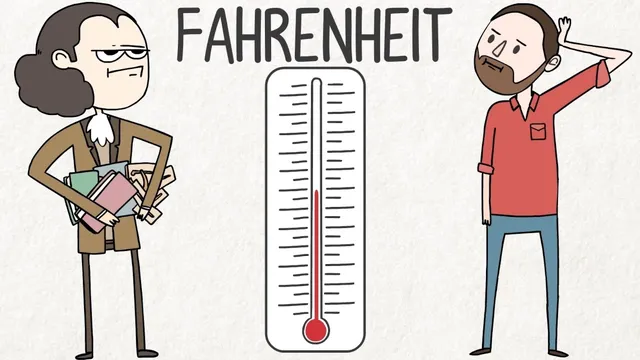
What the Fahrenheit?!
Based on Veritasium's video on YouTube. If you like this content, support the original creators by watching, liking and subscribing to their content.
Ole Rømer’s temperature scale was built around convenient fractional relationships, with boiling set at 60 and freezing/body temperatures placed at one-eighth and three-eighths of the scale.
Briefing
Fahrenheit’s temperature scale wasn’t built on a simple, intuitive link to freezing and body heat; it traces back to a deliberately constructed system created by astronomer Ole Rømer and then reshaped by Daniel Gabriel Fahrenheit for practical measurement. The key twist is that Rømer’s original scale used “nice” fractions based on dividing by 2, 2, and 2 to place water’s freezing point and human body temperature at specific positions—an approach rooted in his astronomical habits and his desire for a workable calibration scheme.
The story begins with Daniel Gabriel Fahrenheit, an instrument maker whose early life was marked by tragedy and instability, including the death of both parents and repeated run-ins with employers. His fascination with thermometers eventually led him to Ole Rømer, the Danish astronomer famous for using Jupiter’s moon eclipses to infer the finite speed of light. While Rømer was recovering from a broken leg, he devised a new temperature scale: water freezes at 7.5 degrees, and body temperature sits at 22.5 degrees. Rømer also wanted the boiling point of water to land at 60 degrees. Because astronomers often work with factors of 60, the scale was designed so that repeated halving places freezing at one-eighth of the way up the scale and body temperature at three-eighths—mathematically tidy positions for calibration.
When Fahrenheit met Rømer in 1708, he adopted the scale but adjusted it to avoid “fractional numbers,” scaling the values up to 8 and 24. That produced the original Fahrenheit scale. Later, Fahrenheit multiplied all values by 4, shifting freezing to 32 and body temperature to 96, the familiar numbers used for centuries. The transcript suggests this later change may have been driven by measurement precision rather than mere convention.
Fahrenheit’s credibility as a calibrator came from his instrument-making skill. His thermometers reportedly matched each other with unusual consistency for the era, and he pioneered the use of mercury as the measuring liquid. Mercury’s higher boiling point made it more reliable than the alcohol used in many contemporary thermometers. The transcript adds a scientific thread: Fahrenheit’s work aligns with Newton, Boyle, and Hooke’s idea that temperature changes correspond to predictable fractional changes in a liquid’s volume. In modern terms, a 1 °F increase corresponds to a mercury volume increase of exactly one part in 10,000—an agreement that may be more than coincidence, though Fahrenheit kept his methods secret.
Finally, the transcript challenges the common claim that 0 °F (and Rømer’s zero) corresponded directly to the temperature of a salt-ice-water mixture. Different descriptions of such mixtures don’t actually yield the promised temperature, so the more likely explanation is that early calibrations used the coldest winter conditions as a baseline and then refined thermometer readings using ice and brine. Today, Fahrenheit remains in limited use—especially in the United States—while the global default is Celsius, which the transcript notes was not invented by Anders Celsius himself. The overall takeaway: the Fahrenheit scale is less a natural law and more a historical artifact shaped by instrument constraints, calibration choices, and the mathematics of its creators.
Cornell Notes
Fahrenheit’s temperature scale traces back to Ole Rømer’s earlier system, not a straightforward “freezing at 32” rule. Rømer designed a scale where water’s freezing point and human body temperature landed at tidy fractional positions, with boiling at 60, using a factor-friendly structure tied to his astronomical habits. Daniel Gabriel Fahrenheit adopted Rømer’s scale, scaled it to remove awkward fractions, and later multiplied everything by 4 to reach the familiar 32 and 96. The transcript also links Fahrenheit’s precision to his mercury thermometers and to early scientific ideas about how liquid volume changes with temperature. It further questions the common story that 0 °F directly equals a specific salt-ice-water mixture temperature, suggesting instead that calibration likely began with real-world cold conditions and was later refined.
Why did Ole Rømer’s temperature scale use the specific numbers 7.5, 22.5, and 60?
How did Daniel Gabriel Fahrenheit transform Rømer’s scale into the original Fahrenheit scale?
What change produced the familiar 32 °F freezing point and 96 °F body temperature?
What made Fahrenheit’s thermometers unusually reliable for their time?
How does the transcript connect Fahrenheit’s work to early physics about liquids and temperature?
Why is the “salt-ice-water mixture equals 0 °F” story questioned?
Review Questions
- What mathematical structure did Rømer use to place freezing and body temperature at convenient fractional positions on his scale?
- How did Fahrenheit’s scaling steps (first to avoid fractions, then multiplying by 4) lead to 32 °F and 96 °F?
- What evidence does the transcript offer for why Fahrenheit’s mercury thermometers could be more consistent than earlier designs?
Key Points
- 1
Ole Rømer’s temperature scale was built around convenient fractional relationships, with boiling set at 60 and freezing/body temperatures placed at one-eighth and three-eighths of the scale.
- 2
Daniel Gabriel Fahrenheit adopted Rømer’s scale in 1708 but rescaled it to eliminate fractional values, moving freezing/body points to 8 and 24.
- 3
Fahrenheit later multiplied the entire scale by 4, producing the familiar freezing point of 32 °F and body temperature of 96 °F.
- 4
Fahrenheit’s reputation rested on instrument consistency and his pioneering use of mercury, which handled higher temperatures better than alcohol.
- 5
The transcript links Fahrenheit’s precision to early scientific ideas about how liquid volume changes with temperature, noting mercury’s modern calibration of 1 °F corresponding to a 1-in-10,000 volume change.
- 6
The common claim that 0 °F corresponds exactly to a salt-ice-water mixture temperature is challenged because real mixture descriptions don’t reliably match the stated value.
- 7
Calibration likely began with real-world cold conditions and was later refined using ice and brine rather than relying on a single exact mixture temperature.