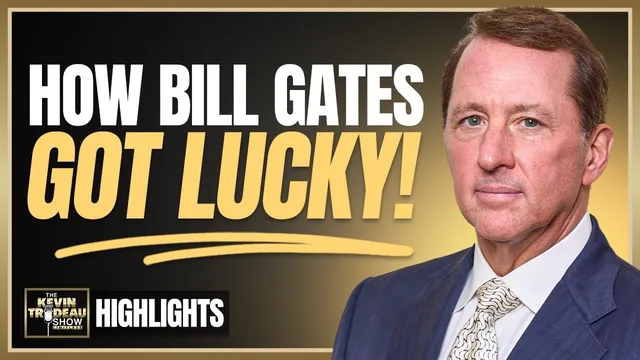
What The Rich Know About Luck (And You Don't)
Based on The Kevin Trudeau Show: Limitless's video on YouTube. If you like this content, support the original creators by watching, liking and subscribing to their content.
Luck is framed as a repeatable outcome of timing plus vision plus immediate action, not a purely random event.
Briefing
Luck isn’t treated as a mysterious gift in this talk—it’s framed as something people can manufacture by combining opportunity, vision, and decisive action. Wealthy and high-profile figures repeatedly credit “being at the right place at the right time,” but the deeper claim is that opportunity only turns into success when someone can recognize potential and move fast. That combination, the talk argues, creates a self-reinforcing cycle where confidence and momentum attract more favorable outcomes.
The transcript leans on a string of examples to make the point that “luck” often looks like coincidence that lands in the right hands. Bill Gates is cited for saying success came from luck and timing, yet also from having the vision to see what software and home computing could become. Steve Jobs is mentioned as hitting a “lottery” with Apple, Elon Musk with multiple ventures tied to PayPal, Tesla, and SpaceX, and Donald Trump as finding gold after repeatedly “digging in the wrong spot” in real estate. The narrative also includes personal anecdotes: taking a wrong turn before GPS, ending up at a gas station, and then meeting a famous billionaire who leads to business; and traveling with prominent figures such as General Norman Schwarzkopf and Mikhail Gorbachev while connecting with Australian businessman Kerry Packer through Renee Rifkin.
A key mechanism is “depth of vision.” The talk describes an origin story from the late 1970s/early 1980s: meeting a former president of Tandy Corporation (RadioShack’s parent) who emphasized that luck matters, but so does the ability to see potential when an opportunity appears. To illustrate “depth of vision,” the example uses a box of matches and then an acorn: one person can see a tree, while another sees a forest—same object, different future possibilities. The prescription is to expand imagination through “dream building,” including studying what major creators have done (the talk name-checks Walt Disney World and encourages reading biographies/autobiographies of figures like Richard Branson, J.P. Morgan, and Elon Musk) and surrounding oneself with dreamers and visionaries.
Even with vision, the talk insists that luck won’t compound without immediate action. Successful people are portrayed as acting while others keep talking—turning opportunities into momentum. That momentum cycle is laid out as: success builds confidence, confidence creates activity, activity forms habits, and consistent habits generate more success. Confidence then connects to an “attractive field” described as being influenced by an “emotional guidance system,” with the claim that research from the book The Field supports the idea that being in a high-confidence, enthusiastic state can shift outcomes.
Finally, the transcript frames the universe as responsive: it will keep offering opportunities, but it may stop if people reject what’s put in front of them. The practical takeaway is a three-part routine—be ready for the right timing, expand vision to recognize potential, and take massive, immediate action—so that favorable “random events” arrive more often and dreams become more attainable.
Cornell Notes
The transcript argues that “luck” is not purely random; it’s created by combining being placed in the right circumstances with the ability to recognize potential and then act quickly. Wealthy figures are repeatedly quoted or referenced as crediting luck and timing, but the difference is framed as vision—seeing what an opportunity could become. “Depth of vision” is treated as a trainable skill through “dream building,” such as studying ambitious creators and surrounding oneself with visionaries. Action completes the loop: taking massive, immediate steps turns opportunity into momentum, where confidence and habits reinforce further success. The talk adds a confidence-and-frequency angle, linking emotional state to improved outcomes via The Field.
Why does the transcript treat luck as something people can create rather than something they simply receive?
What does “depth of vision” mean in the transcript, and how is it illustrated?
How does “dream building” fit into the luck-and-success framework?
What role does action play after an opportunity appears?
How does the transcript connect emotional state to changing outcomes?
What does the transcript suggest happens if opportunities are ignored or rejected?
Review Questions
- What specific three-part sequence does the transcript use to explain how luck becomes success?
- How does the acorn/tree/forest example support the idea of “depth of vision”?
- According to the momentum cycle described, what comes after confidence, and why does that matter for long-term outcomes?
Key Points
- 1
Luck is framed as a repeatable outcome of timing plus vision plus immediate action, not a purely random event.
- 2
Many people can be present at the same opportunity; the transcript claims vision is what turns that opportunity into success.
- 3
“Depth of vision” is treated as a trainable mindset that changes how people interpret the potential of ordinary starting points.
- 4
“Dream building” is recommended to expand imagination through exposure to creators, ambitious environments, and biographies/autobiographies.
- 5
Massive, immediate action is presented as the step that converts opportunity into momentum and habit formation.
- 6
A confidence-driven emotional state is linked to an “attractive field,” with The Field cited as supporting evidence.
- 7
The transcript argues that ignoring opportunities can reduce future offers, while engaging them increases the odds of more favorable events.