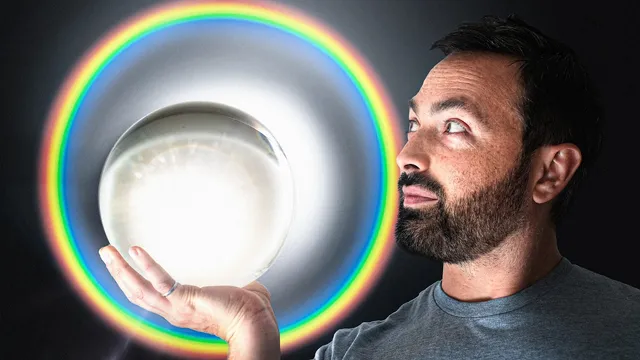
What They (Probably) Don't Teach You About Rainbows At School
Based on Veritasium's video on YouTube. If you like this content, support the original creators by watching, liking and subscribing to their content.
Rainbows form from caustics produced by light reflecting off the back surface of spherical raindrops, concentrating each color at its own maximum scattering angle.
Briefing
Rainbows aren’t just “light refracting and reflecting.” They form because raindrops act like tiny optical devices that concentrate different colors at specific angles, producing a colored ring that only becomes visible from a particular viewpoint. The core insight is that each raindrop sends back a cone of light whose color depends on the maximum scattering angle—set by geometry, refraction, and the wavelength-dependent response of light in water or glass. That angle is about 42° for red light in water, which is why rainbows appear as an arch centered on the antisolar point (your shadow). This matters because it replaces memorized rules with a mechanism that also predicts the “weird” details people notice in real life: why the sky above a rainbow looks darker, why sunglasses can erase it, and why double rainbows and faint extra bands appear.
The explanation starts with a single raindrop modeled as a sphere. Light from the sun enters the sphere, refracts according to Snell’s law, and then some of it reflects off the back surface. As the incoming ray hits the sphere at different heights (impact parameters), the outgoing reflected ray reaches a maximum deflection angle and then turns back. That turning point creates a caustic: a concentration of light rays at a particular angle. Because different colors bend differently—shorter wavelengths (blue) produce larger phase effects in the material and therefore different maximum scattering angles—the caustic angle shifts with color. When many raindrops contribute these color-specific caustics toward an observer, the result is the familiar rainbow ring.
The arch geometry follows directly from viewing conditions. For a given color (like red), the observer sees light only when the sun–raindrop–eye angle matches the caustic angle (about 42° for red). Violet light from the same raindrops misses the eye, but raindrops slightly higher or lower in the sky send violet toward the observer at a shallower angle (around 40°). With raindrops everywhere, the full spectrum fills the arc between those angles. Because the center of the rainbow lies on the line from the sun through the observer’s head, each person sees a different rainbow; even the left and right eyes don’t necessarily receive identical sets of droplets.
Several classic “exceptions” become predictable once polarization and higher-order reflections enter the picture. Rainbow light is polarized because the relevant back-reflection happens near Brewster’s angle, where one polarization component transmits through the droplet and the other reflects—so polarizing sunglasses can block the rainbow while leaving much of the rest of the scene visible. The region below the rainbow can look brighter because raindrops beneath the arc reflect light toward the observer, while drops above the arc do not. Double rainbows arise from additional internal reflections inside droplets; between the primary and secondary deflection ranges lies Alexander’s Dark Band, where neither once- nor twice-reflected light reaches the observer.
Finally, the video connects faint, closely spaced bands and “glories” to interference. Supernumerary rainbows appear when raindrops are small enough (fractions of a millimeter) that rays from slightly different parts of the droplet arrive with path differences on the order of a wavelength, creating alternating bright and dark fringes. Glories (Brocken bows) are similar but occur around the observer’s shadow with much smaller angular radii (about 2–4°), again driven by interference from tiny droplets in fog or clouds. That interference pattern later inspired CTR Wilson’s cloud chamber, beginning with his observation of colored rings around a shadow in mist.
Cornell Notes
Rainbows form because raindrops create wavelength-dependent caustics: for each color, light reflecting inside a spherical droplet concentrates at a specific maximum scattering angle. Geometry then determines what an observer sees—red light corresponds to about a 42° sun–droplet–eye angle (in water), while violet corresponds to a slightly smaller angle (around 40°), producing the rainbow’s arch. The rainbow’s position depends on viewpoint because the center lies along the line from the sun through the observer’s head, so different people see different rainbows. Polarization near Brewster’s angle explains why polarized sunglasses can erase rainbows. Double rainbows and faint extra bands come from additional internal reflections and interference effects in small droplets.
Why does a single raindrop produce a rainbow-like ring rather than just a smear of colors?
How does the ~42° angle arise, and why does it set the rainbow’s arch shape?
What makes rainbows appear polarized, and how do polarizing sunglasses make them disappear?
Why is the sky below a rainbow often brighter than the sky above it?
What causes double rainbows and the dark band between them?
How do supernumerary rainbows and glories relate to interference?
Review Questions
- If a raindrop’s caustic angle depends on wavelength, what observational changes would you expect when switching from red to blue light?
- How does the location of the rainbow center relative to the sun and an observer’s shadow explain why two people can’t see the same rainbow?
- Why do polarizing sunglasses work specifically on rainbows rather than on all bright reflections in the scene?
Key Points
- 1
Rainbows form from caustics produced by light reflecting off the back surface of spherical raindrops, concentrating each color at its own maximum scattering angle.
- 2
The rainbow’s arch geometry comes from the observer seeing light only when the sun–raindrop–eye angle matches the caustic angle (about 42° for red in water, ~40° for violet).
- 3
Rainbow light is polarized because the dominant back-reflection occurs near Brewster’s angle, letting polarizing filters block the rainbow.
- 4
The brightness difference above vs. below a rainbow follows from whether raindrops at those positions send back the relevant reflected light toward the observer.
- 5
Double rainbows result from additional internal reflections inside raindrops, and Alexander’s Dark Band appears where neither once- nor twice-reflected light reaches the eye.
- 6
Supernumerary rainbows and glories are interference patterns that require very small droplets so path differences become comparable to wavelengths.
- 7
The same interference physics that produces glories helped inspire CTR Wilson’s cloud chamber after he observed colored rings around a shadow in mist.