What was Euclid really doing? | Guest video by Ben Syversen
Based on 3Blue1Brown's video on YouTube. If you like this content, support the original creators by watching, liking and subscribing to their content.
Euclid’s constructions function as part of the proof: the proof’s target configuration is generated by a construction recipe, not assumed from a drawn picture.
Briefing
Euclid’s “Elements” didn’t rely on diagrams as decorative aids—it treated ruler-and-compass constructions as part of the proof itself, with diagrams carrying only those properties that can be justified by the construction rules. That shift in perspective helps explain why Greek geometry could be both diagram-friendly and logically strict, even by modern standards, and why Euclid’s system endured as the default model of mathematical certainty for centuries.
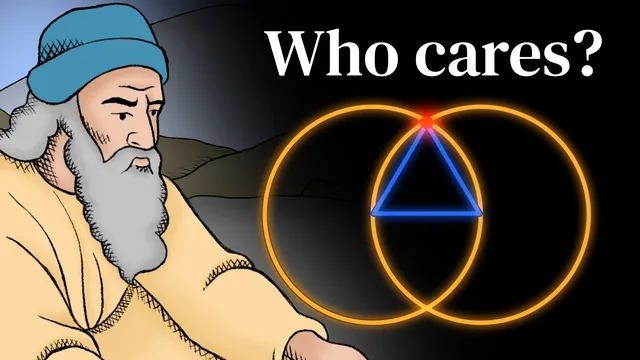
The key example is Proposition 1: constructing an equilateral triangle from a given segment AB. In a modern reading, the proof quietly assumes that two circles drawn with centers at A and B actually intersect. Euclid never adds an extra axiom about intersection; instead, the construction is presented as an operational recipe. In the Greek context, the “skeptic” can’t plausibly deny the intersection after the steps are carried out—because the construction is meant to be performed and checked. The burden of doubt shifts: it’s not enough to claim “the picture might be wrong,” since the proof’s credibility comes from the fact that the construction steps generate the configuration.
That interpretation hinges on a crucial distinction: Euclid doesn’t use diagrams to justify exact numerical equalities that depend on perfect drawing. Rather, diagrams are allowed to support non-exact, topological or order-based claims—like whether a point lies inside or outside a region, or the relative ordering of points along a line. Exact metric claims (like “these lengths are precisely equal”) still require explicit logical argument grounded in the postulates and earlier propositions. In this framework, diagrams and text share the workload: the text supplies the deductive chain, while the construction supplies the “existence” of the geometric situation the proof needs.
The same logic explains why Euclid’s constructions can look unnecessarily elaborate. Proposition 2, for instance, is an intricate procedure for transferring a segment’s length to a new location. If the goal were merely to draw accurately, a simpler method would suffice. Instead, the construction functions like a reusable theorem: it certifies that “copying a length” is legitimate given the initial postulates. Each construction becomes a modular building block—almost like a subroutine—that later proofs can invoke without re-deriving its validity.
Euclid’s insistence on foundational assumptions also reflects Greek philosophical pressure. Geometry offered a way to settle disputes about truth through axiomatic deduction rather than intuition or observation alone. The first postulates are grounded in physically performable actions—straightedge lines and compass circles—so the system starts from rules that can be instantiated without contradiction. Yet diagrams can still mislead if drawn “by eye.” A false proof about right angles illustrates how a tiny placement error can make a diagram suggest an impossible configuration; Euclid’s method avoids this by only using diagrams that correspond to constructions already justified in the Elements.
The most consequential example is the parallel postulate. Euclid delays it until the system has enough machinery to build squares, and the transcript argues that without Postulate 5, Euclid’s square construction cannot be guaranteed to produce a true square—only a distorted quadrilateral. This is why centuries of attempts to prove the parallel postulate failed: the postulate is not a removable assumption but a necessary foundation for the geometry Euclid develops.
Finally, the transcript traces the long afterlife of this approach: Islamic scholarship preserved and extended Euclid; European readers treated constructions as the route to certainty; Descartes adopted analytic geometry but still justified it through constructions; and later, when non-Euclidean geometries undermined the parallel postulate, mathematics shifted toward formal logic. Modern proof checkers like Lean are presented as a contemporary analogue to the ancient “skeptic test,” replacing diagram-based trust with explicit, machine-verifiable rule checking.
Cornell Notes
Euclid’s “Elements” treats ruler-and-compass constructions as evidence inside the proof, not as mere illustrations. The transcript argues that Greek geometry allowed diagrams to support only those claims that follow from the construction steps—especially non-exact properties like inside/outside or point order—while exact metric conclusions still require deductive justification. This explains why Euclid’s constructions can be baroque: each one functions like a reusable, validated operation (a “subroutine”) that later proofs can rely on. The parallel postulate becomes the system’s linchpin: without it, Euclid’s square construction cannot be guaranteed to yield a true square. The long-term impact is framed as a shift from construction-based certainty to formal logic and computer-checked proofs when geometry’s foundations changed.
Why does Proposition 1’s equilateral-triangle construction raise an “unstated assumption,” and how does the Greek interpretation resolve it?
What kinds of claims can diagrams support in Euclid’s framework, and what kinds still need strict argument?
Why does Euclid use complicated constructions for tasks like copying a length (Proposition 2) instead of simpler methods?
How do the postulates relate to physical actions, and why does that matter for consistency?
What goes wrong in the “false proof” about right angles, and how does Euclid’s construction method prevent that kind of failure?
Why is the parallel postulate (Postulate 5) treated as necessary for squares, and what does that imply about attempts to prove it?
Review Questions
- In the transcript’s interpretation, what is the difference between using diagrams to support topological/relational facts versus using them to justify exact metric equalities?
- How does treating constructions as “recipes” change what counts as a credible objection to a proof?
- Why does the parallel postulate become unavoidable for Euclid’s square construction in this account?
Key Points
- 1
Euclid’s constructions function as part of the proof: the proof’s target configuration is generated by a construction recipe, not assumed from a drawn picture.
- 2
Diagrams are permitted to carry non-exact information (like inside/outside or point order) when that information follows from the construction steps.
- 3
Exact claims about lengths and equalities still require explicit deductive reasoning grounded in postulates and earlier propositions.
- 4
Propositions 1 and 2 illustrate two roles of constructions: creating the geometric situation needed for a proof and certifying reusable operations like copying a segment.
- 5
Euclid’s system aims to prevent “by-eye” diagram errors by only using diagrams that correspond to constructions already justified in the Elements.
- 6
Postulate 5 (the parallel postulate) is treated as a necessary foundation for Euclidean squares; without it, the same construction can yield a non-square quadrilateral.
- 7
The long-term trajectory moves from construction-based certainty to formal logic and machine-checkable proofs when geometry’s foundations diversify.