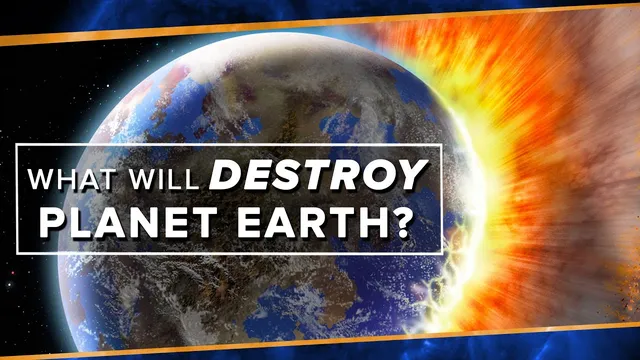
What Will Destroy Planet Earth?
Based on PBS Space Time's video on YouTube. If you like this content, support the original creators by watching, liking and subscribing to their content.
Breaking Earth apart requires overcoming gravity, demanding energy comparable to the solar energy Earth receives over ~40 million years (or ~16 million years for splitting).
Briefing
Earth’s destruction doesn’t hinge on whether humanity can imagine a catastrophe—it hinges on physics: breaking a planet apart requires an energy budget so large that even the most extreme human-scale explosions fall short. The core takeaway is that “planet-killing” scenarios are rare because gravity is the real glue. To separate Earth into chunks, the required energy is comparable to the total solar energy Earth receives over tens of millions of years—about 40 million years for a full breakup, and roughly 16 million years if the goal is only to split Earth in half. That sets the bar for every other scenario: could anything realistically deliver that much energy to Earth?
Nuclear war is the first test case. The most powerful nuclear device ever detonated, the Soviet Tsar-Bomb, released energy equivalent to about 50 megatons of TNT. Even that enormous blast would only devastate a limited region, and calculations imply that wrecking Earth into pieces would require more than one quadrillion Tsar-Bombs. The energy ceiling is not the only problem—producing that many warheads is beyond practical capability, and the necessary fissile material would almost certainly not exist in mineable form at that scale. The result: nuclear weapons could plausibly render Earth uninhabitable, but they can’t realistically shatter the planet.
Asteroids also fail the energy test, largely because of speed. The energy delivered by an impact depends on both mass and velocity, and near-Earth objects don’t approach Earth fast enough. The dinosaur-killing impact is estimated at about one million Tsar-Bomb detonations—massive, but still only about one billionth of what’s needed to blow up a planet. Even the largest “asteroid” object mentioned, 4-Vesta, would supply only about half a percent of the required energy. To compensate, an asteroid would need to hit at roughly 700 kilometers per second—faster than a New York-to-Los-Angeles trip in under five seconds. Realistic collision speeds are more like 70 to 80 kilometers per second, meaning asteroids simply don’t carry enough energy to do the job.
The discussion then shifts from “smash it” to “change the orbit.” A collision between Earth and Mars is possible but uncertain. Over billions of years, gravitational interactions among planets and other bodies can accumulate small orbital changes. Simulations that tweak Mercury’s starting position by about a meter show that most outcomes remain similar, but in a minority of runs Earth’s orbit stretches after around three billion years, leading to close encounters and even a collision with Mars roughly four billion years from now—enough for serious structural damage. Still, the probability is hard to pin down because small differences can cascade chaotically.
Finally, the most likely endgame comes from stellar evolution and cosmic expansion rather than impacts. In about five billion years, the Sun becomes a red giant and expands; if Earth stays put, it could be swallowed. Yet the Sun also loses mass via a stronger solar wind, weakening its gravitational hold and potentially pushing Earth outward. Recent simulations suggest Earth ends up just inside the Sun and “fry” rather than being cleanly swallowed. Beyond that, the “Big Rip” scenario—driven by dark energy—remains speculative but offers a dramatic possibility: if expansion accelerates in the right way, space itself could eventually tear apart everything, from galaxies down to atoms and protons.
In short, Earth is hard to physically break apart with external violence, and the most plausible destruction pathways are slow-burning stellar fate or, less certainly, a universe-wide tearing driven by dark energy.
Cornell Notes
Earth’s breakup is limited by energy: separating Earth against gravity requires energy comparable to the solar output Earth receives over tens of millions of years. Nuclear weapons can make Earth uninhabitable but cannot realistically shatter the planet—calculations using the Soviet Tsar-Bomb imply more than one quadrillion such blasts would be needed for a true breakup. Asteroid impacts also fall short because realistic collision speeds are too low; even the dinosaur-killer scale is about a billionth of the energy required to blow up Earth. A Mars collision is possible over billions of years due to chaotic orbital evolution, but likelihood is uncertain. The most credible long-term fate comes from the Sun’s red-giant phase, with simulations favoring Earth ending up inside the Sun and frying, while the “Big Rip” remains a speculative alternative driven by dark energy measured by ESA’s Planck satellite.
Why does “breaking Earth apart” require so much energy?
How do nuclear weapons compare to the energy needed to destroy Earth as a physical object?
What prevents asteroid impacts from blowing up Earth?
How could Earth collide with Mars, given their different orbits?
What are the most plausible long-term destruction scenarios discussed?
Review Questions
- What energy threshold (in terms of solar-years) is used to argue that physically splitting or breaking Earth is extremely difficult?
- Why does collision speed matter more than people often expect for asteroid impact outcomes?
- What two competing effects determine whether Earth is swallowed by the Sun or ends up inside it during the red-giant phase?
Key Points
- 1
Breaking Earth apart requires overcoming gravity, demanding energy comparable to the solar energy Earth receives over ~40 million years (or ~16 million years for splitting).
- 2
The Soviet Tsar-Bomb benchmark implies that shattering Earth would require more than one quadrillion such detonations—far beyond feasible production.
- 3
Asteroid impacts can be catastrophic but still fall short because realistic impact velocities are about 70–80 km/s, not the ~700 km/s needed for planet-level disruption.
- 4
A Mars collision is physically possible over billions of years due to chaotic orbital evolution, but the probability remains difficult to quantify.
- 5
The Sun’s red-giant phase is the most likely long-term “end” pathway, with simulations favoring Earth ending up just inside the Sun and frying.
- 6
Dark energy could, in principle, lead to a “Big Rip,” tearing apart structures down to atoms—an intriguing but not guaranteed scenario supported by ESA’s Planck data within uncertainties.