What Will We Miss?
Based on Vsauce's video on YouTube. If you like this content, support the original creators by watching, liking and subscribing to their content.
The transcript pairs awe-inspiring future astronomy (supernovas and a Milky Way–Andromeda merger) with the reality that many current sights will vanish over geological and astronomical timescales.
Briefing
The biggest takeaway is that the future will be packed with awe—supernovas, galaxy collisions, and other cosmic spectacles—but the specific “cool things” people imagine seeing are also transient. Over timescales from thousands to millions of years, natural processes will erase familiar landmarks and even change what the sky can do, meaning future generations will inherit a different universe than the one we know.
The timeline starts with human-scale limits and quickly stretches outward. The year 6009 is described as the first since 1961 in which a year written in Hindu-Arabic numerals can be inverted and still read the same—an odd little symmetry trick that, realistically, most people alive today won’t live to witness. Even grand projects won’t finish on anyone’s lifetime schedule: the Time Pyramid in Wemding, Germany, is planned as 120 concrete blocks added at a rate of one every 10 years. With only three blocks added since 1993, completion is projected around 3183, long after today’s builders and their descendants.
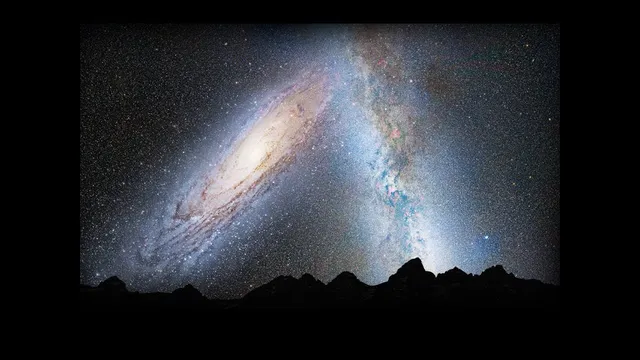
Then the focus shifts to hazards and celestial fireworks. The Chernobyl Exclusion Zone is framed as unsafe for human activity for millennia, with contamination levels expected to remain too high until around the year 22,000. Meanwhile, the sky will deliver its own countdown: Betelgeuse and Eta Carinae are expected to explode as supernovas visible from Earth, potentially making the night look like it has two suns for weeks. The most dramatic event arrives far later—about 3.75 billion years from now—when the Andromeda Galaxy, roughly 2.5 million light-years away, closes in on the Milky Way. Andromeda’s approach at about 300 kilometers per second means the collision will look nearly frozen over a human lifetime, but the long-term outcome is a merged system dubbed “Milkdromeda,” with a glowing central region and a reshaped night sky.
Yet the message isn’t just “you’ll miss out.” It’s that the universe keeps changing in ways that remove even iconic experiences. The Moon is moving away from Earth by about one centimeter per year; around 600 million years from today, it won’t be close enough to fully cover the Sun, eliminating total solar eclipses from Earth’s future. Geological erosion is also relentless: Niagara Falls is expected to retreat until it reaches Lake Erie by about 52,000 years, and Mount Rushmore’s faces are projected to vanish by roughly 7 million years given granite’s slow erosion rate. Saturn’s rings are likewise temporary on cosmic timescales, disappearing in an estimated 50 to 100 million years.
The closing turn reframes “missing out” as a psychological trap. Future people may envy today’s conveniences—like the early Internet—but they’ll also lack experiences we take for granted. The transcript then lands on a personal twist: people don’t form episodic memories at conception or birth, but they can “relive” part of the timeline using light travel. A website called When Was I Conceived? lets users enter their birth date to estimate when the photons they see now left their target star—effectively connecting their current view of the sky to the moment they were born, making space feel less like something to wait for and more like something already happening alongside them.
Cornell Notes
The future will bring spectacular astronomy—supernovas and the Milky Way’s eventual merger with Andromeda—yet many familiar sights and experiences will disappear as time passes. The transcript links that idea to concrete timelines: Chernobyl’s exclusion zone may remain unsafe until around 22,000, total solar eclipses fade about 600 million years from now as the Moon recedes, and landmarks like Niagara Falls and Mount Rushmore erode away over tens of thousands to millions of years. Even Saturn’s rings are temporary on 50–100 million-year scales. The final move reframes “missing out” by noting that people can’t remember conception or birth, but they can connect their present-day starlight to those moments using a conception calculator based on light travel time.
Why does the transcript treat “missing out” as both inevitable and misleading?
What are the key astronomical events mentioned, and roughly when do they occur?
How does the Moon’s recession change what future observers can see?
What Earth-based landmarks are predicted to vanish, and what drives their disappearance?
How does the transcript connect personal life events to astronomy using light travel time?
Review Questions
- Which future changes are driven by orbital mechanics (like the Moon), and which are driven by erosion (like Niagara Falls and Mount Rushmore)?
- How do the timescales for Andromeda’s approach compare to the timescales for the Moon’s recession and Chernobyl’s contamination decline?
- What does the When Was I Conceived? approach rely on—light travel time, stellar photon escape time, or something else—and how does that affect what you see when you look at a star?
Key Points
- 1
The transcript pairs awe-inspiring future astronomy (supernovas and a Milky Way–Andromeda merger) with the reality that many current sights will vanish over geological and astronomical timescales.
- 2
The Time Pyramid in Wemding, Germany, is projected to finish around 3183 because builders add one concrete block every 10 years, far slower than any human lifespan.
- 3
Chernobyl’s exclusion zone is framed as unsafe for human activity until roughly the year 22,000, underscoring how long radioactive contamination can persist.
- 4
Andromeda’s collision with the Milky Way is described as a multi-billion-year process: it looks nearly static over human timescales but transforms the sky into a merged “Milkdromeda” system.
- 5
Total solar eclipses are predicted to end about 600 million years from now as the Moon recedes by about one centimeter per year.
- 6
Erosion will erase landmarks: Niagara Falls is projected to retreat to Lake Erie by about 52,000 years, and Mount Rushmore’s faces are estimated to disappear by around 7 million years.
- 7
A conception/birth connection is offered through light travel: When Was I Conceived? uses birth dates to link what you see in the sky now to when your body was still one cell.