What Would A Million Person Mars Colony Look Like?
Based on Second Thought's video on YouTube. If you like this content, support the original creators by watching, liking and subscribing to their content.
Mars’s atmosphere is only about 1% of Earth’s pressure and is mostly CO2, so breathable air must be manufactured locally rather than supplied from the environment.
Briefing
A million-person Mars colony would be less a matter of “building habitats” and more a full-stack life-support system—one that can survive Mars’s thin air, extreme cold, dust storms, weak radiation shielding, and near-total lack of liquid water. Mars’s atmosphere sits at only about 1% of Earth’s pressure and is essentially unbreathable: roughly 96% carbon dioxide, with small amounts of argon and nitrogen and only trace oxygen and water vapor. Temperatures average around -46°C, plunge to about -143°C in winter, and rise to roughly 35°C at the equator in summer. Add frequent dust storms, a magnetic shield that’s 16 to 40 times weaker than Earth’s, and gravity at about 37% of Earth’s, and the colony’s core job becomes protecting people from the environment while producing air, water, and food continuously.
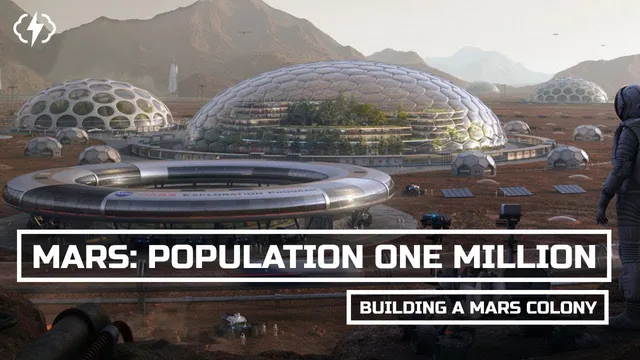
The first major requirement is a large, pressurized enclosure—often imagined as a city under a big glass dome—to buffer residents from cold and dust while providing controlled lighting. Power is the next bottleneck. Solar is a leading option because it avoids accidental radiation risks, but it demands extensive solar farms and large energy storage to cover long darkness periods during storms that can also damage panels. Nuclear is also discussed as an alternative, but either way the colony needs reliable, redundant energy to keep life-support systems running.
Food and water production would have to shift from “importing supplies” to industrial-scale local manufacturing. Hydroponics is presented as a practical path: high-yield farming can be built underground to save space and reduce exposure, and it doesn’t require soil or natural sunlight. Diet likely becomes plant-based or synthetic meat, since transporting and maintaining livestock would add major complexity and risk. Oxygen and water are the hardest parts. One proposed approach is to extract carbon dioxide from the atmosphere and split it into carbon and oxygen, enabling breathable air without relying on Earth shipments. For water, NASA is investigating extraction from underground reservoirs paired with highly efficient recycling, while polar ice could also be processed into usable water if subsurface supplies prove insufficient.
Scaling up to one million people forces a final, decisive constraint: the colony must become self-sufficient. Dependence on Earth would be both prohibitively expensive and dangerously fragile—any disruption to oxygen or critical supplies could kill the entire settlement. That drives interest in technologies that use Martian materials directly, such as molten regolith electrolysis, which uses electricity to break down silicates into usable construction components while releasing oxygen for life support. Even with the right hardware, the colony’s success hinges on people: not only scientists and engineers, but also skilled “fixers” who can improvise when systems fail and repurpose existing tools. The overall picture is clear—Mars can’t be “occupied” so much as engineered into a livable system, and doing it at million-person scale requires turning the planet’s harsh resources into the colony’s daily necessities.
Cornell Notes
A million-person Mars colony would require more than shelters: it would need continuous, closed-loop life support to overcome Mars’s thin, CO2-heavy atmosphere, extreme cold, dust storms, weak radiation protection, and limited accessible liquid water. A pressurized dome-like habitat could protect residents, but the colony must also generate reliable power (solar with large storage or nuclear) to run air, water, and food systems. Hydroponics could supply crops underground, while oxygen production would likely rely on extracting and splitting atmospheric CO2. Water would come from subsurface extraction with recycling or from processing polar ice. Scaling to one million people means self-sufficiency using Martian materials, such as molten regolith electrolysis that can produce construction materials and oxygen.
Why is Mars’s atmosphere such a central obstacle for a human colony?
What would a large habitat on Mars likely look like, and what problem does it solve?
How could the colony produce food without relying on Earth-style farming?
What are the leading ideas for producing oxygen and water on Mars?
Why does the colony need to become self-sufficient, and what technology supports that?
What role do people play beyond engineering and science?
Review Questions
- What specific Mars conditions (atmosphere, temperature, radiation, water) force the colony to rely on local production rather than Earth imports?
- How do hydroponics and CO2-splitting address food and oxygen needs, and what limitations do they help overcome?
- Why does molten regolith electrolysis matter for scaling from small outposts to a million-person colony?
Key Points
- 1
Mars’s atmosphere is only about 1% of Earth’s pressure and is mostly CO2, so breathable air must be manufactured locally rather than supplied from the environment.
- 2
A pressurized, dome-like habitat could shield residents from cold and dust storms, but it depends on dependable power to run life-support systems.
- 3
Solar power would require large solar farms plus major energy storage to handle darkness during dust storms; nuclear is discussed as an alternative with different risk tradeoffs.
- 4
Hydroponic farming underground could provide food without soil or natural light, but animal agriculture is likely impractical at scale, pushing diets toward plants or synthetic meat.
- 5
Oxygen production is likely to rely on extracting CO2 from the atmosphere and splitting it into oxygen, while water would come from subsurface extraction with recycling or from polar ice.
- 6
A million-person settlement must become self-sufficient because shipping from Earth is too costly and too vulnerable to disruption.
- 7
Using Martian materials directly—such as molten regolith electrolysis—can produce both construction inputs and oxygen, reducing dependence on Earth supplies.