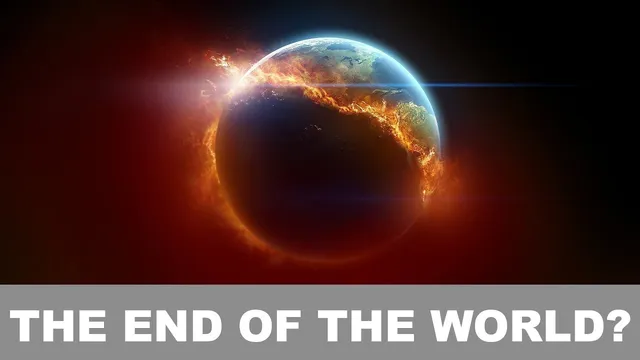
What Would Happen if the Earth Stopped Spinning?
Based on Second Thought's video on YouTube. If you like this content, support the original creators by watching, liking and subscribing to their content.
An instant stop would not stop the atmosphere and oceans; they would keep moving at roughly 460 m/s near the equator, producing extreme winds and global ballistic impacts.
Briefing
Earth’s rotation is the planet’s safety system: if it stopped instantly, the atmosphere and oceans would keep moving at about 460 meters per second near the equator, turning the world into a global impact zone. The immediate result would resemble a highway crash without seat belts—except the “barrier” is the sudden halt of the solid Earth. Winds would exceed the speed of atomic blast shockwaves, flattening buildings and hurling humans, animals, and vehicles as ballistic projectiles. With gravity effectively reduced at the equator during the sudden braking, the oceans would surge toward the poles, generating enormous, fast-moving tsunamis that could sweep across land within minutes. After the initial destruction, ongoing high winds and erosion would strip habitats, homes, and farmland, while the loss of accessible water would drive severe droughts. In that scenario, most life—including humans—would face extinction-level conditions.
Over longer timescales, the consequences depend on how the spin changes. If Earth’s rotation slowed gradually over billions of years, it could reach a “sun synchronous” state where one rotation takes about 365 days. That would lock every location into permanent day or permanent night, pushing oceans toward extreme thermal outcomes: the day side would boil or evaporate, while the night side would freeze. Only the narrow twilight band between day and night would offer any chance for conditions compatible with life. If the planet instead became fully non-spinning, sunlight and darkness would each last about half a year, disrupting agriculture and plant growth because seasons would lack the usual transitions.
A gradual slowdown would also reshape Earth itself. Rotation currently creates an equatorial bulge; without it, the planet would move toward a more perfect sphere. Water concentrated at the equator would migrate toward higher-gravity regions near the poles, flooding into two massive polar oceans and leaving a single continent wrapped around the equator—meaning a “polar ocean world” where land travel could avoid crossing open water.
Perhaps the most quietly catastrophic long-term effect is the fading of Earth’s magnetic field. The dynamo that generates magnetism depends on motion in the molten core; if rotation stops, those convection currents would weaken and the magnetic shield would dissipate. Without it, cosmic radiation and solar particles would bombard the surface, sterilizing the environment over time. The transcript draws a direct comparison to Mars: after losing its magnetosphere, Mars’ atmosphere was stripped away, leaving a barren planet.
Fortunately, an abrupt stop is treated as extraordinarily unlikely. Earth’s spin is expected to slow only over billions of years, and any catastrophic interruption would likely come from an event like a major planetary collision—one that would be lethal regardless. The core takeaway is stark: rotation doesn’t just create day and night; it stabilizes climate, protects life from radiation, and keeps Earth’s oceans and atmosphere from turning into a planet-wide projectile system.
Cornell Notes
Earth’s rotation produces day/night and—more importantly—keeps the atmosphere, oceans, and magnetic protection in a stable balance. An instant stop would be catastrophic: the solid Earth would halt while air and water continue moving at roughly 460 m/s near the equator, producing extreme winds, global ballistic impacts, and rapid polar tsunamis. Over billions of years, gradual slowing could lead to sun-synchronous rotation (about 365-day days) with permanent day and night, or to full non-rotation with half-year light and darkness—both hostile to life and agriculture. Rotation also maintains Earth’s equatorial bulge and helps power the magnetic dynamo; losing it would reshape the planet and eventually allow radiation to strip away habitability, similar to Mars.
Why would an instant stop of Earth’s rotation be so destructive even though the planet itself “just stops”?
What happens to day length if Earth’s rotation slows gradually rather than stopping suddenly?
How does full non-rotation differ from sun-synchronous rotation in terms of sunlight and seasons?
How would losing rotation change Earth’s shape and where would the water go?
Why does the magnetic field depend on rotation, and what would happen if it faded?
Review Questions
- If Earth’s rotation stopped instantly, what physical mismatch would cause the atmosphere and oceans to behave like high-speed projectiles?
- Compare the climate outcomes of sun-synchronous rotation versus full non-rotation in terms of day/night duration and implications for life and agriculture.
- Explain how the loss of rotation could lead to the disappearance of Earth’s magnetic field and why that matters for atmospheric survival.
Key Points
- 1
An instant stop would not stop the atmosphere and oceans; they would keep moving at roughly 460 m/s near the equator, producing extreme winds and global ballistic impacts.
- 2
Rapid polar tsunamis would follow as ocean water rushes toward the poles after the sudden braking.
- 3
Even if some areas survived the initial winds and waves, continued erosion and habitat loss would worsen the damage.
- 4
Gradual rotational slowdown could produce sun-synchronous conditions with permanent day or permanent night (about a 365-day rotation period).
- 5
Full non-rotation would create half-year stretches of sunlight and darkness, disrupting agriculture and plant growth due to the lack of seasonal transitions.
- 6
Rotation helps maintain Earth’s equatorial bulge and supports the magnetic dynamo; losing it would reshape the planet and eventually expose the surface to lethal radiation.
- 7
A sudden stop is considered extremely unlikely; any catastrophic interruption would likely involve a major collision that would be fatal anyway.