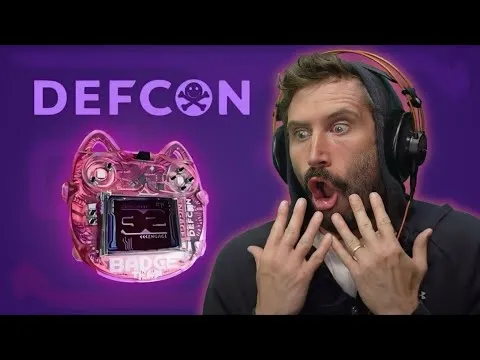
Whats Going On WIth DEFCON
Based on The PrimeTime's video on YouTube. If you like this content, support the original creators by watching, liking and subscribing to their content.
DEF CON’s stop-work order is tied to allegations of unauthorized firmware/code and a coin wallet promotion beyond negotiated terms.
Briefing
DEF CON’s Raspberry Pi badge controversy centers on two competing claims: a stop-work dispute tied to alleged nonpayment and unauthorized firmware/code, and a separate fight over how much credit and visibility the badge’s hardware/firmware contractor should receive—especially after a crypto “coin wallet” element appeared alongside what many attendees initially read as simple credits.
The badge itself is described as an ambitious, high-end retro handheld-style device with a battery, memory, custom PCB work, and gaming software. DEF CON hired Entropic Engineering (via Tropic Engineering) for hardware development and firmware, after budget overruns and with production still in pre-production. DEF CON later issued a stop work order, saying unauthorized code had been included in the firmware. The organization also alleges the contractor credited itself for the whole badge and promoted a coin wallet to solicit money from DEF CON attendees beyond what was negotiated.
Entropic Engineering’s side, presented through a dated statement, frames the conflict as a contract and payment breakdown rather than misconduct. It says DEF CON approached in January with extremely difficult requirements—specifically a gaming-element electronic badge—and that Entropic Engineering leveraged early access to an unreleased Raspberry Pi RP2350 chip to make the device possible. The statement emphasizes the scale and timeline: aiming for mass production of 30,000 units, coordinating emulator software, sourcing components, designing hardware, and managing manufacturing and logistics. It claims that after months of late-night work and prototype success, DEF CON stopped paying for services already rendered, and that Entropic Engineering repeatedly sought fair compensation for work completed prior to June 7.
A key flashpoint is the “credits” presentation. Attendees reportedly saw a credits page that looked acceptable, but the bottom of the page included a crypto wallet component—shifting perceptions from “crediting contributors” to “asking attendees to pay.” During the badge talk, Demitri (identified as the person walked off stage) was removed after refusing to leave and demanding security intervene to remove him. DEF CON says it kept slides that gave him credit but escorted him off stage so other contributors could present.
The transcript also highlights the difficulty of sorting truth in a rumor-heavy environment. Both sides accuse the other of bad faith, and the narrator repeatedly returns to the idea that receipts—contract terms, hours, discounts, and payments—are the only way to resolve “he said, she said.” Entropic Engineering argues that the badge team continued post-stop work to ensure delivery, while DEF CON says it fulfilled financial obligations and that any nonpayment dispute is between the parties.
Beyond money and code, the dispute leaves a reputational cost. The community’s trust is portrayed as the main casualty: future badge collaborations may face heightened suspicion, and volunteers may hesitate when credit, compensation, and enforcement mechanisms become contested. The transcript closes on the broader pattern—major conferences eventually generate drama once stakes rise—while the badge’s technical achievements remain a bright spot for attendees who still want the hardware delivered and working.
Cornell Notes
The DEF CON 32 Raspberry Pi badge controversy boils down to a stop-work and payment dispute tangled with allegations of unauthorized firmware/code and a “coin wallet” element that changed how attendees interpreted contributor credits. DEF CON says Entropic Engineering included unauthorized code, promoted a wallet to solicit money beyond the negotiated deal, and therefore issued a stop work order; it also says it met its financial obligations. Entropic Engineering counters that the project was extremely ambitious (including mass production targets) and that DEF CON stopped paying for work already completed, with compensation negotiations failing. The conflict played out publicly during a badge talk when Demitri was removed after refusing to leave, while slides reportedly remained to preserve credit. The lasting impact is community trust: future badge efforts may become harder when credit, contracts, and enforcement are questioned.
What were the two main allegations that triggered the stop-work order?
Why did the credits/coin wallet detail matter so much to attendees?
How does Entropic Engineering’s statement explain the timeline and technical feasibility?
What does the dispute look like when reduced to contract mechanics?
What happened during the badge talk, and why did it become a flashpoint?
Why does the transcript argue the community may be the biggest loser?
Review Questions
- What specific firmware/code and monetization-related claims does DEF CON make, and how do those claims connect to the coin wallet element?
- How does Entropic Engineering’s statement use the project timeline (January start, RP2350 access, mass production target) to justify its compensation demands?
- What kinds of documentation (“receipts”) does the transcript suggest would resolve the dispute, and why are they currently missing from public view?
Key Points
- 1
DEF CON’s stop-work order is tied to allegations of unauthorized firmware/code and a coin wallet promotion beyond negotiated terms.
- 2
Attendees’ reactions reportedly shifted when a crypto wallet appeared alongside what looked like a contributor credits page.
- 3
Entropic Engineering’s counter-narrative emphasizes extreme timeline pressure, technical complexity, and work completed before payment stopped.
- 4
The public badge talk escalated when Demitri refused to leave and was escorted off stage while slides reportedly preserved credit.
- 5
The dispute remains difficult to adjudicate in public without contract terms, payment records, and documented discount/hours details.
- 6
The controversy’s biggest downstream risk is reduced community trust, which can chill future badge collaborations and volunteer participation.
- 7
Large conference drama is portrayed as recurring once projects become high-stakes and high-visibility.