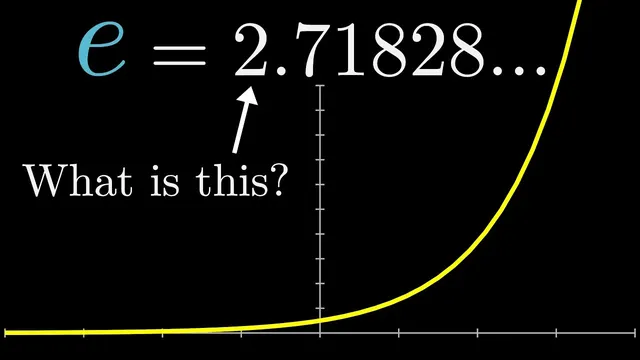
What's so special about Euler's number e? | Chapter 5, Essence of calculus
Based on 3Blue1Brown's video on YouTube. If you like this content, support the original creators by watching, liking and subscribing to their content.
For any base a, the derivative of a^t is (ln a)·a^t, so exponentials differentiate into proportional exponentials.
Briefing
Exponentials are special in calculus because their derivatives are proportional to the functions themselves—and the constant of proportionality is exactly the natural logarithm of the base. The clearest starting point is the function 2^t: over a full day, its mass doubles, so the increase during that day matches the value at the start of the day. That “derivative looks like the function” intuition is directionally right, but it only works when comparing changes over a whole unit of time. Calculus demands the limit of ever-smaller time steps, replacing the difference 2^(t+1) − 2^t with the difference 2^(t+dt) − 2^t divided by dt as dt shrinks toward zero.
Using the key exponential identity 2^(t+dt) = 2^t · 2^dt, the derivative of 2^t becomes 2^t times a constant that depends only on dt—not on t. Numerically, that constant is about 0.6931, which is the natural logarithm of 2. So the derivative is not exactly 2^t; it is (ln 2)·2^t. The same pattern holds for other bases: for 3^t the proportionality constant is ln 3 (about 1.0986), and for 8^t it is ln 8 (about 2.079). These “mystery constants” aren’t random; they follow a single rule tied to logarithms.
The standout base is e ≈ 2.71828, because it is the unique number for which the proportionality constant becomes 1. In other words, e^t is the exponential whose slope at any point equals its height: the tangent line to y = e^t at any x has slope equal to e^x. That defining property is what makes e so central in calculus. Once that fact is in place, the chain rule finishes the story: differentiating e^(3t) gives e^(3t) times 3, because the derivative of the inside (3t) is the constant 3. More generally, any exponential written as a^t can be rewritten using logarithms as e^(t ln a), making the derivative (ln a)·a^t.
The practical payoff is interpretability. In many real-world systems, the rate of change is proportional to the quantity itself—population growth without resource limits, cooling where the temperature difference drives the cooling rate, or investment growth where returns scale with current money. Those proportional-to-self dynamics naturally produce exponentials. Writing them as e^(kt) isn’t just a convention: it makes k directly readable as the proportionality constant between the variable and its rate of change. The result is a calculus-friendly language for modeling growth and decay with a built-in meaning for the parameters.
Cornell Notes
Exponentials behave cleanly under differentiation: for any base a, the derivative of a^t is (ln a)·a^t. The constant ln a appears because a^(t+dt) factors as a^t·a^dt, leaving a dt-dependent limit that does not depend on t. The special number e is singled out because ln e = 1, so e^t differentiates to itself: (e^t)' = e^t. With the chain rule, e^(kt) differentiates to k·e^(kt), and rewriting a^t as e^(t ln a) explains why the “mystery constants” are natural logarithms. This matters because many natural processes follow “rate proportional to current amount,” producing exponentials with parameters that directly represent proportionality rates.
Why does the derivative of 2^t end up being proportional to 2^t rather than exactly equal to it?
What role does the identity a^(t+dt) = a^t·a^dt play in the derivative calculation?
How does e become the “special” exponential base?
How does the chain rule extend the result from e^t to e^(3t) and beyond?
Why do the proportionality constants for other bases match natural logarithms?
Review Questions
- For a^t, what limit produces the constant of proportionality in (a^t)' = (constant)·a^t, and why does it not depend on t?
- What condition on a makes (a^t)' equal to a^t exactly, and how does that identify e?
- How does rewriting a^t as e^(t ln a) make the derivative rule immediate?
Key Points
- 1
For any base a, the derivative of a^t is (ln a)·a^t, so exponentials differentiate into proportional exponentials.
- 2
The constant ln a arises from the limit of (a^dt − 1)/dt as dt → 0 after factoring a^(t+dt) = a^t·a^dt.
- 3
The base e is special because ln e = 1, giving (e^t)' = e^t and making tangent slope equal function value.
- 4
The chain rule turns (e^t)' = e^t into (e^(kt))' = k·e^(kt) by multiplying by the derivative of the inner exponent.
- 5
Any exponential a^t can be rewritten as e^(t ln a), which explains why the “mystery constants” are natural logarithms.
- 6
Writing exponentials as e^(kt) makes k directly represent the proportionality between a quantity and its rate of change.
- 7
Many real processes match “rate proportional to current amount,” which is why exponential models are so common in growth and decay.