What's The Brightest Thing In the Universe?
Based on Vsauce's video on YouTube. If you like this content, support the original creators by watching, liking and subscribing to their content.
Absolute magnitude enables fair brightness comparisons by removing distance effects that distort apparent magnitude.
Briefing
The brightest sustained objects in the universe aren’t stars or even the brief flash of a gamma-ray burst—they’re quasars, powered by black holes feeding on surrounding gas and dust. Using “absolute magnitude” (how bright an object would look if placed at the same distance), the discussion shifts from what looks bright from Earth to what truly outshines everything across the cosmos. That matters because distance can make a nearby object look dominant even when it’s intrinsically dimmer; a 100-watt bulb can outshine the Sun in apparent brightness if it’s extremely close, yet the Sun would still be vastly brighter if compared at equal distance.
The brightest stars can be quantified too, and the Sun’s absolute magnitude is given as 4.8. A standout example is R136a1, an extremely massive star in the Large Magellanic Cloud region: it’s about 256 times more massive than the Sun and reaches an absolute magnitude of -12.6—about 8.7 million times brighter than the Sun. But even that record-holder doesn’t set the ceiling for cosmic brightness.
When massive stars die, they can produce supernovae and hypernovae, sometimes accompanied by gamma-ray bursts—described as among the brightest electromagnetic events. A typical gamma-ray burst can release in seconds the energy the Sun emits over roughly 10 billion years. The transcript adds a stark safety comparison: if a burst like WR104 were aimed directly at Earth for about 10 seconds, predictions suggest it could deplete 25% of the ozone layer and trigger mass extinction and starvation. Yet gamma-ray bursts are fleeting, often lasting milliseconds to minutes, so they don’t win the “brightest sustained” category.
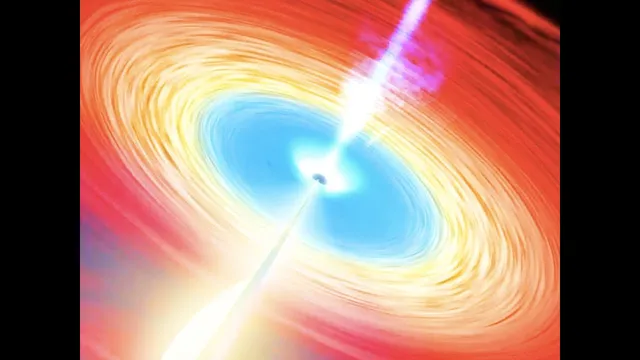
That title goes to black holes—not because they emit light directly, but because their surroundings do. Black holes are “dark” in the sense that they trap light, yet the act of feeding generates intense heat. Material spiraling into a black hole forms an accretion disk, where friction heats gas until it glows. This glowing region is what astronomers identify as a quasar. Quasars can outshine entire galaxies: the first identified quasar, 3C 273, has an absolute magnitude of -26.7, making it about four trillion times brighter than the Sun and roughly 100 times more luminous than the total light output of the Milky Way. If 3C 273 were placed 33 light-years away, it would appear as bright as the Sun.
Some quasars are even more extreme depending on orientation. The transcript distinguishes active galactic nuclei—galactic centers whose light is dominated by a central engine—and notes that when a jet points toward Earth, the object is classified as a blazar. Blazar 3C 454.3 set the greatest brightness ever observed at an absolute magnitude of -31.4.
Quasars are also tied to cosmic history. Because they’re billions of light-years away, the light we see reflects an earlier universe when monster black holes were actively fueled. A black hole must consume on the order of 10 stars per year to remain a quasar; many consume far more, but eventually they grow too large and the supply of shredded stars dwindles. The “brightest” objects are therefore often ancient, and what we see can be described as their ghosts—light emitted while they were actively feeding.
Finally, the brightness theme loops back to a Yin–Yang framing: the universe’s most intense light is driven by the darkest objects—black holes—and the best view of the sky comes from the darkest places, where artificial light no longer drowns out what’s above. The transcript closes with examples of how city lights hide the night sky and with a reminder that the most luminous cosmic engines are powered by the most light-imprisoning phenomena.
Cornell Notes
Absolute magnitude is used to compare intrinsic brightness across the universe, avoiding the distortions of distance. The brightest sustained objects are quasars, powered by black holes feeding on gas and dust that heats up in accretion disks. The Sun’s absolute magnitude is 4.8, while the massive star R136a1 reaches -12.6 (about 8.7 million times the Sun’s brightness). Quasars far exceed that: 3C 273 has an absolute magnitude of -26.7 (about four trillion times the Sun), and blazar 3C 454.3 peaks at -31.4. Quasars are often ancient because their light shows an earlier era when black holes still had enough fuel to stay active.
Why does the transcript switch from apparent magnitude to absolute magnitude?
How bright is the Sun compared with a nearby light bulb, and what does that illustrate?
What makes R136a1 a standout among stars, and how bright is it?
Why don’t gamma-ray bursts win the “brightest sustained” category?
How do black holes produce quasars if black holes themselves are dark?
What determines whether a quasar is classified as a blazar, and which object set the record?
Review Questions
- How does absolute magnitude change the ranking of “brightest” objects compared with apparent magnitude?
- Explain the chain from black hole feeding to accretion disk heating to quasar brightness.
- Why are many quasars observed as ancient phenomena rather than current, ongoing events?
Key Points
- 1
Absolute magnitude enables fair brightness comparisons by removing distance effects that distort apparent magnitude.
- 2
R136a1 reaches an absolute magnitude of -12.6, making it about 8.7 million times brighter than the Sun, but quasars still outshine it.
- 3
Gamma-ray bursts can release enormous energy quickly, yet their short duration prevents them from being the brightest sustained sources.
- 4
Black holes are “dark” in direct light, but accretion disks around them glow intensely, powering quasars.
- 5
Quasars can outshine entire galaxies; 3C 273 is given as -26.7 in absolute magnitude, about four trillion times the Sun’s brightness.
- 6
Jet orientation can boost observed brightness: blazars occur when jets aim toward Earth, with 3C 454.3 peaking at -31.4.
- 7
Quasar activity is often tied to earlier cosmic epochs because black holes need a steady supply of fuel to remain luminous.