What's The Most Dangerous Place on Earth?
Based on Vsauce's video on YouTube. If you like this content, support the original creators by watching, liking and subscribing to their content.
Danger depends on the metric: fast lethality (minutes) and long-run fatality counts can point to different “worst places.”
Briefing
The most dangerous place on Earth, in the sense of causing the greatest number of deaths over time, isn’t a mountain, a trench, or a radioactive lake—it’s wherever malaria can enter the bloodstream through mosquito bites. The argument pivots from “how fast you die” to “how many people die,” then zooms in on microscopic threats. Influenza killed nearly 100 million people in 1918, and the bubonic plague wiped out roughly a third of Europe between 1347 and 1353. Yet both pale next to malaria’s long-running toll: malaria is caused by Plasmodium, transmitted by mosquitoes, and researchers have estimated that across human history it may have killed about half of all people who ever lived. Statistically, that makes a mosquito-borne Plasmodium infection the most lethal “place” imaginable.
Before landing on that conclusion, the discussion runs a gauntlet of environments that kill quickly—useful for illustrating how extreme conditions can be. At 0°C, a naked human would die from internal hypothermia in about 20 minutes, because the body can’t generate enough heat without clothing. On Mount Everest, the air contains only about one-third the breathable oxygen found at sea level; a sudden teleport to the summit would likely be fatal within 2–3 minutes due to oxygen deprivation. The Mariana Trench is framed as equally lethal, with roughly 7 miles (11 km) of water creating pressure exceeding 15,000 pounds per square inch—enough to collapse lungs and render a person unconscious in about 15 seconds, with death in under 90.
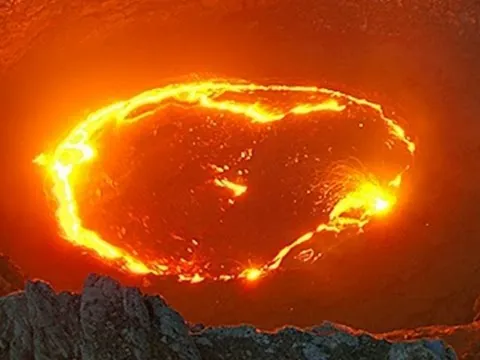
The transcript also contrasts spectacular hazards with their physical reality. Falling into molten lava is described as far more violent than movie depictions: lava is liquid rock around four times hotter than an oven can reach, and because the human body is mostly water, the heat turns it into steam explosively, producing “fireworks” rather than a slow sink.
From Earth’s extremes and microbes, the focus shifts to human-made danger. In La Oroya, Peru, pollution from a smelter combines with temperature inversions that trap gases, leading to air arsenic levels reported as 85 times above safe limits. In Russia, Lake Karachay—called the most polluted spot on Earth by the World Watch Institute—can deliver a lethal radiation dose after about an hour near certain areas.
Violence and governance are treated as another kind of “place-based” risk. The Global Peace Index ranks Iceland as safest and Somalia as least safe, while murder-rate comparisons highlight places like Juárez, Mexico, and fictional benchmarks from “Murder She Wrote” (Cabot Cove) alongside real-world figures such as San Pedro Sula, Honduras.
The closing note returns to Chernobyl: radioactive isotopes spilled from the reactor core in 1986, triggering mass evacuations, and decades later parts of the exclusion zone remain dangerously radioactive. Yet the absence of humans has allowed wildlife—including endangered species—to move in, live, reproduce, and be safer from us. The final takeaway is a grim paradox: humans can make places lethal enough to force their own retreat, leaving pockets of relative safety for other life forms.
Cornell Notes
The transcript ranks “danger” by different measures and lands on a surprising winner: malaria transmission via mosquito bites. After comparing fast-death environments—freezing cold, Everest’s thin oxygen, the Mariana Trench’s crushing pressure, and lava’s explosive heat—the discussion switches to total fatalities across history. Influenza and the bubonic plague caused catastrophic death, but malaria’s long-term toll is estimated to have killed about half of all humans who ever lived. That makes a Plasmodium-infected mosquito bite the most dangerous “place” in statistical terms. The closing sections broaden the idea of danger to human-made pollution, radiation, and violence, ending with Chernobyl’s exclusion zone where wildlife can thrive despite lingering hazards.
Why does the transcript move from “how quickly you die” to “how many people die,” and what changes as a result?
What specific biological threat is presented as the most dangerous by historical death toll?
How do Everest and the Mariana Trench illustrate different mechanisms of death?
Why is lava described as more violent than many movie portrayals?
How does the transcript treat human-made danger, and what examples are used?
What paradox is raised by the Chernobyl ending?
Review Questions
- If danger is measured by time-to-death, which hazards dominate the transcript’s examples, and what mechanisms do they rely on (temperature, oxygen, pressure, heat)?
- When the metric changes to total fatalities across history, why does malaria become the top candidate over influenza and bubonic plague?
- How do La Oroya, Lake Karachay, and Chernobyl each represent different kinds of human-made environmental risk?
Key Points
- 1
Danger depends on the metric: fast lethality (minutes) and long-run fatality counts can point to different “worst places.”
- 2
Extreme cold can kill quickly because the body cannot maintain core temperature without clothing; at 0°C, death is estimated around 20 minutes.
- 3
Mount Everest is framed as deadly mainly due to oxygen scarcity—about one-third sea-level breathable oxygen—leading to likely death within 2–3 minutes without acclimation.
- 4
The Mariana Trench is portrayed as lethal through crushing pressure that collapses lungs, with unconsciousness in about 15 seconds and death in under 90.
- 5
Malaria transmission via mosquito bites is presented as the most dangerous “place” by historical death toll, with estimates that it killed about half of all humans who ever lived.
- 6
Human activity creates deadly environments too: arsenic pollution in La Oroya, lethal radiation exposure near Lake Karachay, and high murder rates in places like Juárez.
- 7
Chernobyl’s exclusion zone remains radioactive, but the absence of humans has allowed some wildlife—especially endangered species—to recover and reproduce.