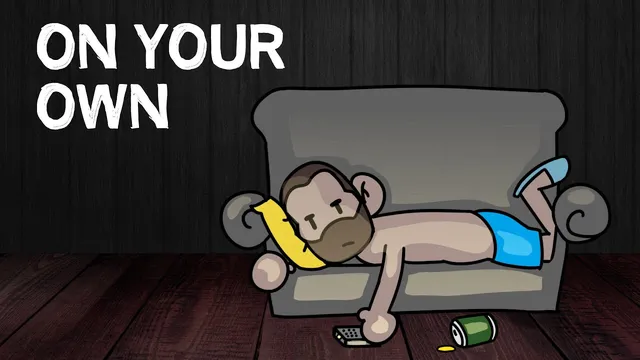
When being alone is a choice... (personal journey)
Based on Einzelgänger's video on YouTube. If you like this content, support the original creators by watching, liking and subscribing to their content.
Social isolation (reduced contact) and loneliness (felt distress) are distinct and can diverge in either direction.
Briefing
Spending long stretches alone isn’t automatically a sign of depression—it can be a deliberate coping strategy shaped by past hurt, personality, and social context. The central distinction is that social isolation (an objective reduction in contact) and loneliness (a subjective distress) don’t always travel together: someone can be socially isolated without feeling lonely, while others can be surrounded by people yet still feel lonely. That mismatch helps explain why generic advice—“get out there,” “humans are social animals,” “don’t isolate yourself”—often misses the real drivers behind chronic solitude.
A key framework is a “double bind” at the heart of human relationships. People tend to crave connection, yet interaction can also bring pain—sharp “spikes,” in Arthur Schopenhauer’s hedgehog metaphor. For some, the negative experiences outweigh the benefits, so retreating into solitude becomes a protective choice rather than an accident. The narrator describes years of semi-social isolation—rarely fully cut off in the digital age, but often disengaged from real-life contact—especially after leaving regular work and during the 2020 lockdown, when weeks could pass without seeing anyone. Even when loneliness arrived, solitude also delivered relief: fewer obligations, fewer unwanted social encounters, and a sense of solidarity with others who were also stuck at home.
The transcript also argues that solitude can reshape cognition and emotion in both directions. Without other people to challenge distorted thinking, long periods alone can intensify rumination and “analytical” spirals, turning inner dialogue into a tormenting loop. The absence of a listener can make cognitive distortions harder to correct. Yet the same isolation can offer peace, creative focus, and introspection—especially for people who find social demands draining or who need distance to function.
Several motivations for choosing isolation are offered beyond simple introversion. Schizoid Personality Disorder is mentioned as a condition associated with a preference for solitude and reduced need for social interaction, alongside diminished pleasure. Literature and cultural examples broaden the picture: Charles Bukowski’s Henry Chinaski is portrayed as alienated and ostracized, seeking solace in alcohol that can function both as escape and as a social lubricant. Japan’s hikikomori—social withdrawal—illustrates how social pressure, rigid career expectations, and economic disappointment can push people to retreat, often living with parents and leaving their homes rarely or never.
The transcript doesn’t treat isolation as purely harmful. Risks are acknowledged—research links social isolation to depression, anxiety, stress, lower self-esteem, and physical effects like inflammation and sleep problems—but outcomes vary by personality and circumstances. For those who want connection without the full cost of closeness, Schopenhauer’s proposed remedy is “politeness and good manners”: interacting while keeping distance to reduce pain. The narrator’s practical alternative is more selective and creative socializing—choosing “good company,” using travel when possible, and building social contact into daily life through libraries, coffee shops, and online gaming (Age of Empires IV) as a partial bridge.
Ultimately, there’s no one-size-fits-all fix. Some people need more social exposure; others may do better with controlled, low-pressure interaction; and some—hermits in heart and soul—may genuinely thrive in solitude. The most useful question becomes personal: why solitude is chosen, and what balance between isolation and connection changes over time.
Cornell Notes
Long stretches of solitude aren’t automatically the same as loneliness. Social isolation is an objective reduction in contact, while loneliness is a subjective feeling; people can be isolated without distress, and others can be socially connected yet still feel lonely. A “double bind” helps explain why: people crave warmth and connection, but interaction can also hurt, so retreating into solitude becomes protective. The transcript describes semi-social isolation, including lockdown periods, showing both relief (freedom from obligations) and downsides (rumination and cognitive distortions without others to challenge them). Solutions depend on motivation—selective, low-pressure interaction, meaningful company, travel, and even structured online socializing can help when full closeness isn’t sustainable.
How do social isolation and loneliness differ, and why does that distinction matter?
What is the “double bind” behind choosing solitude?
What does semi-social isolation look like in the digital age?
What psychological risks and benefits of solitude are highlighted?
How do cultural and clinical examples broaden the explanation for isolation?
What practical strategies are proposed to balance solitude and connection?
Review Questions
- What evidence in the transcript supports the claim that social isolation and loneliness are not synonymous?
- How does Schopenhauer’s hedgehog dilemma map onto the “double bind” described for people who retreat from social life?
- Which strategies in the transcript aim to reduce the costs of interaction while still maintaining some social connection, and why might they work differently for different people?
Key Points
- 1
Social isolation (reduced contact) and loneliness (felt distress) are distinct and can diverge in either direction.
- 2
A “double bind” drives many choices: people want warmth from others but also experience social interaction as painful or threatening.
- 3
Semi-social isolation is common in the digital age because online contact remains available even when real-life interaction drops.
- 4
Extended solitude can both support creativity and introspection and also worsen rumination by removing outside feedback that corrects distorted thinking.
- 5
Clinical and cultural examples—Schizoid Personality Disorder, Bukowski’s Henry Chinaski, and Japan’s hikikomori—show multiple pathways into withdrawal.
- 6
No universal solution exists; effective approaches depend on the underlying motivation and how much interaction a person can tolerate.
- 7
Selective, low-pressure social contact—plus environments like libraries, coffee shops, travel, and structured online play—can help people find a workable balance.