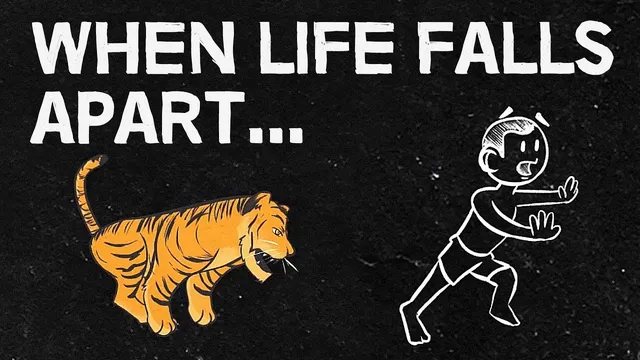
When Life Falls Apart, Does it Actually Fall Into Place? | A Buddhist Story
Based on Einzelgänger's video on YouTube. If you like this content, support the original creators by watching, liking and subscribing to their content.
The parable frames misery as a perception choice rather than a direct product of external events.
Briefing
A Buddhist parable about a man trapped between a tiger above and a poisonous snake below argues that “life falling apart” is often a perception problem—and that survival depends on how a person meets the moment. In the well, the man clings to a root while mice chew it away, leaving him with no control over the external threats. Yet he doesn’t panic; instead, he finds a small, immediate source of joy: honey dripping from a beehive overhead. The story frames that choice as a kind of freedom—refusing to let uncontrollable conditions dictate inner state.
The parable’s core claim is that circumstances don’t automatically produce misery; perception does. The man’s calm is tied to Buddhist practice and the “eight worldly winds”: pleasure and pain, gain and loss, praise and blame, fame and disrepute. Most people, the story says, become slaves to these shifting forces—suffering when pain arrives, becoming elated when praise and pleasure come, collapsing when reputation falls. Because these external conditions are unreliable and not fully controllable, happiness built on them becomes unstable. The man’s response is different: he treats the threats as expected features of life, not as proof that the world is permanently hostile.
From there, the lesson widens into a meditation on impermanence. Change is certain, but its direction is unknown. A king who swings between confidence in good times and despair in bad times is given a ring engraved with “This too shall pass,” a reminder that even the worst stretches of life are temporary. The story warns that despair often comes from freezing reality into a single moment—assuming the present misery is permanent simply because the future hasn’t arrived yet. In Buddhist terms, the “reality” being judged is shifting even while it feels fixed.
That impermanence can flip outcomes is illustrated with a twist: the tiger, hungry and leaning forward, falls into the well, landing past the man, crushing the snake, and breaking its own neck. The man survives and climbs out. The point isn’t that tragedy always turns into triumph, but that the future can surprise—and that solutions may appear where danger seemed absolute.
The parable then lands on a practical ethic. Since outcomes can’t be demanded, it’s better to align desire with what actually happens. Epictetus is quoted: don’t require events to match wishes; instead, wish them to happen as they do, and life will go well. Even when circumstances are unavoidable—pain in the well being the example—the story insists that suffering is optional. The man’s “honey” becomes the symbol: when life feels like it’s collapsing, the best move may be to reclaim attention and attitude in the only place that remains under one’s control, while remembering that the winds can change.
Cornell Notes
A man trapped in a dried well—facing a tiger above, a poisonous snake below, and mice chewing the root he holds—survives by refusing to let fear define his inner state. The story argues that misery comes less from circumstances than from perception, especially the Buddhist “eight worldly winds” (pleasure/pain, gain/loss, praise/blame, fame/disrepute) that usually control mood. Instead of panicking, he finds honey dripping from a beehive overhead, treating joy as something available in the present moment. The parable also emphasizes impermanence: “This too shall pass,” and the future can overturn what seems sealed. A final twist shows the tiger falls into the well, crushing the snake and allowing escape, reinforcing that life may be “falling into place” rather than simply falling apart.
Why does the parable insist that misery is not caused by circumstances alone?
What role do the “eight worldly winds” play in the story’s advice?
How does the honey episode change the meaning of “no way out”?
Why does impermanence matter for someone stuck in despair?
What does the tiger’s fall into the well teach about outcomes?
How do Epictetus and the “pain is certain, suffering is optional” line connect?
Review Questions
- How does the story distinguish between pain and suffering, and what example is used to make that distinction concrete?
- In what ways do the “eight worldly winds” create emotional instability, according to the parable?
- What does the ring message “This too shall pass” aim to correct in a person’s perception during bad times?
Key Points
- 1
The parable frames misery as a perception choice rather than a direct product of external events.
- 2
Buddhist practice is used to explain how the “eight worldly winds” typically control mood and create emotional dependence.
- 3
Finding joy in the present moment—symbolized by honey—can function as a form of freedom when escape seems impossible.
- 4
Impermanence is presented as the antidote to despair: change is certain, even when its direction is unknown.
- 5
Desperate people often mistake a shifting moment for a permanent reality, ignoring that the future is still unfolding.
- 6
The tiger’s unexpected fall illustrates how outcomes can reverse when the “wind changes,” making solutions possible where none seemed available.
- 7
Since outcomes can’t be demanded, aligning attitude with what happens—echoing Epictetus—helps a person “go on well.”