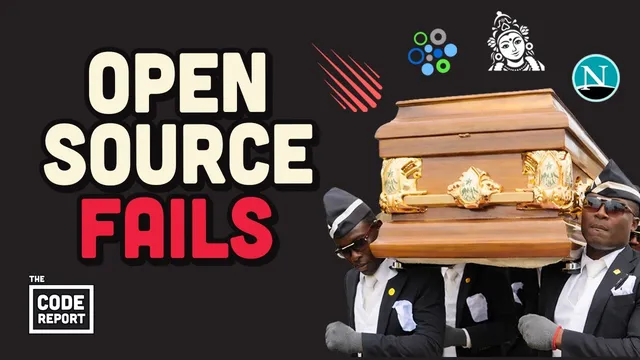
When open-sourcing your code goes wrong...
Based on Fireship's video on YouTube. If you like this content, support the original creators by watching, liking and subscribing to their content.
Open-source projects can collapse even when the code is good, because governance, incentives, and sustainability matter as much as engineering.
Briefing
Open-sourcing can accelerate adoption and even produce technically superior software—but success often collapses when maintainers burn out, ownership changes, or distribution power overwhelms community momentum. Across five cautionary stories, the common thread isn’t that open source can’t build great products. It’s that open source is vulnerable to human limits, corporate control, and ecosystem timing.
The fastest rise-and-fall example is Faker.js, a JavaScript library that generated fake data for testing and for inflating social media metrics. After years of widespread use, developer Marac Squires made a protest move in 2022: he deleted the source code, replaced it with “endgame,” and published version 6.6.6 on npm. That update broke thousands of JavaScript apps when dependency updates pulled the new version. Even though the backlash was predictable—corporations depended on the library—Squires framed the action as retaliation for providing free work without compensation. He was removed from the project, and the codebase continued under new stewardship.
Other failures show how “success” can be a maintenance trap. Emily Glay’s work behind Mutable Instruments’ Arteria Microreak illustrates how commercial products can rest on open or semi-open creative foundations, yet the underlying project can still fade when the original maintainer moves on. In Glay’s case, the project’s momentum stalled due to burnout and the solo nature of its management.
Pars, a backend-as-a-service for mobile apps launched in 2011, demonstrates how corporate acquisition can reverse open-source fortunes. Facebook acquired Pars for $85 million in 2013, bringing it under a powerful umbrella. But in 2016, Facebook shut it down and forced developers to migrate. The story partially recovered because the Pars server code was open-sourced, enabling self-hosting and independent maintenance.
Meteor shows a different kind of collapse: not a legal shutdown, but a market shift. Built for full-stack JavaScript and known for instant UI updates using websockets and stateful servers, Meteor felt magical in demos. In production, it proved harder to maintain and didn’t scale horizontally well in cloud environments. As React and Angular popularized separating client and server, Meteor’s approach lost favor—though later frameworks like Next began reintroducing similar ideas.
Finally, Open Solaris and Mozilla Firefox highlight how ownership and platform control can dominate technical merit. Open Solaris launched with features like ZFS, DTrace observability, and container-like capabilities before Docker became mainstream. Yet Oracle’s acquisition of Sun Microsystems in 2010 effectively ended open development; source releases disappeared and the community concluded the experiment was over. Firefox’s origin is similarly sobering: Netscape open-sourced its browser to fight Microsoft’s distribution advantage via Internet Explorer bundled with Windows. The resulting Mozilla rewrite was painful and slow, while Internet Explorer captured users through platform control. Firefox eventually proved open source could deliver better software, but it won only after the commercial browser war was already lost—reviving competition and shaping the modern web.
The takeaway is pragmatic: open-source projects need more than code quality. They require sustainable governance, clear ownership paths, and resilience against dependency breakage, maintainer burnout, and corporate or platform shifts.
Cornell Notes
Open-source success can unravel when maintainers burn out, governance breaks, or corporate ownership changes hands. Faker.js illustrates how a maintainer protest—deleting code and publishing npm version 6.6.6—can instantly disrupt thousands of dependent apps, even if the action is framed as a response to unpaid labor. Pars shows the risk of acquisition: Facebook bought it for $85 million, then shut it down in 2016, leaving developers to migrate—though open-sourcing the Pars server code enabled self-hosting. Meteor’s decline reflects timing and architecture tradeoffs: websocket-driven, stateful servers were hard to scale and lost ground as React and Angular separated client and server. Open Solaris and Firefox further demonstrate that technical superiority can’t overcome ownership changes or distribution power.
Why did Faker.js become a case study in dependency risk?
What does the Pars story reveal about open-source projects tied to corporate owners?
How did Meteor’s technical design contribute to its decline?
Why did Open Solaris fail despite strong technical features?
What lesson does Firefox’s origin offer about distribution versus open development?
Review Questions
- Which failure mode is most directly illustrated by npm version 6.6.6 breaking dependent apps: governance, burnout, or ownership? Explain with the Faker.js details.
- How do the Pars and Open Solaris stories differ in what caused community disruption—shutdown versus acquisition-driven closure?
- Why did Meteor’s websocket/stateful-server approach become a liability once React and Angular changed expectations for client-server separation?
Key Points
- 1
Open-source projects can collapse even when the code is good, because governance, incentives, and sustainability matter as much as engineering.
- 2
Faker.js demonstrates how a maintainer’s npm release can instantly break downstream software when dependency updates pull in a disruptive version.
- 3
Burnout and solo maintenance can quietly end projects, even when their work powers successful commercial products.
- 4
Corporate acquisition can reverse open-source trajectories; Pars and Open Solaris both show how ownership changes can shut down or strand communities.
- 5
Technical architecture and scaling characteristics can determine long-term relevance, as seen in Meteor’s production maintenance and horizontal scaling challenges.
- 6
Platform distribution power can outweigh open development speed, as Firefox’s origin story shows against Microsoft’s Windows bundling strategy.