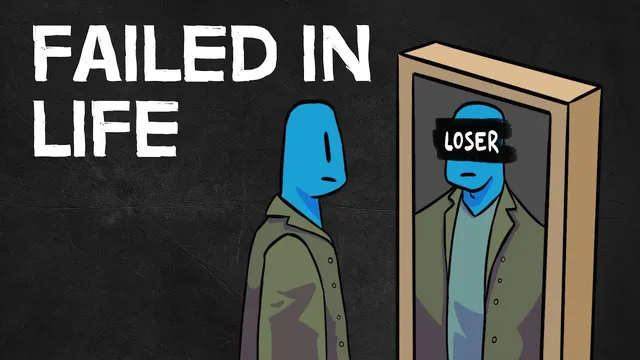
When your self-worth depends on what you achieve
Based on Einzelgänger's video on YouTube. If you like this content, support the original creators by watching, liking and subscribing to their content.
Achievement-based status turns people into “human doings,” where worth is treated as conditional on performance rather than inherent humanity.
Briefing
Status platforms may show a person’s job title, education, and carefully staged photos, but they rarely reveal character or well-being. The deeper issue is how achievement has become the yardstick for human value—turning people into “human doings” whose worth rises and falls with performance. In that system, the question “So, what do you do?” functions like a ranking mechanism, pushing everyone to prepare elevator pitches and measure one another’s status as if it were the only meaningful signal.
That achievement-first culture feeds a psychological loop. Social comparison theory—popularized by psychologist Leon Festinger—describes how people evaluate themselves by comparing to others, and social media accelerates those comparisons through beauty standards, curated lifestyles, and visible success. When the comparison target is career progress and money, the result is a “rat race” and hustle culture that never feels complete: always chasing “purpose,” buying courses that promise endless grind, and treating self-improvement as a commodity. The incentive structure matters: people are not only urged to work, they are sold a dream that makes constant striving feel voluntary.
Byung-Chul Han’s “Burnout Society” frames the shift as a move from a disciplinary society to an achievement society. Instead of being told what they cannot do, people are told what they can do—“Yes, we can”—and they become “entrepreneurs of themselves.” The approach is positive on the surface, but it can be more effective precisely because it recruits internal motivation into relentless self-optimization. Han argues that this positivity can produce “depressives and losers,” because failing to meet the ideals of happiness and success becomes socially stigmatized.
In that environment, non-achievement starts to look like blasphemy. The “loser” archetype—meme-ready, socially untouchable—becomes a warning label for what happens when someone falls outside the performance script. The culture’s constant self-display also aligns with narcissism: not only as a clinical disorder, but as tendencies like grandiosity, self-absorption, and craving admiration. Han’s point is that achievement society doesn’t merely contain narcissists; it rewards behaviors that match narcissistic traits, so self-worth becomes inseparable from how others perceive status and importance.
The transcript stresses that achievement itself isn’t inherently harmful. The problem is the demand that success be continuous, even though life includes failure, stagnation, and outcomes shaped by circumstances beyond individual control. When worth depends on factors people can’t fully control, self-esteem becomes unstable—rising with recognition and collapsing when circumstances change. The proposed escape route is to rebuild self-worth on something more stable than performance: an inherent sense of value rooted in being human, and a commitment to what individuals themselves deem important, even when that requires resisting society’s rankings.
Cornell Notes
Achievement has become the main currency of social value, reshaping people into “human doings” whose worth depends on what they accomplish. Social comparison—described through Leon Festinger’s theory—turns career and status into a constant measuring stick, intensified by social media’s curated visibility. Byung-Chul Han’s “Burnout Society” argues that modern life has shifted from disciplinary control to an achievement model that sells the dream of “unlimited can,” making people self-exploit in pursuit of success. The transcript links this system to psychological strain, burnout, and the stigmatization of those who don’t conform, while also explaining why narcissistic tendencies can flourish when admiration and status are rewarded. A healthier alternative is to ground self-worth in inherent human value and in personal priorities rather than in circumstances and public approval.
Why does the transcript describe social media as revealing “achievements” while still failing to show “character” or well-being?
How does Leon Festinger’s social comparison theory connect to achievement-based self-worth?
What does Byung-Chul Han mean by the shift from a disciplinary society to an achievement society?
Why does the transcript argue that narcissistic tendencies can be “understandable” in an achievement society?
What makes achievement-based self-worth especially unstable, according to the transcript?
What alternative sources of self-worth does the transcript propose?
Review Questions
- How does social media’s emphasis on visible success intensify social comparison, and what psychological effects does that create?
- According to Han’s framework, why can an achievement society produce burnout even though it feels “positive” rather than punitive?
- What are the transcript’s main reasons achievement-based self-worth becomes unreliable, and what would a more stable self-worth system look like?
Key Points
- 1
Achievement-based status turns people into “human doings,” where worth is treated as conditional on performance rather than inherent humanity.
- 2
Social comparison theory helps explain why career and money become constant self-evaluation targets, especially under social media visibility.
- 3
Hustle culture functions like a status treadmill: it sells endless striving as a lifestyle while profiting from the promise of transformation.
- 4
Han’s “achievement society” replaces external discipline with internalized incentives, making people self-exploit in the name of “unlimited can.”
- 5
When success is treated as moral proof, non-achievement becomes stigmatized, producing shame and a “loser” narrative.
- 6
Narcissistic tendencies can be reinforced by environments that reward personal branding and admiration as identity.
- 7
A more robust path to self-worth centers on inherent human value and personal priorities, not on circumstances and public recognition.