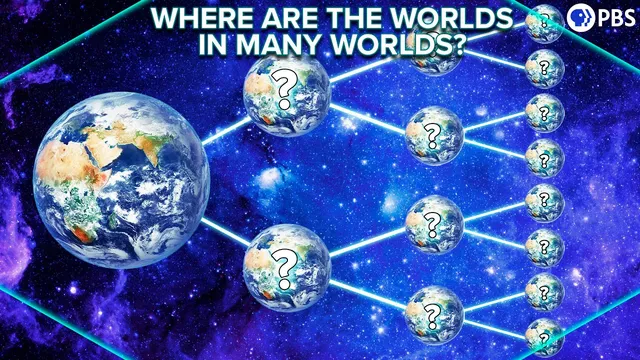
Where Are The Worlds In Many Worlds?
Based on PBS Space Time's video on YouTube. If you like this content, support the original creators by watching, liking and subscribing to their content.
Many Worlds treats different outcomes as overlapping components of a single evolving wavefunction rather than as physically separated universes.
Briefing
Many Worlds doesn’t require a literal “place” where alternate universes are stored; it treats different outcomes as overlapping parts of a single quantum wavefunction that become effectively non-interfering once interactions scramble their phase. The practical upshot is that “worlds” are real only in the sense that they remain correlated with specific measurement records—yet they become inaccessible to each other through decoherence, making them impossible to observe directly with ordinary experiments.
The core idea starts with superposition, illustrated through pond ripples. When multiple waves overlap in a linear system, the combined pattern is just the sum of the individual components, and the evolution of each component can be tracked separately. Quantum mechanics uses the same mathematical logic, but with a wavefunction whose amplitude corresponds to probability density. The wavefunction can interfere constructively or destructively, as in the double-slit experiment, where an electron’s probability distribution forms interference bands even though each detection event registers as a single spot.
The interpretive fork comes at measurement. Copenhagen attributes the single outcome to wavefunction collapse: the wavefunction abruptly shrinks to the measured result, with randomness weighted by the pre-measurement amplitudes. Many Worlds instead keeps the wavefunction evolving continuously via the Schrodinger equation, without collapse. In that picture, the electron’s wavefunction doesn’t vanish into one detector location; it propagates through the detector and onward through circuitry, photons, nerves, and neurons for every possible outcome. The reason only one spot is experienced is that the rest of the wavefunction becomes dynamically irrelevant to interference with the experienced branch.
That irrelevance is explained by decoherence. Before the electron hits the screen, the two-slit alternatives can remain coherent, meaning their phase relationship is preserved and interference is possible. But if detectors are placed to determine which slit the electron passed through, the measurement process destroys the phase correlation between the two components. After that, the components still overlap in space and time, but they can’t recombine into the interference pattern because the phase information is scrambled into the environment. “Worlds” effectively split when phase relations become unrecoverable, and they remain separated because there’s no practical way to restore coherence.
The same logic scales up to brains and bodies. Different branches of the wavefunction correlate with different internal neural states and different physical outcomes—one version of a person moves left, another right—yet those branches are out of phase, so they don’t interfere in a way that would let one “world” influence the other. In the pond analogy, the worlds overlap spatially but behave like ripple patterns that cannot add coherently; only patterns sharing a phase relation with a given observer remain part of that observer’s experience.
The transcript also cautions against common misconceptions. Worlds don’t split constantly and irreversibly; quantum components can recombine when coherence is restored, and splitting is tied to interactions that scramble phase rather than to every microscopic event. Finally, while Many Worlds is often described as untestable, the discussion notes ongoing efforts to find ways to test it—possibly even through speculative ideas about sending messages between branches if such communication is possible.
Cornell Notes
Many Worlds treats quantum outcomes as overlapping components of a single wavefunction rather than as separate universes stored somewhere in space. The wavefunction evolves continuously by the Schrodinger equation, and what looks like “collapse” is replaced by decoherence: interactions scramble phase relations so different components can no longer interfere. In the double-slit experiment, coherence between slit alternatives produces interference; adding which-slit detectors destroys that phase correlation, eliminating interference even though both components continue to propagate. Applied to brains, each outcome correlates with a different internal neural state, but those brain states are out of phase, so only one branch is experienced. “Worlds” therefore mean stable, decohered patterns correlated with measurement records, not permanently separated physical locations.
How does the pond-ripple analogy clarify what “superposition” means in quantum mechanics?
Why does the double-slit experiment produce interference bands even though each electron hits one spot?
What changes between Copenhagen and Many Worlds at measurement?
How does decoherence make different “worlds” effectively non-interfering?
Where are the worlds “located” relative to each other in the Many Worlds picture?
What misconceptions does the transcript warn against regarding how often worlds split?
Review Questions
- In the double-slit setup, what specific change destroys interference, and what does that imply about phase relationships between wavefunction components?
- According to Many Worlds in this account, how does an observer’s experience become correlated with one outcome rather than another?
- Why does decoherence prevent interference between branches even when their wavefunction components overlap in the same region of space?
Key Points
- 1
Many Worlds treats different outcomes as overlapping components of a single evolving wavefunction rather than as physically separated universes.
- 2
Superposition and interference are central: overlapping wavefunction amplitudes add constructively or destructively to shape probability distributions.
- 3
Copenhagen’s collapse is replaced by continuous Schrodinger evolution in Many Worlds, with all outcome-branches propagating through the detector and environment.
- 4
Decoherence explains why branches become effectively non-interfering: interactions scramble phase correlations so interference can’t be recovered.
- 5
Which-slit detectors illustrate the mechanism: measuring path information destroys coherence and eliminates interference even though both components continue to evolve.
- 6
“Worlds” correspond to stable, decohered patterns correlated with specific measurement records, including correlated neural states in the observer.
- 7
Common depictions of constant, irreversible splitting are misleading; coherence can sometimes be restored and components can recombine.