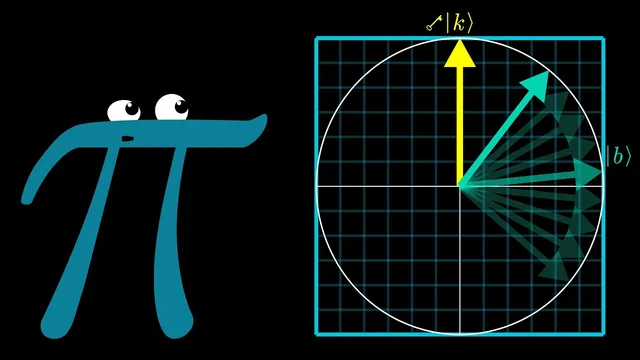
Where my explanation of Grover’s algorithm failed
Based on 3Blue1Brown's video on YouTube. If you like this content, support the original creators by watching, liking and subscribing to their content.
Grover’s algorithm relies on turning a classical 1/0 verifier into a quantum operation that flips the sign (phase) of exactly one basis component.
Briefing
Grover’s algorithm hinges on a subtle quantum translation: a classical “verifier” that outputs 1 for the correct input and 0 otherwise becomes, in quantum form, an operation that flips the sign of exactly one basis component of a state vector—without the algorithm ever being told which input is correct. The confusion that derailed the earlier explanation came from imagining that the quantum machine must already know which axis (which basis vector) to flip. The clarification reframes the problem: the “which one” is not stored as a hidden parameter; it emerges from the structure of the verifier’s logic gates, such as those implementing Sudoku rules or cryptographic checks.
To make that concrete, the discussion contrasts two kinds of functions. For Sudoku, a classical checker can verify a proposed grid but doesn’t reveal the solution by itself; the rules constrain the answer without pointing to it directly. For cryptography, SHA-256 is treated as a cryptographic hash: finding an input that yields a particular output is believed to be effectively as hard as guess-and-check because the function’s internal structure doesn’t leak useful guidance. Grover’s algorithm targets exactly this pattern—a hard-to-invert verifier—by searching for the unique input that triggers it, using fewer evaluations than classical brute force.
The key step is how a classical true/false output maps into quantum behavior. After compiling the verifier into quantum logic gates (built from AND/OR/NOT-style components), the quantum analogue acts on basis vectors labeled by all possible bit strings. If a particular bit string would make the classical verifier output 1, the corresponding quantum basis component gets multiplied by −1 (a 180-degree phase flip); if it would output 0, that component stays unchanged. Crucially, assembling the gates does not require knowing the solution in advance—the gates encode the rules, not the answer.
The explanation then tackles why this doesn’t amount to “parallel instructions” that require knowing the target. Quantum operations are linear: when the quantum state is a superposition over many basis vectors, the transformation applies to each component in a way that preserves the overall weighted-sum structure. That means the sign flip affects only the component associated with the satisfying input, but the algorithm doesn’t need to separately identify that component before running. A z-gate example (flipping the phase of |1⟩ while leaving |0⟩ unchanged) illustrates the same principle in a simpler setting.
Finally, the clarification tempers expectations. Grover’s algorithm provides only a quadratic speedup, not an exponential one. Even for a Sudoku-like search space, the step count remains astronomically large. For SHA-256 inversion, the brute-force cost of 2^256 drops to roughly 2^128 under Grover’s algorithm (up to constants), which is still infeasible. The takeaway is that Grover’s method is mathematically elegant and practically relevant only in narrow cases, and it doesn’t justify claims that quantum computers will instantly break all cryptography.
Cornell Notes
Grover’s algorithm uses a classical verifier (a function that outputs 1 for the correct input and 0 otherwise) and turns it into a quantum operation that flips the phase of exactly one basis component of a quantum state. The algorithm does not need to know which input is correct ahead of time; the “which component” is determined by the verifier’s compiled logic gates (e.g., Sudoku rules or SHA-256-like checks), not by a hidden parameter supplied by the user. Because quantum operations are linear, a superposition over all candidate inputs evolves by applying the verifier’s phase flip to the satisfying component while leaving the others unchanged. The speedup is only quadratic, so even with ideal hardware, many realistic search problems remain far too large to solve.
Why does the phase-flip step not require knowing the solution in advance?
How does a classical verifier become a quantum operation?
What role does linearity play in understanding Grover’s phase flip?
What does the z-gate example teach about phase flips?
Why is Grover’s speedup not enough to break SHA-256 in practice?
Review Questions
- In Grover’s algorithm, what exactly changes for the basis vector corresponding to the satisfying input, and what stays the same for all other basis vectors?
- How does linearity explain why a phase flip applied to one basis component can be described consistently even when the quantum state is a superposition?
- Why does a quadratic speedup still leave many search problems (like Sudoku brute force or SHA-256 inversion) computationally out of reach?
Key Points
- 1
Grover’s algorithm relies on turning a classical 1/0 verifier into a quantum operation that flips the sign (phase) of exactly one basis component.
- 2
The algorithm does not need to know the satisfying input beforehand; the verifier’s compiled logic gates determine which basis component gets the −1 multiplier.
- 3
Sudoku and SHA-256 illustrate the same structural idea: verification is easy, but finding the unique triggering input is hard and behaves like guess-and-check.
- 4
Quantum operations act on state vectors via linear transformations, so phase flips on basis components extend naturally to superpositions.
- 5
Linearity means the transformation of a superposition equals the superposition of transformations, not a requirement to run separate “instructions” for each candidate in parallel.
- 6
Grover’s speedup is quadratic, so realistic problems with huge search spaces remain infeasible even on idealized quantum hardware.