Which Planet Has the Best Eclipse?
Based on minutephysics's video on YouTube. If you like this content, support the original creators by watching, liking and subscribing to their content.
Earth’s S tier comes from a near-perfect moon–sun apparent-size match that blocks the sun while still revealing the corona, plus the rarity and speed of totality.
Briefing
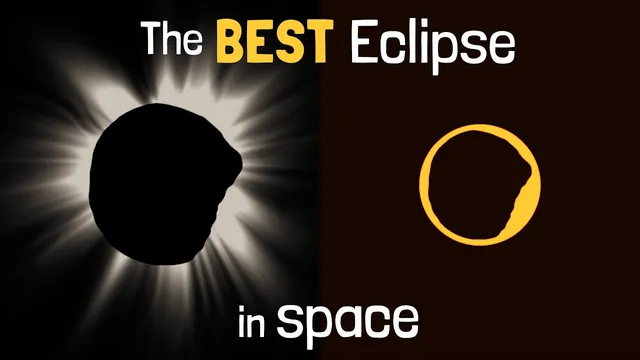
The best eclipses in the solar system aren’t automatically the ones with the biggest moons—they’re the ones that match the sun’s apparent size closely enough to create an Earth-like “totality” look: a dark hole in the sky, a visible corona, and a 360° sunrise effect. By that standard, the top tier belongs to Saturn’s moons—especially Pandora and Prometheus—because they can produce both total and annular eclipses with the right apparent geometry, plus their irregular, potato-like shapes make the partial and annular phases more visually interesting than Earth’s mostly spherical moon.
Earth’s eclipses still land in S tier for a simple reason: the moon and sun appear nearly the same size from our planet, so the moon can fully block the sun while leaving the corona visible. Totality also happens rarely and quickly, which makes the experience feel unusually dramatic—midday darkness, stars popping out, and the horizon glowing like sunrise in every direction.
From there, the ranking quickly turns into a lesson in apparent size and atmosphere. The Moon (Earth’s lunar eclipses) earns B tier: Earth blocks the sun, but the lunar sky starts dark, so there’s no true “sky darkening” or 360° sunrise. The corona is also largely blocked by Earth itself, and the event would last hours, with a dusky red rim glow from sunlight scattering through Earth’s atmosphere.
Mars gets a split verdict: Phobos can cover up to about 30% of the sun, producing a lumpy ring-like partial eclipse (C tier), while Deimos covers only about 1% and would be barely visible even with good eyesight and solar glasses (D tier). Jupiter’s eclipses look spectacular from space, but from Jupiter’s own upper atmosphere they skew toward nighttime-like views because several large moons would block most of the corona and the “360° sunrise” effect would be muted. Callisto’s eclipses are the standout on Jupiter: it’s close to the right apparent size to preserve the corona and 360° sunrise, and its eclipse frequency is roughly every sixteen days for three years at a time—earning A tier.
Saturn dominates the upper ranks. Several moons are too small or too distant for naked-eye viewing from Saturn’s upper atmosphere (F tier), while others require solar glasses (C or D tier). But Janus and Epimetheus can still deliver total and annular eclipses similar to Earth’s—only downgraded from S because the sun appears smaller from Saturn, making the “match” less perfect. Pandora and Prometheus hit the sweet spot: they’re the only moons in the solar system known from this ranking to reliably produce both total and annular eclipses, and their shapes promise more varied eclipse visuals—S tier.
Beyond Saturn, the sun shrinks in the sky, making it easier for moons to appear “too big,” which pushes eclipses toward nighttime-like totality or dull star-like dimming. Uranus and Neptune mostly land in C to F territory depending on whether moons are close enough in apparent size to show corona and a 360° sunrise. Perdita on Uranus is the best case (B tier), while Hippocamp on Neptune is also B tier. Pluto and other distant dwarf planets fare poorly: their atmospheres are absent, and the sun appears so tiny that even when eclipses are geometrically possible, the result is essentially normal night or slight dimming unless a telescope is used—D tier for Styx, Kerberos, Charon, Nix, and Hydra. Eris is also D tier, and double asteroids are mostly C tier at best, limited by the same atmosphere problem.
Overall, the “best eclipse” isn’t about raw size—it’s about the rare combination of apparent-size match, corona visibility, and an atmosphere-free or atmosphere-friendly setting that preserves the dramatic sky effects.
Cornell Notes
The strongest eclipses in the solar system are those that recreate Earth’s signature look: the sun is fully blocked while the corona remains visible, and the sky shows a dark “hole” plus a 360° sunrise effect. Saturn’s moons lead the ranking because Pandora and Prometheus are sized to produce both total and annular eclipses with the right apparent geometry, and their shapes add visual variety. Earth remains S tier due to the moon–sun size match and the rarity/rapidity of totality. Farther out, the sun appears smaller, so many moons become “too big” (nighttime-like eclipses) or “too small” (star-like dimming), and the lack of atmosphere on bodies like Pluto makes the dramatic sky effects largely disappear. The result is a tier list driven mostly by apparent size and atmospheric conditions, not just moon mass.
Why do Earth’s total solar eclipses feel so dramatic compared with most other worlds?
What makes lunar eclipses on the Moon (viewed from the Moon) less visually “eclipse-like” than on Earth?
How do Jupiter’s moons differ between “spectacular from space” and “good from Jupiter”?
Why do Saturn’s Pandora and Prometheus earn S tier in this ranking?
Why do Pluto’s eclipses get such low marks even when the geometry can be “perfect”?
What is the “sunrise shrinking effect,” and how does it change the tier ranking for some moons?
Review Questions
- Which eclipse features in the ranking depend most on apparent moon–sun size matching, and which depend on having an atmosphere?
- How does the “sunrise shrinking effect” alter whether an eclipse is total versus annular?
- Why do eclipses on distant bodies like Pluto often look like simple dimming rather than an Earth-like corona-and-sky event?
Key Points
- 1
Earth’s S tier comes from a near-perfect moon–sun apparent-size match that blocks the sun while still revealing the corona, plus the rarity and speed of totality.
- 2
The Moon’s lunar eclipses score lower because the sky is already dark and Earth blocks much of the corona, limiting the 360° sunrise effect.
- 3
Mars’s eclipses are mostly partial: Phobos can cover up to ~30% of the sun (C tier), while Deimos covers ~1% (D tier).
- 4
Jupiter’s eclipses look different from Jupiter than from space; Callisto is the best because its apparent size supports corona visibility and a 360° sunrise (A tier).
- 5
Saturn’s Pandora and Prometheus are top-ranked because they can produce both total and annular eclipses with Earth-like visual elements, and their shapes add variety (S tier).
- 6
Farther from the sun, the sun’s apparent size shrinks, making many moons either too large (nighttime-like totality) or too small (star-like dimming), and atmosphereless worlds like Pluto lose the dramatic sky effects.
- 7
The “sunrise shrinking effect” can change eclipse type (total vs annular) by making the eclipsing moon appear smaller near horizons or poles, affecting which moons land in higher tiers.