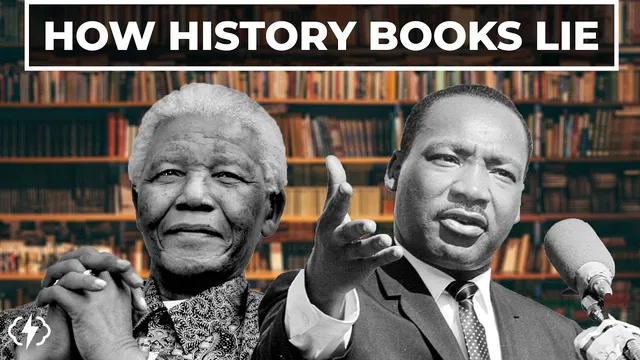
Whitewashing 101: How To Rewrite Black History
Based on Second Thought's video on YouTube. If you like this content, support the original creators by watching, liking and subscribing to their content.
King’s popular image is portrayed as being narrowed to quotable “colorblind” themes that obscure his anti-war, anti-capitalist, and pro-structural-change agenda.
Briefing
Martin Luther King Jr. and Nelson Mandela are widely celebrated in American public memory in ways that strip out their anti-capitalist, anti-war, and anti-imperialist politics—an editing process that also helps preserve the legitimacy of U.S. power. The core claim is that “colorblind” soundbites and heroic “peace” narratives make these figures usable to institutions that would otherwise have to confront the economic and political systems they challenged.
King’s legacy, in particular, is portrayed as being “recuperated” by the American state and political establishment through a narrow focus on a few iconic lines—especially the “content of our character” idea from his speeches. That narrowing, the argument goes, obscures the breadth of King’s work, including his opposition to the Vietnam War and his Poor People’s Campaign, as well as his willingness to praise and draw lessons from international anti-colonial policy. It also sidelines his explicit critique of capitalism and his insistence that racial injustice is inseparable from economic injustice. The transcript highlights King’s calls for restitution and structural change—guaranteed annual income, major reforms in education, housing, employment, and health care—framing these as incompatible with a later political use of King as a symbol of moderation.
A major example offered is Ronald Reagan’s role in elevating King into a national icon. The transcript argues that Reagan’s administration helped make King acceptable by turning him into an “empty shell” of vague justice while Reagan opposed major civil-rights legislation, including the Civil Rights Act of 1964, the Voting Rights Act of 1965, and the Fair Housing Act of 1968. It also cites Reagan’s record on school funding tied to race discrimination, opposition to extending voting-rights protections, vetoing the Civil Rights Restoration Act, and weakening the Equal Employment Opportunity Commission. The implication is that the “I Have a Dream” emphasis—poetic and easy to quote—made it easier for politicians to celebrate King while discarding the policies he demanded.
The same pattern is applied to Mandela in textbooks and public narratives. Mandela is described as being channeled into a set of comforting archetypes: prisoner-turned-savior, peacemaker, reconciler, and healer. That framing, the transcript argues, distorts the anti-apartheid struggle by minimizing the ANC’s shift toward armed revolution and the role of sabotage and guerrilla warfare. It also downplays how the U.S. government supported apartheid’s continuation for decades, partly because anti-apartheid groups included socialists and communists, and because Cold War priorities shaped Washington’s response.
Finally, the transcript argues that whitewashing works alongside demonization. The Black Panther Party is presented as the foil: targeted by the FBI’s COINTELPRO, remembered as domestic terrorists, and contrasted with King’s sanitized image. The transcript lists Panther community programs—free breakfast for children, health clinics, and patrols intended to reduce police brutality—while arguing that public memory keeps the “bad guys with guns” version prominent to prevent audiences from seeing continuity between King’s poor-focused agenda and later radical organizing.
The closing message urges viewers to honor King by engaging his anti-war, anti-racist, and anti-capitalist legacy rather than using him as a rhetorical prop, and it suggests that skepticism toward “fast” or “violent” movements often mirrors the same reactions once directed at King.
Cornell Notes
The transcript argues that American public memory “whitewashes” major Black revolutionary figures by turning them into safe, inspirational symbols while removing their most disruptive politics. Martin Luther King Jr. is portrayed as being reduced to a few quotable lines about character and colorblindness, which obscures his anti-war, anti-capitalist, and pro-structural-change positions. Nelson Mandela is similarly mythologized as a peaceful reconciler, while the ANC’s armed revolution and the U.S. government’s long support for apartheid are minimized. The transcript adds that this sanitization is paired with demonization of radicals like the Black Panther Party, whose community programs and political continuity are often left out. The stakes, it says, are that whitewashing ultimately protects the U.S. systems those leaders challenged.
Why does the transcript claim King’s legacy became politically “usable” to mainstream institutions?
What specific parts of King’s politics are highlighted as being cut out of popular retellings?
How does the transcript connect Reagan to the transformation of King’s public image?
What does the transcript say about how Mandela is portrayed in textbooks, and what gets distorted?
Why does the transcript bring up the Black Panther Party after discussing King and Mandela?
Review Questions
- What mechanisms does the transcript describe for turning King into a “safe” symbol, and which parts of his politics are most affected?
- How does the transcript use Reagan’s civil-rights record to argue that King’s legacy was reshaped for political convenience?
- What distortions does the transcript claim occur in textbook portrayals of Mandela, and how does it connect those distortions to U.S. foreign policy during the Cold War?
Key Points
- 1
King’s popular image is portrayed as being narrowed to quotable “colorblind” themes that obscure his anti-war, anti-capitalist, and pro-structural-change agenda.
- 2
The transcript argues that Reagan-era commemoration helped make King politically acceptable while Reagan’s record opposed major civil-rights legislation.
- 3
The transcript claims King’s economic critique—linking racial injustice to capitalism and exploitation—gets left out of mainstream retellings.
- 4
Mandela’s textbook portrayal is described as mythologizing him into peaceful archetypes while minimizing the ANC’s armed revolution and the role of international and Cold War dynamics.
- 5
The transcript argues that U.S. support for apartheid for decades is softened or displaced when Mandela is framed mainly as a prisoner-turned-peacemaker.
- 6
Whitewashing is presented as working alongside demonization, with the Black Panther Party used as a foil through selective public memory.
- 7
The transcript concludes that honoring King requires engaging his anti-war, anti-racist, and anti-capitalist legacy rather than using him as a rhetorical prop.