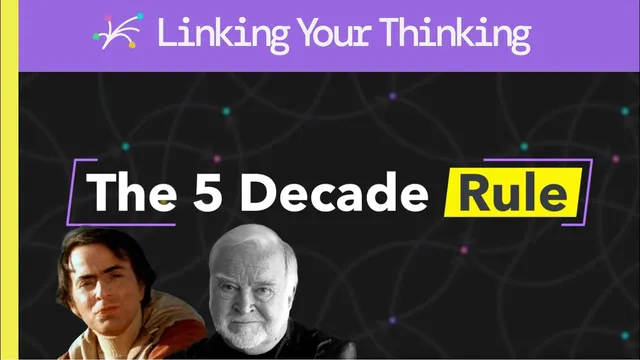
Who are your Idea Grandparents? The 5 Decade Rule
Based on Linking Your Thinking with Nick Milo's video on YouTube. If you like this content, support the original creators by watching, liking and subscribing to their content.
Use “people mapping” by tagging influential thinkers and sorting them by birth year to reveal clusters you might otherwise miss.
Briefing
The “five-decade rule” argues that the most useful intellectual influences often come from people born about five decades before you—“idea grandparents,” not by blood but by timing. The core claim is that this age gap hits a sweet spot: those thinkers are old enough to have already produced their most significant work (and had it tested by time), yet young enough to share a broadly comparable cultural context, making their ideas easier to understand and apply.
The rule is built from a practical method called “people mapping,” where a person tags prominent thinkers and then sorts them by birth year. In the transcript, the creator describes doing this with a note labeled “prominent people” (science-focused), then sorting by birth date to see patterns. When Carl Sagan appeared with a birth year in the 1930s, the next step—looking at who else clustered around that same period—triggered the epiphany. Two examples anchor the pattern: Edward de Bono (associated with the “Six Thinking Hats”) and Richard Saul Wurman (creator of TED). The clustering around roughly the same birth window suggested that certain decades produce waves of influential thinkers that resonate strongly with later generations.
From there, the concept is visualized as a timeline: if someone is born in the 1980s, their “idea grandparents” would be born in the 1930s. The argument then extends beyond trivia. When those earlier thinkers’ ideas remain relevant by the time you reach adulthood—when you start actively pursuing meaning and understanding the world—their continued presence functions like a filter. Time becomes the “ultimate test,” while the shared era of lived experience provides context that older, more distant historical periods may lack (for instance, ancient thinkers didn’t grapple with industrial revolution realities, modern warfare, or aviation-era technology).
The transcript also offers a how-to exercise. View your current “big idea influencers,” list at least five people, and look up their birth years. If most of them cluster in your own decade—especially if everyone you learn from is in their 20s—the learning environment may be too narrow. The method recommends widening across decades, and it even claims that many of the most enriching influences should already be dead, because their work has had time to mature and be vetted.
Finally, the approach encourages deeper follow-up questions once birth-year patterns emerge: where were these thinkers during major historical events like World War II, how might that have shaped their psychology, and what other creators (art, ideas, movements) were born in the same window. The “surprising takeaway” is that organizing people by birth date—alongside books and movies by publication date—can strengthen linking systems by preserving context, helping ideas connect more meaningfully across time. The goal becomes personal: to become, for someone else, the kind of “idea grandparent” whose life and work reshape how another person thinks.
Cornell Notes
The five-decade rule says the most valuable intellectual influences for a person often come from thinkers born about five decades earlier. The logic is twofold: those earlier thinkers are likely to have already produced their best work and had it tested by time, and they also come from a cultural context closer enough to yours to make their ideas easier to interpret. The rule is generated using “people mapping,” where prominent people are tagged and sorted by birth year to reveal clusters. Once clusters appear, the method recommends asking what historical events shaped them and who else was born in the same window. This matters because it turns learning from a random feed of ideas into a structured, context-rich search for “idea grandparents.”
What is the five-decade rule, and why does a five-decade gap matter?
How does “people mapping” generate the rule from real data?
What does the rule predict about when “best works” appear?
What exercise helps someone apply the rule to their own learning?
What follow-up questions should be asked once a birth-year cluster is found?
What is the “surprising takeaway” about organizing information?
Review Questions
- If you list five major influences and find they cluster in your own decade, what specific change does the five-decade rule recommend and why?
- How would you use people mapping to test whether a birth-year cluster is meaningful rather than coincidental?
- What historical-context questions (e.g., World War II) would you ask about a group of idea grandparents born in the same window?
Key Points
- 1
Use “people mapping” by tagging influential thinkers and sorting them by birth year to reveal clusters you might otherwise miss.
- 2
Treat “idea grandparents” as people born about five decades before you to balance vetted contributions with cultural interpretability.
- 3
Assume time acts as a filter: ideas that still matter when you reach adulthood are more likely to have lasting value.
- 4
Avoid overly narrow learning sources; if most influences are from one decade (especially your own), widen across ages and eras.
- 5
After finding a birth-year pattern, ask what major events shaped those thinkers and who else was born in the same window.
- 6
Organize people by birth date (and works by publication date) to preserve context and strengthen linking systems.
- 7
Aim to become an “idea grandparent” for someone younger by producing work that can reshape their thinking.