Who cares about topology? (Old version)
Based on 3Blue1Brown's video on YouTube. If you like this content, support the original creators by watching, liking and subscribing to their content.
The inscribed-rectangle condition is equivalent to finding two distinct pairs of points with the same midpoint and equal separation, because equal diagonals with a shared midpoint characterize rectangles.
Briefing
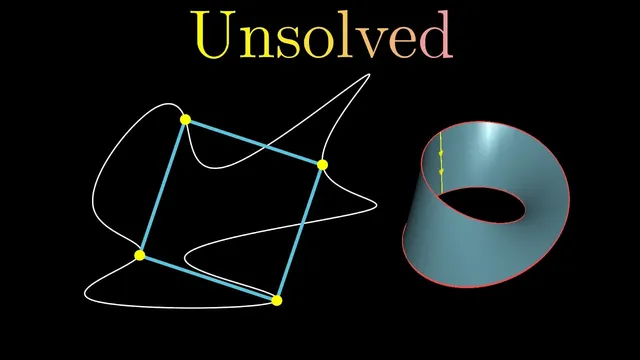
The core breakthrough is a topological “collision” argument: for any closed loop in space, there must exist two distinct pairs of points that share the same midpoint and have the same separation, and that condition forces an inscribed rectangle. The unsolved inscribed square problem asks whether every closed loop contains a square; the rectangle version is weaker, but it admits a clean, elegant proof that turns geometry into topology.
The rectangle criterion starts with a geometric fact about rectangles. If four points are labeled A, B, C, D in order around a rectangle, then the diagonals AC and BD have equal lengths and share the same midpoint. Conversely, if two pairs of points AC and BD have the same midpoint and equal distance, those four points must form a rectangle. So the task becomes: given an arbitrary closed loop, find two different pairs of points on it that land on the same “midpoint + distance” data.
To organize that search, the argument defines a function from pairs of points on the loop to points in 3D space. Place the loop in the xy-plane. For any pair of points, compute their midpoint m (in the xy-plane) and their distance d. Then map the pair to the point located d units above m in the z-direction. As the pair of points varies continuously along the loop, the mapped points trace out a surface in 3D. Crucially, when the two points in the pair approach each other, the height d shrinks, and in the limiting case of a “pair” where both points coincide (xx), the mapped point lies exactly on the original loop.
A collision in this mapping—two distinct pairs producing the same 3D point—would mean the pairs share a midpoint and the same distance, hence they form a rectangle. The proof therefore reduces to showing that the constructed surface cannot avoid intersecting itself.
The key topological move is to represent “pairs of points on a loop” as a single geometric object. Ordered pairs can be parameterized by a square [0,1]×[0,1] after cutting the loop open into an interval and identifying endpoints; gluing opposite edges turns that square into a torus (the doughnut surface). But unordered pairs matter here, since AB and BA describe the same pair. Enforcing the symmetry that swaps the two points requires folding the square along its diagonal (where x=y, i.e., pairs of the form xx). After the necessary edge identifications—with a twist—the resulting space is a Möbius strip. The red boundary of this Möbius strip corresponds exactly to the degenerate pairs xx.
Now comes the collision logic. The continuous mapping from unordered pairs to the 3D “midpoint+distance” surface sends the Möbius strip’s boundary to the original loop in the xy-plane. Yet a Möbius strip cannot be glued to a purely two-dimensional boundary without forcing self-intersection: the twist in the Möbius strip makes it topologically impossible to embed it in a way that keeps the boundary flat and non-self-crossing. That forced intersection means two different points on the Möbius strip map to the same 3D location, i.e., two distinct pairs of points share midpoint and distance—therefore the loop contains an inscribed rectangle. Making the “can’t glue without intersection” step fully rigorous is where topology earns its keep, but the geometric intuition is already visible in the Möbius strip picture.
Cornell Notes
Every closed loop contains an inscribed rectangle because the rectangle condition is equivalent to a “midpoint + distance” collision. For any pair of points on the loop, the midpoint m and separation d define a point in 3D at height d above m; two different pairs mapping to the same 3D point guarantee equal midpoints and equal diagonal lengths, which forces a rectangle. Unordered pairs of points on the loop can be parameterized by a Möbius strip: ordered pairs form a torus, and identifying AB with BA folds the torus construction into a Möbius strip whose boundary represents degenerate pairs xx. Mapping this Möbius strip into 3D must send its boundary onto the original loop in the plane, but the Möbius strip’s twist makes self-intersection unavoidable. That self-intersection produces the needed collision, hence an inscribed rectangle.
Why does finding two pairs of points with the same midpoint and equal distance guarantee a rectangle?
How does the 3D mapping turn “pairs of points” into a geometric surface?
What is the role of continuity in the collision argument?
Why do ordered pairs lead to a torus, while unordered pairs lead to a Möbius strip?
How does the Möbius strip’s boundary force an intersection in the mapped surface?
Review Questions
- In the midpoint+distance mapping, what geometric meaning does the height z=d have, and what happens when the pair is xx?
- How do the rectangle condition (equal diagonals and shared midpoint) and the collision condition (two pairs mapping to the same 3D point) relate logically?
- What specific identification step turns the parameter space from a torus (ordered pairs) into a Möbius strip (unordered pairs)?
Key Points
- 1
The inscribed-rectangle condition is equivalent to finding two distinct pairs of points with the same midpoint and equal separation, because equal diagonals with a shared midpoint characterize rectangles.
- 2
A continuous map from point-pairs to 3D points can be built by sending each pair to the point d units above its midpoint in the xy-plane.
- 3
A collision in that map (two different pairs landing on the same 3D point) directly produces a rectangle on the original loop.
- 4
Ordered pairs of points on a loop can be parameterized by a torus via a square with edge identifications after cutting the loop into an interval.
- 5
Unordered pairs require identifying (x,y) with (y,x), which turns the parameter space into a Möbius strip whose boundary represents degenerate pairs xx.
- 6
The Möbius strip’s twist makes it impossible to map its boundary onto a planar loop without forcing self-intersection, and that self-intersection yields the needed collision.