Why 5/3 is a fundamental constant for turbulence
Based on 3Blue1Brown's video on YouTube. If you like this content, support the original creators by watching, liking and subscribing to their content.
Turbulence is defined by chaotic evolution and diffusive mixing, not just by the presence of rotation (vorticity).
Briefing
Turbulence may look like pure randomness, but a century of fluid research points to a measurable regularity inside the chaos: in the “inertial subrange,” the total kinetic energy carried by eddies of size d scales like d^(5/3). That 5/3 power law—attributed to Andrej Komagorov—acts like a fundamental constant of turbulent flows because it links the geometry of swirling motion to how energy is distributed across length scales, even when the exact swirl-by-swirl details remain unpredictable.
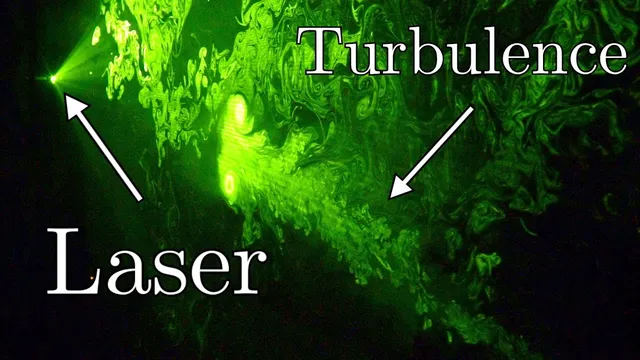
The discussion begins with a home-style visualization of turbulent motion using a laser sheet, fog, and a glass rod to reveal otherwise invisible airflow. The same optical trick also makes vortex rings—donut-shaped packets of rotating fluid—look strikingly ordered in cross-section, resembling two adjacent “hurricanes” rotating as the ring travels. Those rings illustrate an important theme: high vorticity (strong local rotation) does not automatically mean turbulence. What distinguishes turbulence is not just swirling, but chaotic evolution—small differences in initial conditions can snowball into dramatically different outcomes—along with diffusive mixing that spreads momentum and energy through the fluid.
From there, the transcript frames turbulence as a hard problem in mathematical physics. The governing Navier–Stokes equations, essentially Newton’s second law adapted to fluids, are notoriously difficult to solve and even harder to prove well-posed. For incompressible flow, major open questions ask whether “reasonable” solutions always exist and stay smooth rather than blowing up into infinite kinetic energy. Compressible fluids like air add further complications, and the elusive nature of turbulence sits at the center of both the computational and theoretical difficulties.
Komagorov’s contribution targets a different kind of question: not “what does the flow do next?” but “how is energy organized across scales?” Turbulent motion contains eddies spanning a wide range of sizes, and energy tends to cascade from large structures to smaller ones until viscosity dissipates it as heat. In this cascade picture—captured in a famous Richardson verse—larger whorls feed smaller ones down to the molecular scale.
The key quantitative leap is that, within a specific band of length scales called the inertial subrange (for air, roughly 0.1 cm to 1 km), the collective energy in eddies of diameter d follows the d^(5/3) scaling. Experiments have repeatedly confirmed the law, making 5/3 feel less like a lucky fit and more like a structural feature of three-dimensional turbulence.
Finally, the transcript emphasizes why the law belongs to three dimensions. Energy transfer in two-dimensional turbulence behaves differently, often moving from small scales up to larger ones. A mechanism unique to three dimensions—vortex stretching—lets rotating fluid elements extend out of their plane, creating faster-spinning smaller eddies and enabling the downward cascade. Even the seemingly stable vortex rings produced in the demos slowly stretch over long times, hinting at the same underlying 3D dynamics. The result is a rare blend of order and chaos: turbulent flows may be unpredictable in detail, yet their energy distribution obeys a simple, repeatable exponent.
Cornell Notes
Turbulence is chaotic fluid motion with strong mixing and sensitivity to initial conditions, governed by the Navier–Stokes equations. While vorticity (rotation) can appear in smooth flows like whirlpools or vortex rings, turbulence requires chaotic evolution plus diffusive mixing. In three-dimensional turbulence, energy cascades from large eddies to smaller ones until viscosity dissipates it as heat. Andrej Komagorov’s hypothesis predicts that, in the inertial subrange, the kinetic energy carried by eddies of diameter d scales like d^(5/3). Experiments repeatedly support this scaling, making 5/3 a widely treated “fundamental constant” of turbulent energy distribution and a key reason turbulence has some predictable structure despite its randomness.
Why doesn’t “lots of swirling” automatically mean turbulence?
What makes the Navier–Stokes problem so difficult, even before turbulence enters the picture?
What is the energy cascade, and how does it connect large eddies to heat?
What exactly does Komagorov’s 5/3 law claim, and where does it apply?
Why is the 5/3 scaling tied to three-dimensional turbulence rather than two-dimensional flow?
How do vortex rings relate to the broader turbulence story?
Review Questions
- What additional features beyond vorticity distinguish turbulence from smooth rotating flows?
- In Komagorov’s picture, what happens to kinetic energy as eddy size decreases, and where does viscosity enter?
- Why does vortex stretching make three-dimensional turbulence fundamentally different from two-dimensional turbulence?
Key Points
- 1
Turbulence is defined by chaotic evolution and diffusive mixing, not just by the presence of rotation (vorticity).
- 2
Navier–Stokes equations govern fluid motion but remain difficult both computationally and theoretically, with major open existence/smoothness questions.
- 3
Turbulent kinetic energy typically cascades from large eddies to smaller ones until viscosity dissipates it as heat.
- 4
Komagorov’s 5/3 law predicts that energy associated with eddies of diameter d scales like d^(5/3) within the inertial subrange.
- 5
For air, the inertial subrange is described as approximately 0.1 cm to 1 km, where the scaling is observed experimentally.
- 6
Energy cascade behavior differs in two dimensions, where transfer can run from small scales to larger ones.
- 7
Vortex stretching is a three-dimensional mechanism that enables the downward cascade by creating smaller, faster-spinning eddies.