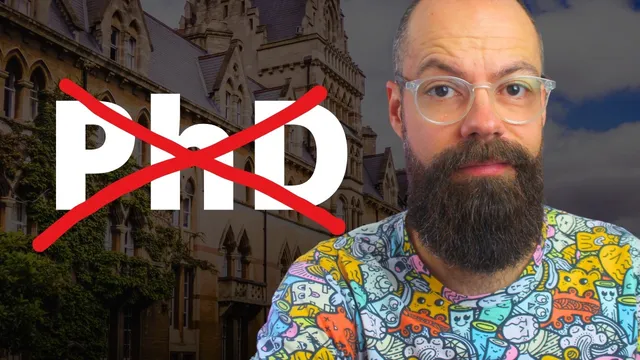
Why 80% of PhD Students Regret Their Decision – Don’t Be Next!
Based on Andy Stapleton's video on YouTube. If you like this content, support the original creators by watching, liking and subscribing to their content.
Avoid a PhD if it’s being used to dodge life planning, job-market evaluation, or decisions about the next career stage.
Briefing
A PhD is a high-stakes career move that many people treat as the “next logical step,” but that mindset often turns into regret—especially when the decision is driven by avoidance, peer pressure, or financial strain. The clearest red flag is using a PhD to dodge uncomfortable choices: deciding what to do next, evaluating the job market, or committing to a life direction. When someone delays those decisions by defaulting to the “path of least resistance,” the PhD can simply carry them to a future they didn’t actually choose.
That avoidance can be reinforced by academic culture. Supervisors and researchers may encourage promising students with praise—“you’re capable, come to my lab”—without fully accounting for the student’s personal goals. The incentive structure matters: labs need researchers to keep producing work, so enthusiasm can blur into pressure. A student who hears that encouragement may start treating it as validation rather than asking whether the PhD fits their own timeline, interests, and career plan.
Peer influence is another common trap. Seeing friends pursue PhDs can create a sense that it’s the “right” move, even though what works for one person doesn’t automatically fit another. The transcript includes a personal reflection that looking down on an industry path was misguided: the industry researcher was successful, happy, and financially better off—outcomes that contradict the assumption that a PhD is the only route to a strong future.
Money is where the stakes become especially stark. The transcript strongly discourages self-funded PhDs, arguing they are not an investment with reliable returns. A PhD does not guarantee higher-paying work, and in many cases a master’s degree may deliver better value. The opportunity cost is central: the time spent in a PhD could instead be used to earn income, build experience, and climb a career ladder. The guidance is blunt—avoid debt for a PhD, wait for funding or scholarships, and only consider self-funding if someone is financially secure.
Even beyond finances, the structure of a PhD can be psychologically difficult. Unlike degrees with a fixed curriculum and predictable milestones, a PhD is highly dependent on the supervisor and often lacks clear step-by-step guidance. It’s described as a “Choose Your Own Adventure,” marked by repeated setbacks, rethinking, and non-linear progress. For people who need certainty and stability—or who struggle with uncertainty—this turbulence can worsen stress and mental health issues.
Finally, the transcript targets a deeper motivation: using a PhD to patch personal insecurity. It describes a cycle where someone pursues a PhD to “prove” they’re clever after earlier underperformance, only to find that the insecurity isn’t resolved by becoming an “expert.” The result is a mismatch between the identity hope (“I should be an expert”) and the lived reality of expertise, which doesn’t feel like a dramatic emotional transformation. In short: a PhD can be the wrong tool for avoidance, social pressure, financial risk, and self-worth repair—so the decision needs to be intentional, funded, and aligned with how the work actually unfolds.
Cornell Notes
The transcript warns that many PhD regrets come from treating the degree as the default next step rather than a deliberate choice. Avoidance is a major red flag: using a PhD to dodge job-market decisions, life planning, or uncertainty about the future. Financial pressure is another key issue, with strong advice against self-funded PhDs and debt, since a PhD doesn’t reliably lead to higher pay and carries major opportunity costs. The work itself is described as non-linear and supervisor-dependent, often lacking the structure people expect from earlier degrees. Finally, pursuing a PhD to resolve personal insecurity or prove intelligence often backfires, because the “expert” identity doesn’t automatically fill the emotional gap.
What counts as a major red flag in deciding to pursue a PhD?
How can academic encouragement unintentionally steer students toward the wrong decision?
Why does peer pressure—friends doing PhDs—get treated as a weak reason to enroll?
What is the transcript’s position on self-funded PhDs, and what reasoning supports it?
How does the transcript describe the day-to-day reality of PhD work compared with earlier degrees?
Why does the transcript say pursuing a PhD to fix insecurity can backfire?
Review Questions
- Which motivations for a PhD does the transcript label as avoidance or pressure, and what decision questions should replace them?
- What financial and opportunity-cost arguments are used to oppose self-funded PhDs?
- How does the transcript’s description of PhD structure (non-linear, supervisor-dependent) affect who might be a poor fit for doctoral study?
Key Points
- 1
Avoid a PhD if it’s being used to dodge life planning, job-market evaluation, or decisions about the next career stage.
- 2
Treat supervisor praise and lab invitations as signals of lab needs, not proof that a PhD is the right personal choice.
- 3
Don’t assume peer pressure is evidence of fit; friends’ paths may reflect their own interests and circumstances, not yours.
- 4
Avoid self-funded PhDs and debt when possible; a PhD doesn’t reliably produce higher pay, and the opportunity cost can be significant.
- 5
Expect a PhD to be non-linear and uncertain, with progress shaped heavily by the supervisor rather than a fixed curriculum.
- 6
Be cautious about pursuing a PhD to resolve personal insecurity or to “prove” intelligence; the degree may not deliver the emotional payoff people expect.
- 7
Choose funding first—scholarships or university support—so financial strain doesn’t compound stress during doctoral work.