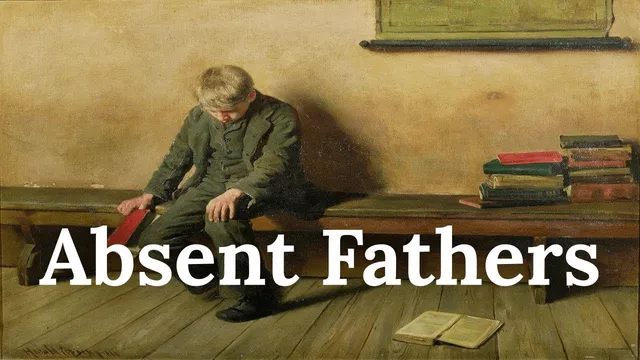
Why Absent Fathers Harm Children and Ruin Society
Based on Academy of Ideas's video on YouTube. If you like this content, support the original creators by watching, liking and subscribing to their content.
Fatherlessness is defined as fathers being physically, economically, and emotionally unavailable, and it is presented as a leading driver of declining child well-being.
Briefing
Fatherlessness—defined as fathers being physically, economically, and emotionally unavailable—has become a leading driver of declining child well-being and a major engine behind broader social breakdown. Research cited from sociologist David Popenoe frames paternal deprivation as a form of child maltreatment that is now more prevalent than many traditionally recognized harms. The stakes are presented as both personal and societal: children raised without a committed biological father face higher risks of emotional, behavioral, and physical health problems, lower educational success, greater social impairment, and more dysfunctional relationship patterns in adulthood.
The transcript ties this pattern to family structure and the mechanics of separation. Around 40% of children are born to unmarried mothers, and more than half of marriages end in divorce—often with mothers receiving custody. Even when fathers remain physically present, emotional availability can be thin: some are described as distracted by smartphones, others as dealing with drugs or alcohol, and many as working long hours or multiple jobs amid declining purchasing power. The core claim is that a mother cannot fully substitute for a father, because boys and girls benefit from gender-differentiated parenting that combines emotional security with challenge, boundary-pushing, and risk-taking in a safe context.
Stepfathers are offered as an imperfect remedy. The transcript argues that the lack of genetic ties can reduce investment in a child’s development, and that some stepfathers may treat stepchildren as competition for a partner’s attention. Research summarized as “surprising findings” suggests stepfather presence can aggravate child-rearing problems and worsen negative outcomes.
The harm is also linked to how divorce changes father-child contact. Drawing on Frank Furstenberg and Andrew Cherlin’s work, the transcript says that after a few years of divorce only one in ten children have weekly contact with their fathers, while two thirds have no contact at all. Even when contact continues, it is often sporadic and superficial. A key causal mechanism is described as conditional fathering: men are portrayed as viewing marriage and childrearing as a single package, so when the marriage deteriorates, fathering deteriorates; when divorce or non-marriage occurs, responsibility and interest can drop.
That leads to a proposed solution centered on strengthening marriage. Historically, marriage is described as a sacred contract broken only in extreme cases, but the transcript argues that modern norms have undermined it—making divorce statistically typical and discouraging commitment. The sexual revolution beginning in the 1960s is cited as a major contributor, with promiscuity normalized and monogamy and marriage weakened. Broader cultural shifts are also blamed: responsibility and commitment are said to have been replaced by self-focused fulfillment, and divorce is portrayed as socially approved even when children are involved.
The transcript acknowledges that abusive or highly dysfunctional marriages should end, but insists fatherlessness can only be addressed by revitalizing marriage and re-centering it as a child-focused institution. It further claims that committed fatherhood benefits men as well—promoting health, competence, virtue, and life satisfaction—citing psychologist Angus Campbell’s findings that the most well-off males are fathers of grown children still married, while divorced and unattached men are among the unhappiest. The closing message is that children are society’s future, so fatherlessness risks producing a cycle of broken adults and continued social dysfunction: “every father counts.”
Cornell Notes
The transcript argues that fatherlessness—fathers who are physically, economically, and emotionally unavailable—has become a major cause of declining child well-being and wider social problems. It links this to divorce and non-marriage patterns, custody outcomes, and the tendency for fathering to weaken when men are no longer in a relationship with the child’s mother. It also contends that stepfathers are not a reliable substitute, citing research suggesting stepfather presence can worsen outcomes. A central remedy offered is strengthening marriage and treating it as a long-term social commitment that holds fathers to children. The transcript further claims committed fatherhood supports men’s well-being, while children’s outcomes ultimately shape society’s moral and social order.
What does “fatherlessness” mean in this argument, and why is it treated as a form of child harm?
How does the transcript connect divorce to weaker father-child relationships?
Why does the transcript argue that mothers cannot fully replace fathers?
What case is made against stepfathers as a solution?
What social changes are blamed for weakening marriage, and how is that tied to fatherlessness?
What solution does the transcript propose, and what benefits does it claim for men and children?
Review Questions
- According to the transcript, what mechanisms make fathering decline after divorce, and how does that affect children’s outcomes?
- How does the transcript justify the claim that gender-differentiated parenting is developmentally important, and what does it say happens when fathers are absent?
- What arguments are offered for why stepfathers may not offset fatherlessness, and what evidence is cited to support that view?
Key Points
- 1
Fatherlessness is defined as fathers being physically, economically, and emotionally unavailable, and it is presented as a leading driver of declining child well-being.
- 2
The transcript links higher child risk to divorce and non-marriage, including custody patterns and reduced father-child contact after separation.
- 3
Emotional absence is treated as as damaging as physical absence, with examples including addiction, substance use, and chronic work demands.
- 4
The argument claims mothers cannot fully substitute for fathers because children benefit from complementary parenting roles: emotional security plus challenge and autonomy-building.
- 5
Stepfathers are portrayed as an unreliable replacement due to incentives and relationship dynamics, with cited research suggesting worse outcomes in some cases.
- 6
A central remedy is strengthening marriage as a long-term social institution that holds fathers to children, while acknowledging that abusive or highly dysfunctional marriages should end.
- 7
Committed fatherhood is also framed as beneficial for men’s well-being and virtue, which the transcript argues helps sustain healthier families and social order.