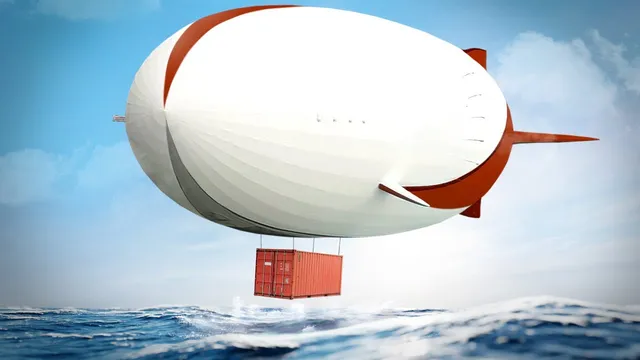
Why Airships Might Make A Comeback
Based on Veritasium's video on YouTube. If you like this content, support the original creators by watching, liking and subscribing to their content.
Airships are framed as a “third option” for freight: faster than ocean shipping, potentially cheaper than air, and with much lower emissions because buoyancy supplies lift without continuous fuel burn.
Briefing
Airships are being pitched as a “third option” for moving goods—faster than ocean freight and cheaper than air—while cutting emissions dramatically. The core idea is that global shipping is dominated by trucks domestically (the speed–cost “sweet spot”) and by ships internationally (cheap but slow). Airships, if they can scale, could become the sky’s version of trucks: carrying cargo across oceans in about a week instead of a month, potentially several times cheaper than air freight, and with far lower carbon emissions because buoyancy from lighter-than-air gas replaces much of the energy needed to stay aloft.
The physics behind why scale matters is central. Lift from the lifting gas grows with the cube of an airship’s size (radius cubed), while drag grows with the square (radius squared). That “cubed vs. squared” advantage means larger airships become more efficient as they get bigger—so the path to cargo dominance would require building the largest airships ever. But scaling isn’t just a matter of making a bigger balloon. Blimps are limited by the tension and shape-maintenance problems of over-pressurized hulls. Semi-rigid designs add structure but still face scaling constraints. Rigid airships, by contrast, use internal frameworks and gas cells that aren’t over-pressurized, allowing size to increase without the same structural bottlenecks.
Eli Dourado’s compelling proposal centers on a massive rigid airship concept: a 388-meter-long craft designed to carry roughly 500 tons at around 90 km/h—enough, the transcript notes, to move the equivalent of multiple large landmarks at highway speeds. Capturing a meaningful share of ocean freight container volume at truck-comparable pricing could translate into enormous revenue potential, theoretically rivaling the biggest global companies.
Yet cargo airships face two major engineering hurdles. First is the “load exchange” problem: when a heavy payload is dropped, the airship suddenly becomes too light and wants to rise rapidly, so the system needs a way to counterbalance the released weight. Venting lifting gas is theoretically simple but impractical for helium due to cost and scarcity, and using propellers to push down burns fuel and erodes the advantage of free lift. Compressing and decompressing lifting gas is described as the long-term dream but requires compressors capable of handling enormous volumes quickly—an undeveloped technological capability. The short-term workaround is to replace the released weight with ballast or pickup cargo weight; the Airlander 10’s hybrid approach uses helium buoyancy for “free lift” and aerodynamic lift from its hull that can be turned on and off, preventing unwanted floating when people disembark.
Second is the sheer scale of manufacturing and infrastructure. The largest hangar built so far is only 360 meters long, which would not fit a 388-meter airship. Building thousands of large airships would either require new construction methods or a massive expansion of hangar capacity. Each craft would also need over one million cubic meters of lifting gas, raising the hydrogen-versus-helium question. Hydrogen offers higher lift and lower cost, but safety and regulation are major barriers; helium is safer but expensive and scarce, and the Federal Aviation Administration has long restricted hydrogen for airships.
Because these challenges are formidable, current efforts focus on niches where airships already have advantages: luxury experiential travel (Hybrid Air Vehicles’ Airlander 10), disaster relief and communications where infrastructure is damaged or absent, and industrial logistics like transporting oversized wind turbine blades or extracting timber from remote forests. The transcript closes with the suggestion that “trucks of the sky” may still be possible—just not quickly, and not without solving the scaling, certification, and load-control problems that stopped earlier eras of airship ambition from becoming mainstream again.
Cornell Notes
Airships are pitched as a practical “third” freight option: faster than ships, cheaper than planes, and potentially far lower in emissions because buoyancy provides lift without constant fuel burn. The case depends on scaling rigid airships, since lift grows with size faster than drag, making larger designs more efficient. Cargo operations hinge on solving the load-exchange problem—when heavy payloads are released, the craft must avoid shooting upward, which is difficult with helium-only buoyancy. Hybrid airships like the Airlander 10 use aerodynamic lift that can be switched on and off to manage weight changes for lighter payloads, while large cargo concepts rely on ballast/payload replacement or other yet-to-be-perfect solutions. Real-world progress so far targets markets with better margins and clear infrastructure advantages, such as disaster relief, remote logistics, and luxury travel.
Why does scaling up an airship improve performance, and what physics relationship drives that claim?
What makes blimps and semi-rigid airships hard to scale, compared with rigid airships?
What is the “load exchange” problem, and why does it threaten cargo airships specifically?
Why are common solutions like venting helium or using propellers considered inadequate for large cargo airships?
How does the Airlander 10’s hybrid lift approach help with weight changes?
What infrastructure and manufacturing constraints make a 388-meter cargo airship especially difficult to deploy at scale?
Review Questions
- What lift-to-drag scaling argument is used to justify why larger airships could be more efficient than smaller ones?
- Describe two different strategies mentioned for handling the load-exchange problem when a heavy payload is released.
- Why do current airship development efforts focus on niches like disaster relief or luxury travel rather than immediately targeting the full cargo market?
Key Points
- 1
Airships are framed as a “third option” for freight: faster than ocean shipping, potentially cheaper than air, and with much lower emissions because buoyancy supplies lift without continuous fuel burn.
- 2
Rigid airships are the scaling path because internal structures and gas cells avoid the shape-tension limits of over-pressurized blimps.
- 3
Lift scales with size faster than drag (radius³ vs. radius²), so very large airships could gain efficiency as they grow.
- 4
Cargo airships must solve the load-exchange problem: releasing a heavy payload makes the craft too buoyant and prone to rising uncontrollably.
- 5
Venting helium is costly and constrained by helium scarcity; pushing down with propellers burns fuel and erodes the advantage of free lift.
- 6
Hybrid designs like the Airlander 10 combine helium buoyancy with controllable aerodynamic lift to manage weight changes for lighter payloads.
- 7
Even if the concept is attractive, building and certifying extremely large airships at scale faces major hangar, manufacturing, and lifting-gas constraints.