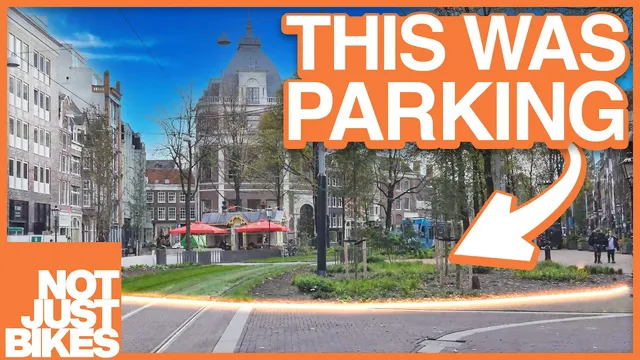
Why Amsterdam is Removing 10,000 Parking Spaces
Based on Not Just Bikes's video on YouTube. If you like this content, support the original creators by watching, liking and subscribing to their content.
Amsterdam’s 10,000-space goal targets on-street parking specifically, aiming to reclaim curb space for safer, more useful streets.
Briefing
Amsterdam’s plan to remove 10,000 on-street parking spaces by 2025 is already underway—and the city is treating parking as a traffic and safety problem, not a neutral convenience. The core idea is straightforward: street parking consumes scarce public space, increases crashes and congestion, and encourages driving by making car trips easier to complete. Amsterdam has been reducing curbside capacity through a mix of policy “attrition,” street redesigns, and targeted removals tied to construction and canal maintenance.
The push is politically and culturally contentious because drivers often expect cheap or free parking everywhere. Even in a city where only about 40% of households have a car, streets can look dominated by parked vehicles—meaning a minority of residents consume a majority of public curb space. That curb space also creates predictable hazards: parked cars reduce sightlines at side streets, and drivers pulling out of parking spots add conflict points for everyone else, including cyclists who face serious injury risk from door openings. On top of safety issues, street parking disrupts traffic flow, and on commercial streets the “parking is needed for business” argument doesn’t hold up well—most shops have room for only a couple of cars, and turnover rates and revenue potential rarely match the scale of the space being surrendered.
Amsterdam’s approach starts with permitting rules. Each on-street space requires a permit, so when residents sell cars or move away, the city doesn’t automatically replace permits. That “attrition” method frees roughly a thousand spaces per year, but it’s not fast enough to hit the 10,000 target. To accelerate reductions, the city is rebuilding streets with fewer parking spots whenever construction happens. One example in Amsterdam South is a redesign that will make cycling safer while cutting about 140 parking spaces on a relatively busy corridor. Other projects remove parking for practical reasons, including canal wall maintenance: removing heavy loads on canal edges can extend the life of old structures, and Amsterdam has already removed parking along some canal sections with a longer-term goal of eliminating car parking along canal areas in the city center.
Not every experiment sticks. A 2019 trial that removed parking on one street and replaced it with temporary planters and bike parking depended on resident buy-in; the street later reverted. But a broader neighborhood removal along the Frans Halsstraat and nearby streets used the freed space for trees, greenery, bicycle parking, and small public amenities, with plans for a permanent redesign.
A major twist is where the cars go. In one case, 300 on-street spaces were removed and replaced by a multi-level parking garage built under a canal, with capacity for 600 cars and many electric charging spots. The goal still counts as removing on-street parking, but it raises a concern: off-street parking can increase driving by making car trips feel more reliable. That matters because Amsterdam’s city center is not fully pedestrianized; cars remain widely allowed, and weekend traffic into the canal ring often comes from people shopping—enabled by large park-and-ride garages.
So far, Amsterdam has removed over 4,000 on-street spaces, and the city expects the number to climb as construction finishes. The changes are framed as incremental but meaningful: less curbside parking means safer, more inviting streetscapes, even if it isn’t a complete solution on its own.
Cornell Notes
Amsterdam is removing 10,000 on-street parking spaces by 2025 by treating curb parking as a driver of congestion, crashes, and inefficient land use. The city reduces parking through permit “attrition” (no replacement permits when residents leave), then speeds up reductions by rebuilding streets with fewer spaces and by removing curb parking for canal maintenance. Some trials rely on resident support and can be reversed, but neighborhood-wide redesigns have produced large improvements in street comfort and cycling safety. A key complication is that removed on-street spaces can be replaced by off-street garages, which may increase driving by making parking more reliable—so the policy’s traffic effects depend on where cars are redirected.
Why does Amsterdam treat street parking as a safety and traffic problem, not just a convenience?
How does the city’s “attrition” method work, and why isn’t it fast enough alone?
What kinds of construction projects help Amsterdam remove parking more quickly?
Why do some parking-removal trials fail or get reversed?
Where do removed cars go, and what trade-off does that create?
How does Amsterdam’s limited pedestrianization affect the impact of parking policy?
Review Questions
- What mechanisms does Amsterdam use to reduce on-street parking, and how do they differ in speed and political friction?
- How can removing curb parking lead to more driving if off-street garages expand capacity?
- Which street-safety mechanisms are linked to curbside parking, and how do they affect cyclists and drivers differently?
Key Points
- 1
Amsterdam’s 10,000-space goal targets on-street parking specifically, aiming to reclaim curb space for safer, more useful streets.
- 2
Street parking concentrates public space use among a minority of car-owning households, even when many residents don’t drive.
- 3
Curbside parking increases crash risk by blocking sightlines at side streets and adding conflict when drivers pull out or open doors.
- 4
Permit “attrition” gradually removes spaces when residents leave, but it frees only about 1,000 spaces per year—so construction-led redesigns are needed to accelerate progress.
- 5
Amsterdam removes parking during street reconstructions and canal-related maintenance, tying curb changes to safety and infrastructure needs.
- 6
Neighborhood-wide redesigns can replace cars with trees, greenery, bicycle parking, and public amenities, but temporary trials may be reversed without resident buy-in.
- 7
Redirecting cars into off-street garages can undermine traffic goals by making car trips feel more reliable, even while on-street spaces are reduced.