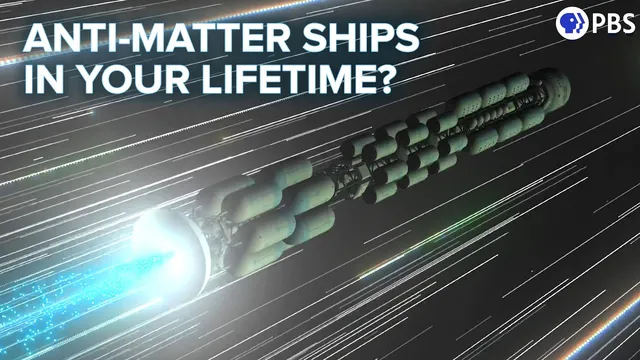
Why Antimatter Engines Could Launch In Your Lifetime
Based on PBS Space Time's video on YouTube. If you like this content, support the original creators by watching, liking and subscribing to their content.
Antimatter annihilation releases energy through E=mc^2, but rocket thrust requires momentum exchange, not just energy output.
Briefing
Antimatter propulsion is still far from “warp drive,” but the path to the first practical antimatter-powered spacecraft may be shorter than many assume—especially for unmanned missions—because antimatter’s energy density is unmatched and recent advances have made trapping and handling anti-particles less speculative. The central constraint isn’t physics so much as logistics: producing and storing enough antimatter fast enough remains the bottleneck, with current production rates implying centuries to millennia before meaningful fuel quantities are available.
The groundwork starts with why antimatter exists at all. In a universe governed by the symmetries of quantum physics, matter and antimatter are essentially mirror images: charge-reversed and time-reversed versions of the same underlying particles. That symmetry allows pair production from vacuum—creating a particle and its antiparticle together—while the reverse process, annihilation, converts mass into energy via E=mc^2. The catch is that “pure energy” is a misconception. Annihilation energy often ends up partly locked into new massive particles, and even when it becomes photons, propulsion needs momentum, not just energy. High-energy photons carry less momentum per unit energy and are difficult to direct efficiently, pushing designs toward using more massive anti-particles or capturing annihilation products in ways that can generate thrust.
Heavier antimatter species are the key to making propulsion practical, but they’re hard to produce and even harder to store. Anti-protons and antineutrons were discovered in stages (anti-protons in 1955; antineutrons soon after), followed by increasingly complex anti-nuclei such as anti-deuterium, anti-tritium, antihelium-4, and even anti-hyperhydrogen-4. These are typically created in high-energy collisions, meaning they start fast and randomly directed. Facilities such as CERN’s Antiproton Decelerator slow them down, but containment is the tougher problem: any contact with normal matter triggers annihilation, so “containers” must be non-material—force fields.
Charged antimatter can be held with electromagnetic traps like Penning traps, where electric fields confine along one axis and magnetic fields prevent radial drift. Yet charged particles repel each other, making dense storage impractical. A workaround is to form anti-hydrogen by trapping positrons and antiprotons together, then using magnetic minimum traps to confine neutral anti-atoms. Even then, trapping is inefficient and requires extreme cooling—on the order of 1 Kelvin or colder. The ALPHA collaboration has held 112 anti-atoms for durations from fractions of a second up to about 1,000 seconds, demonstrating feasibility but not long enough for interstellar travel.
Once anti-hydrogen is available, propulsion concepts broaden. Hydrogen–antihydrogen annihilation yields gamma rays and neutrinos, but it also produces complex hadronic debris when protons and antiprotons annihilate through quark–antiquark interactions. Charged pions from these events could serve as a “working mass” in a pion rocket, while other energy could be converted into electricity to power ion-like thrust systems. For near-term mission timelines, the most plausible route may be hybrid propulsion: using antimatter in microgram-scale amounts to catalyze nuclear fission or fusion in smaller, more manageable nuclear pulse systems. One proposal suggests such antimatter-catalyzed designs could reach the Oort cloud in roughly a decade, though the timeline depends on producing enough antimatter.
The final reality check is production. At today’s rates, generating the needed antimatter fuel could take centuries to millennia, though scaling up dedicated antimatter colliders is one option. Another is harvesting antimatter in space: Earth’s magnetic environment can confine antiprotons and positrons created by cosmic-ray collisions, as observed by PAMELA. If that can be harnessed safely, it could reduce the dependence on Earth-based production. Crewed interstellar travel remains out of reach for most lifetimes, but the first unmanned antimatter-enabled launches may be within the realm of possibility—provided the supply problem is solved.
Cornell Notes
Antimatter propulsion is constrained less by fundamental physics than by the practical challenge of making and storing enough antimatter. Annihilation converts mass to energy through E=mc^2, but “pure energy” isn’t directly usable for thrust because propulsion requires momentum and many annihilation products (like photons and neutrinos) are hard to steer. Progress in trapping has moved from charged anti-particles in Penning traps to neutral anti-hydrogen in magnetic minimum traps; experiments such as those by BASE and ALPHA demonstrate storage of anti-atoms, though only for short times and with low efficiency. The most promising near-term path for missions in this century is antimatter-catalyzed nuclear pulse or hybrid propulsion, potentially using micrograms of antimatter to ignite smaller fission/fusion systems. Production rates remain the main holdup, with space-based harvesting of antiprotons in Earth’s radiation belts as a possible supplement.
Why does antimatter annihilation not automatically translate into “easy rocket fuel”?
What makes storing antimatter so hard, and what solutions exist?
How do experiments demonstrate antimatter containment progress?
What propulsion concepts use antimatter without relying solely on steering photons?
Why does antimatter-catalyzed nuclear pulse propulsion get attention for nearer-term missions?
What are the main realistic obstacles to antimatter-powered launches?
Review Questions
- What distinction between energy and momentum undermines the idea that annihilation products automatically make efficient thrust?
- How do Penning traps and magnetic minimum traps differ in what they confine and why temperature matters for anti-hydrogen?
- Why might antimatter-catalyzed nuclear pulse propulsion reduce spacecraft size compared with conventional nuclear pulse or fusion-only approaches?
Key Points
- 1
Antimatter annihilation releases energy through E=mc^2, but rocket thrust requires momentum exchange, not just energy output.
- 2
“Pure energy” from annihilation is misleading because annihilation often produces other massive particles and because many products (photons, neutrinos) are hard to direct for propulsion.
- 3
Charged antimatter can be confined with Penning traps, but repulsion between like charges makes dense storage difficult.
- 4
Neutral anti-hydrogen can be trapped using magnetic minimum traps based on its magnetic moment, but it demands extreme cooling (around 1 Kelvin or colder) and yields low capture efficiency.
- 5
Hydrogen–antihydrogen annihilation can produce charged pions that may be magnetically channeled for a pion rocket, while other energy can be converted into electricity for ion-like thrust.
- 6
The most plausible near-term antimatter mission concepts rely on antimatter-catalyzed nuclear fission/fusion or hybrid propulsion, potentially using micrograms of antimatter.
- 7
The main timeline limiter is antimatter production and storage rate; space-based harvesting of antiprotons/positrons in Earth’s magnetic environment is a potential supplement.