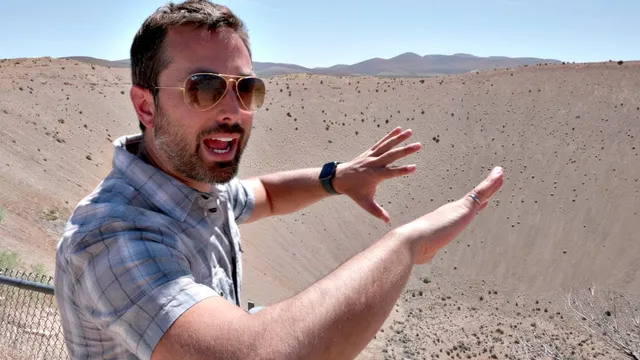
Why Apollo Astronauts Trained in Nuclear Bomb Craters
Based on Veritasium's video on YouTube. If you like this content, support the original creators by watching, liking and subscribing to their content.
Sedan Crater at the Nevada Test Site served as a high-fidelity training analog for meteor impacts because nuclear blasts reproduce impact-like shock pressures and crater excavation behavior.
Briefing
Apollo astronauts trained at a nuclear-bomb crater site because the Nevada Test Site produced a rare, controllable stand-in for meteor impacts—complete with the same kinds of shock effects and crater-forming mechanics. That mattered because the Moon is cratered, and recognizing the right rocks and minerals on arrival depended on understanding what impact processes leave behind.
The training ground was Sedan Crater, excavated in 1962 at the Nevada Test Site, a desert range used for nuclear weapons testing. The U.S. carried out 928 nuclear explosions there, and from 1965 onward the program hosted Apollo training with spacesuit mock-ups, TV cameras, and even a lunar roving vehicle mock-up. Over seven years, 11 of the 12 men who would later walk on the Moon visited the site.
The “obvious” reason—cratered terrain—was only part of the logic. Other crater fields existed, including Barringer Crater in Arizona, whose impact origin was disputed until the 1960s, and an Arizona site where conventional explosives recreated lunar-like crater patterns near the Apollo 11 landing area. Nevada offered something extra: a nuclear blast crater that closely mimicked the physics of an impact.
Sedan Crater was created by drilling 635 feet (194 meters) down and detonating a 104-kiloton device, releasing energy roughly eight times the TNT yield of the Hiroshima bomb. The explosion excavated about 12 million tons of rock and dirt, forming a crater about 400 meters across and nearly 100 meters deep—described as the largest man-made crater in North America. The blast was part of “Plowshare,” an initiative that explored whether nuclear explosives could serve as a powerful, compact excavator for large construction projects. That broader goal faded once radioactive contamination proved difficult to manage, but the crater remained a high-fidelity analog for impact geology.
Meteor impacts don’t simply “push dirt aside” mechanically. At typical impact speeds of 10 to 20 kilometers per second, the collision creates an extremely hot, high-pressure region that melts and vaporizes rock, then drives a shockwave that transforms minerals. As the high-pressure zone decompresses, an outward explosion-like event excavates the crater, which is why impact craters tend to be circular. Nuclear detonations generate comparable shock conditions, so the Nevada craters provided evidence that Barringer Crater was truly impact-made.
Scientists compared samples from Sedan and Barringer and found matching shocked minerals such as coesite, a quartz form only produced under extreme pressure. Similarities also helped estimate impact energy at around 10 megatons. Another shared signature was “inverted stratigraphy”—layers of rock turned over at the crater rim—useful for teaching astronauts where to look and what to collect.
That training fed directly into Apollo science. Astronauts spent about a quarter of their final year before launch studying geology and visiting sites like Sedan. On the Moon, they recognized rocks and minerals they had practiced identifying, and those samples later underpinned major conclusions. Apollo 11 returned lunar regolith that raised concerns about spontaneous ignition when exposed to oxygen, but it remained stable. Among the samples, scientists identified anorthosite, supporting the idea that the early Moon had a deep magma ocean and that anorthosite crystallized and floated to form a primordial surface. Isotope comparisons between Moon rocks and Earth rocks pointed to a shared origin from a giant impact roughly 4.5 billion years ago. With under 400 kilograms of lunar material from the Moon’s near side, the crater training helped turn field recognition into planetary-scale evidence.
Cornell Notes
Apollo astronauts trained at Sedan Crater in Nevada because a nuclear blast crater can mimic key features of meteor impacts. The blast produced shock effects and crater mechanics—such as shocked minerals (e.g., coesite) and inverted stratigraphy—that help geologists know what to look for. Sedan Crater was created in 1962 by detonating a 104-kiloton device 635 feet underground, excavating about 12 million tons of material and forming a crater roughly 400 meters wide. Scientists used the same kind of evidence to confirm that Barringer Crater was impact-made. That training later supported Apollo’s sample collection and helped drive findings like anorthosite’s link to a magma-ocean early Moon and isotope similarities between Earth and Moon.
Why does a nuclear-bomb crater resemble a meteor impact crater more than a typical crater field?
What specific geological “tells” did scientists use to link nuclear craters to real impacts?
How was Sedan Crater created, and what scale did it reach?
What was “Plowshare,” and why did it end?
How did crater training connect to Apollo’s lunar discoveries like anorthosite?
Review Questions
- What physical sequence during a meteor impact leads to crater excavation, and why does that make nuclear detonations a useful analog?
- How do shocked minerals like coesite and features like inverted stratigraphy help confirm an impact origin?
- What do isotope similarities between Earth and Moon rocks imply about the Moon’s formation, and how did Apollo samples enable that conclusion?
Key Points
- 1
Sedan Crater at the Nevada Test Site served as a high-fidelity training analog for meteor impacts because nuclear blasts reproduce impact-like shock pressures and crater excavation behavior.
- 2
Apollo astronauts trained there extensively, including field practice with spacesuit mock-ups, TV cameras, and a lunar roving vehicle mock-up; 11 of 12 future Moon walkers visited over seven years.
- 3
Sedan Crater was formed in 1962 by detonating a 104-kiloton device 635 feet underground, excavating about 12 million tons of material and creating a crater roughly 400 meters wide.
- 4
Scientists validated the impact analogy by comparing nuclear-test and impact craters and finding matching shocked minerals such as coesite and shared crater signatures like inverted stratigraphy.
- 5
Apollo’s geology training helped astronauts recognize relevant rocks on the Moon, improving the quality of returned samples used for major conclusions about lunar history.
- 6
Anorthosite in Apollo 11 samples supported the idea that the early Moon had a deep magma ocean, with anorthosite crystallizing and floating to form a primordial surface.
- 7
Isotope measurements in lunar rocks matched Earth’s isotopic patterns, strengthening the giant-impact origin theory for the Earth-Moon system.