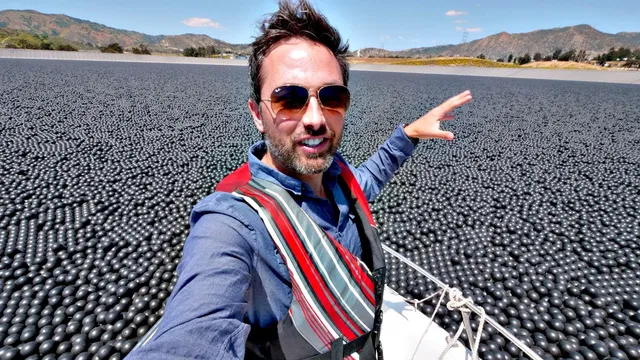
Why Are 96,000,000 Black Balls on This Reservoir?
Based on Veritasium's video on YouTube. If you like this content, support the original creators by watching, liking and subscribing to their content.
Shade balls were adopted to stop sunlight from driving bromide-to-bromate formation in an open reservoir, after bromate levels spiked between filtration and a customer.
Briefing
Los Angeles’ drinking-water reservoir is covered with about 96 million black “shade balls,” and their job is far more than cutting evaporation. The balls were adopted after a chemistry problem emerged: bromide already present in the water can turn into bromate—a carcinogenic byproduct—when disinfected and exposed to sunlight. When bromate levels spiked between the filtration plant and a beverage-company customer, operators traced the jump to the open reservoir itself, where bromide plus chlorine under bright light formed bromate even more than ozone did. The practical fix became clear: remove sunlight from the water surface.
The balls work by blocking light and doing it reliably for years. They’re made from high-density polyethylene, the same plastic family as a milk jug, but stabilized with carbon black pigment so they last at least a decade in direct sun. Other colors were tested; blue dyes degraded too quickly to guarantee long-term performance. Safety concerns about heat and leaching were addressed by treating the material as inert and food-grade—cutting or chewing a piece was described as posing no harm.
The “shade” approach also solved a second water-quality headache: algae. With sunlight blocked, algae discoloration that previously required heavy chlorine dosing largely disappeared. Operators said they used to rely on much more chlorine—sometimes half the system’s chlorine—just to control algae growth, but after deployment they added chlorine only rarely.
Evaporation reduction was the third major payoff, and it runs counter to first impressions. Black plastic might seem like it would absorb energy and speed evaporation, but the reservoir’s open surface area and constant airflow already drive water loss. Under the balls, the top surfaces warm while the bottoms stay cooler; the balls also trap air, acting like insulation similar to a double-paned window. Measurements reportedly found the water under the balls cooler than the water exposed to sun alone. Taken together, the system reduces evaporation by roughly 80–90%, a meaningful gain for a dry climate.
The balls are engineered for stability in wind. They’re partially filled with water so they don’t bounce out of the reservoir during high winds; the water inside also makes them wobble rather than scatter. That design creates a practical challenge for visitors and staff: boats can pull some balls along in the wake, and driving through the dense “crystal-like” packing is difficult—described as moving through something like peanut butter.
Cost and economics were also part of the decision. Each ball costs on the order of a few cents (around 33–34 cents reported), with recycling value at end of life. Operators argued that savings from reduced evaporation and reduced chemical use would offset at least half the purchase cost over the balls’ lifespan, while the bromate and algae benefits were treated as non-negotiable.
Even so, the balls’ presence has sparked curiosity and imitation—people have proposed hexagonal alternatives—but the round shape helps prevent perching on reservoir edges as water levels rise and fall, keeping coverage even.
Cornell Notes
Los Angeles’ reservoir uses roughly 96 million black “shade balls” to protect drinking water from sunlight-driven chemistry. Bromide naturally present in the water can become bromate, a carcinogen, when disinfected and exposed to bright light in an open reservoir. Operators found bromate levels jumped after filtration, so they removed sunlight by covering the surface with high-density polyethylene balls containing carbon black for long-term light blocking. The shade also suppresses algae, reducing chlorine needs, and it cuts evaporation by about 80–90% despite the balls being black—because trapped air insulates and the water beneath stays cooler. The balls are partially filled to resist wind-driven bouncing, making them stable but hard to navigate through.
What problem forced the reservoir to cover its surface with shade balls?
Why are the balls black, and how is long-term performance ensured?
How do shade balls reduce evaporation without overheating the water?
What other water-quality benefit came from blocking sunlight?
How do the balls stay put in high winds, and what does that mean for navigation?
How were costs justified beyond the evaporation and algae benefits?
Review Questions
- What chemical pathway turns bromide into bromate, and why does sunlight matter in the reservoir setting?
- Explain why black shade balls can reduce evaporation even though they absorb sunlight.
- What design choices (material, pigment, partial water fill, shape) address both water-quality goals and physical stability?
Key Points
- 1
Shade balls were adopted to stop sunlight from driving bromide-to-bromate formation in an open reservoir, after bromate levels spiked between filtration and a customer.
- 2
Carbon black in high-density polyethylene provides long-lasting light blocking (about a decade) and outperformed unstable colored dye alternatives.
- 3
Blocking sunlight also suppresses algae, cutting chlorine demand and preventing greenish discoloration seen during earlier algae outbreaks.
- 4
Evaporation drops by roughly 80–90% because trapped air insulates and the water beneath stays cooler, despite the balls’ black surfaces.
- 5
Balls are partially filled with water to prevent wind-driven bouncing and scattering, improving coverage stability.
- 6
Navigation through the densely packed balls is difficult because they resist displacement and can move as a group in a boat’s wake.
- 7
Cost calculations include reduced chemical use and evaporation savings, plus recycling value at end of life.