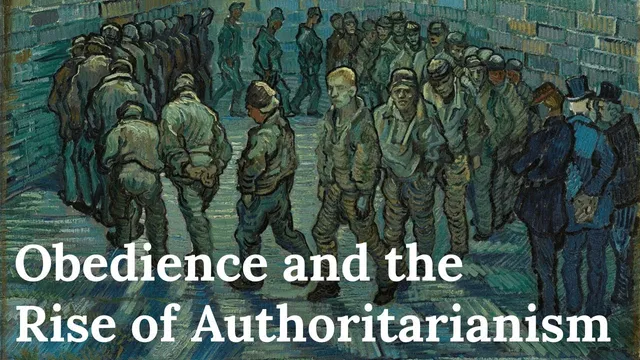
Why are Most People Cowards? | Obedience and the Rise of Authoritarianism
Based on Academy of Ideas's video on YouTube. If you like this content, support the original creators by watching, liking and subscribing to their content.
Authoritarianism is portrayed as spreading through conformity driven by anxiety and powerlessness, not necessarily through explicit support for tyranny.
Briefing
Western societies are drifting toward authoritarianism less because citizens explicitly endorse tyranny and more because widespread anxiety and powerlessness push people into conformity—an obedience that crowds out courage. The central claim is that when social validation becomes the highest value, moral judgment gets replaced by rule-following, and “ethics” starts to mean compliance. In that environment, authoritarian control can expand quickly: governments gain leverage, dissent is framed as immorality, and majorities rationalize coercion as protection of social norms.
Rollo May’s warning from 1953—describing “automaton conformity”—is used to explain why obedience becomes a moral substitute. The transcript argues that many people treat legality as morality and assume that being “good” means doing what authority demands, even when those rules are corrupt or destructive. Independent judgment threatens the conformist’s sense of self, so nonconformity is experienced as a personal threat rather than a legitimate ethical alternative. Stanley Feldman’s research is brought in to connect social conformity with political repression: when conformity is valued, people become more willing to support government efforts to restrict behavior and punish those who deviate from norms.
That dynamic is framed as a psychological continuum of destruction, drawing on Ervin Staub’s work. As coercion targets a noncompliant minority, the majority devalues victims and justifies their suffering—often by portraying them as evil or as obstacles to “higher ideals.” The transcript lists historical examples where early discrimination and exclusion in public life escalated into curfews, job loss, fines, restricted movement, mass scapegoating, mass imprisonment, and mass murder—citing the Soviet Union, Turkey, Germany, Cambodia, and China.
The proposed antidote is not institutional tinkering but moral courage: the willingness to accept risk in order to defy immoral orders and stand for truth, freedom, and justice. Rushworth Kidder is used to distinguish courage from comfort—courage becomes real when hazard is involved, whether the cost is ridicule and ostracism or something far harsher like job loss, imprisonment, or death. The transcript emphasizes that courage often requires standing alone on convictions, especially when social pressure makes silence feel safer.
To make that abstract psychology concrete, the narrative turns to Viktor Pestov, a 20-year-old in the Soviet Union in 1967. Despite his family’s privileged position—his mother was a high-ranking KGB official—Pestov helped form a clandestine group called “Free Russia” after Soviet tanks crushed the Prague Spring. He and his brother distributed pamphlets exposing regime lies, warning recruits they would likely be arrested. In 1970 Pestov was arrested, sentenced to five years in a Soviet prison camp; his mother lost her KGB job and was barred from working in Russia again.
The closing warning ties courage to political trajectory: without enough people renouncing conformity and resisting tyranny, Western societies may reach what Ayn Rand called “the stage of the ultimate inversion,” where government can do anything it pleases while citizens act only by permission—rule by brute force rather than consent.
Cornell Notes
The transcript argues that authoritarianism spreads when anxiety and powerlessness drive people into hyper-conformity, replacing moral judgment with obedience to rules. Social validation—amplified by social media—and education that elevates majority rights over individual rights are presented as forces that make compliance feel like virtue. Drawing on Rollo May, Feldman, and Ervin Staub, it links conformity to repression: majorities support coercion, dehumanize nonconformists, and rationalize escalating harm. The antidote is moral courage—risking social or physical consequences to defy immoral orders and stand for truth, freedom, and justice. Viktor Pestov’s anti-Soviet activism illustrates how courage can cost everything yet still contribute to pushing tyrants out of power.
Why does the transcript treat obedience as a moral danger rather than a civic virtue?
How does social conformity translate into government repression, according to the transcript?
What psychological mechanism helps explain escalation from discrimination to mass violence?
What does “moral courage” mean in practical terms, and what kinds of risks does it include?
How does Viktor Pestov’s story function as an example of the transcript’s theory?
What final political warning does the transcript attach to the lack of courage?
Review Questions
- What conditions does the transcript say make obedience feel like morality, and why does that matter for authoritarian growth?
- According to the Staub-based “continuum of destruction,” how do people psychologically reconcile harming others with a belief in justice?
- How does the transcript distinguish moral courage from ordinary endurance, and what examples of risk does it use?
Key Points
- 1
Authoritarianism is portrayed as spreading through conformity driven by anxiety and powerlessness, not necessarily through explicit support for tyranny.
- 2
When social validation becomes central, rule-following can replace moral reasoning, making obedience feel like virtue.
- 3
Conformity-based values can increase public support for government restrictions and punishment of nonconformists.
- 4
A psychological escalation mechanism—devaluing victims and justifying their suffering—helps explain how discrimination can grow into mass violence.
- 5
Moral courage is defined as accepting risk to defy immoral orders and stand for truth, freedom, and justice.
- 6
Viktor Pestov’s anti-Soviet activism illustrates how courage can require clandestine action and lead to imprisonment and family consequences.
- 7
Without widespread moral courage, societies may drift toward a permission-based political order where citizens lose meaningful agency.