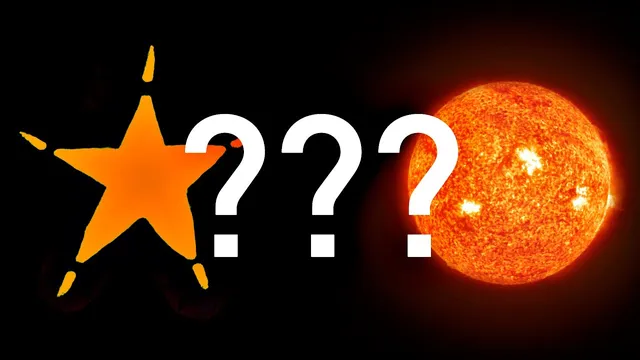
Why are Stars Star-Shaped?
Based on minutephysics's video on YouTube. If you like this content, support the original creators by watching, liking and subscribing to their content.
Stars look pointy because diffraction turns a point source into a geometry-dependent interference pattern.
Briefing
Stars look like round, hot plasma balls in reality, yet people routinely sketch them with sharp points. The mismatch comes down to how light behaves on the way to the eye: diffraction turns a distant point source into a patterned “smear” that often resembles a multi-point star.
When light from a faraway object passes through an opening or around an obstacle, it doesn’t travel as a perfectly straight ray. Instead, its wavefront bends and spreads, and the resulting waves interfere. That interference pattern carries an imprint of the geometry involved. A simple slit produces a set of evenly spaced bright and dark bands—like a row of dashes when you squint. A cross yields two perpendicular dash patterns; circles create concentric rings; squares generate a four-pointed, dashed star; hexagons produce six-pointed stars. Even the famous double-slit setup creates its own characteristic series of dashes. The key idea is that the “shape” seen around a point of light is not the star’s shape—it’s the diffraction pattern of the aperture or obstruction the light encountered.
This effect shows up in real instruments. The Hubble Space Telescope has four struts supporting its secondary mirror, and those structures imprint a four-pointed star pattern in Hubble images. The same logic applies to the human eye. The lens contains subtle structural imperfections where its fibers meet, called suture lines. As light passes by these features, they impose a consistent diffraction imprint. Researchers have confirmed the phenomenon by shining lasers into people’s eyes, finding that the resulting starlike smear matches the eye’s internal structure.
Because diffraction depends on fine details, every eye produces a slightly different starlike smear. Even the left and right eyes of the same person can differ. Yet within a single eye, the pattern stays stable for different stars, which is why it’s scientifically acceptable to draw “star” symbols—provided that multiple stars in one picture share the same point pattern.
Color adds another layer. Diffraction spreads longer wavelengths more than shorter ones, so the arms of the star-shaped diffraction pattern act like tiny “mini-rainbows.” Red light tends to appear on the outside of each arm, while blue sits closer to the center. That means the familiar rainbow tint around bright points in telescope images isn’t artistic license; it’s the wavelength-dependent diffraction signature, as long as the color ordering is correct.
Cornell Notes
A distant star is effectively a point source, but diffraction reshapes that point into a star-like pattern. Light waves bend around openings and obstacles, and interference imprints the geometry of the aperture or obstruction onto the image. Hubble’s four supporting struts create the telescope’s characteristic four-pointed stars, and the human lens’s suture lines produce a consistent starlike smear on the retina. Each eye has its own diffraction pattern, so different eyes can see slightly different “star shapes,” while a single eye sees the same pattern for all stars. Wavelength-dependent diffraction also creates mini-rainbows in the arms, with red on the outside and blue toward the center.
Why do stars drawn with points appear “wrong” but still make sense scientifically?
How does the geometry of an opening or obstacle determine the number of star points?
What specific telescope feature explains the four-pointed stars in Hubble images?
What in the human eye creates the starlike smear seen on the retina?
Why can two eyes see different star shapes, yet one eye sees the same pattern for all stars?
Why do the star arms show rainbow-like colors, and which colors go where?
Review Questions
- If a telescope’s aperture changed from a square-like to a hexagon-like shape, what change would you expect in the diffraction pattern around a point source?
- How would you justify drawing multiple stars in one picture with identical point patterns, based on diffraction and eye structure?
- What wavelength-dependent rule determines whether red appears on the outside or inside of the star arms?
Key Points
- 1
Stars look pointy because diffraction turns a point source into a geometry-dependent interference pattern.
- 2
Light waves bending around openings or obstacles carry an imprint of that geometry into the final image.
- 3
A slit, cross, circle, square, and hexagon produce distinct dash/ring/star diffraction signatures tied to symmetry.
- 4
Hubble’s four supporting struts for its secondary mirror create the telescope’s characteristic four-pointed star patterns.
- 5
Human lens suture lines impose their own diffraction imprint, confirmed by laser experiments into people’s eyes.
- 6
Each eye has a slightly different diffraction pattern, but a single eye produces the same starlike smear for different stars.
- 7
Wavelength-dependent diffraction makes the star arms act like mini-rainbows, with red on the outside and blue toward the center.