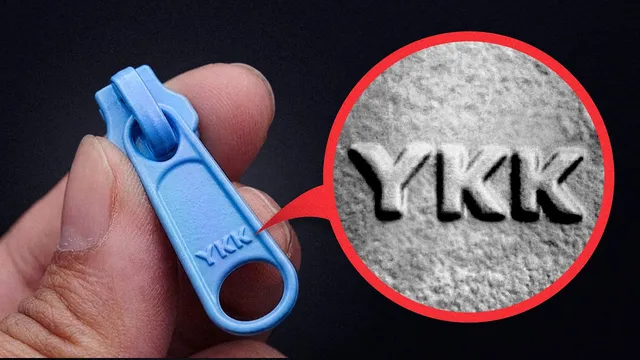
Why are these 3 letters on almost all of my zippers?
Based on Veritasium's video on YouTube. If you like this content, support the original creators by watching, liking and subscribing to their content.
Sundback’s zipper works because the slider’s Y-shaped cavity tilts and wedges teeth into alignment, making closure effortless.
Briefing
Zippers work because a carefully engineered slider forces misaligned teeth into alignment—then uses a shaped internal “wedge” to separate them again—turning what should be a stubborn mechanical problem into a smooth, one-pull action. That core insight traces back to Gideon Sundback’s 1914 breakthrough: two rows of teeth shaped to be wider at the closing end, paired with a Y-shaped cavity in the slider that tilts the teeth into place as the zipper closes and wedges them apart as it opens. The result is effortless motion for the user, but with a tradeoff: the zipper can never be fully closed at the very top because the wedge must remain between the teeth.
Before Sundback, the dominant fasteners were hooks, eyes, laces, and buttons—effective but slow because each closure had to be handled individually. Whitcomb Judson, an American engineer, tried to automate the process with a Universal Fastener Company device showcased at the 1893 Chicago World’s Fair. Investors backed it, but the design jammed, rusted, and required removal for washing; one misplaced hook or eye could destabilize the whole mechanism, so a simple bend could pop it open. The company limped along until Sundback joined in 1906 and eventually abandoned the old approach after years of tinkering.
Sundback’s modern zipper wasn’t just a clever tooth shape—it depended on manufacturing engineering. His process started with Y-shaped wire made from a nickel alloy, then sliced it into teeth and stamped matching “scoop” and “nib” features. The teeth were clamped onto fabric tape, which later gets stitched into garments. Precision spacing mattered: for teeth to unpair, they need enough room for neighboring nibs to pop out. Because the machines placed teeth so tightly, the zipper stayed strong and resistant to accidental separation. Still, the design had a vulnerability: if a single tooth falls off, the spacing can allow a cascading failure where adjacent teeth unseat and the zipper can pop open.
As the product matured, it spread through niche applications—money belts, tobacco pouches, and especially rubber boots—helped by B.F. Goodrich’s early 1920s zipper boots. The success of those boots helped “zipper” become the generic term for the fastener itself. Later, Talon improved durability by simplifying parts and using rust-resistant nickel alloy, enabling zippers to stay on through washing (with the practical advice to zip items before laundering to prevent snagging).
Even with widespread adoption, the zipper’s dominance wasn’t guaranteed. Sundback’s original patent expired in 1934, opening the market. That year, Japanese businessman Tadao Yoshida founded YKK, which rebuilt after wartime destruction and imported and improved US zipper-making machinery. By emphasizing quality and manufacturing at scale, YKK surpassed Talon around 1980 and grew to roughly 45% global share by the early 2000s, with sales exceeding 10 billion zipper units annually.
Today’s zippers still largely follow Sundback’s architecture, but variations address specific needs: coil zippers made from molded plastic loops became common from the 1940s onward, especially on suitcases and backpacks, and they avoid single-tooth cascade failures. Locking mechanisms—often found on more than half of zippers in one sample—prevent worn sliders from unzipping on their own. The enduring lesson is that the zipper’s “genius” isn’t novelty; it’s a rare combination of tooth geometry, slider mechanics, and manufacturable precision that solved the problem once—and kept solving it.
Cornell Notes
Zippers became reliable and easy to use when Gideon Sundback redesigned both the teeth and the slider. His 1914 approach uses two rows of teeth shaped so they resist closing unless guided, while a Y-shaped cavity in the slider tilts and wedges the teeth into alignment for smooth zipping and separation for unzipping. The design depends on precise manufacturing: tightly spaced teeth prevent accidental unpairing, though losing a single tooth can trigger a cascading failure. After Sundback’s patent expired in 1934, YKK rose to dominate global production through scale, quality focus, and improved machinery. Modern variants like coil zippers and locking mechanisms further reduce failure modes and address wear.
Why does pushing on a zipper from above feel stuck, but pulling the tab makes it “buttery smooth”?
What tradeoff comes with Sundback’s wedge-in-slider mechanism?
How did Sundback’s manufacturing approach make the zipper strong?
What failure mode can still make a zipper pop open?
How did YKK end up dominating zippers even though Talon had early success?
Why do coil zippers reduce the risk of cascade failures?
Review Questions
- What specific role does the Y-shaped cavity in the slider play during zipping and unzipping?
- Why does precise tooth spacing matter for zipper strength, and what happens when one tooth is lost?
- What combination of patent timing, manufacturing scale, and quality strategy helped YKK surpass earlier leaders like Talon?
Key Points
- 1
Sundback’s zipper works because the slider’s Y-shaped cavity tilts and wedges teeth into alignment, making closure effortless.
- 2
The wedge must stay between teeth, so a zipper can’t be fully closed at the very top end.
- 3
Zipper strength depends on precise manufacturing spacing; tight spacing prevents teeth from unpairing under normal stress.
- 4
A single missing tooth can trigger a cascading failure where neighboring teeth loosen and the zipper pops open.
- 5
After Sundback’s 1934 patent expired, YKK scaled production and emphasized quality, eventually surpassing Talon as the world’s biggest zipper maker.
- 6
Coil zippers use interconnected plastic loops, reducing the chance of single-tooth cascade failures and improving flexibility for luggage and backpacks.
- 7
Locking mechanisms help prevent worn sliders from unzipping on their own by physically lodging the slider in place until the pull tab is moved.