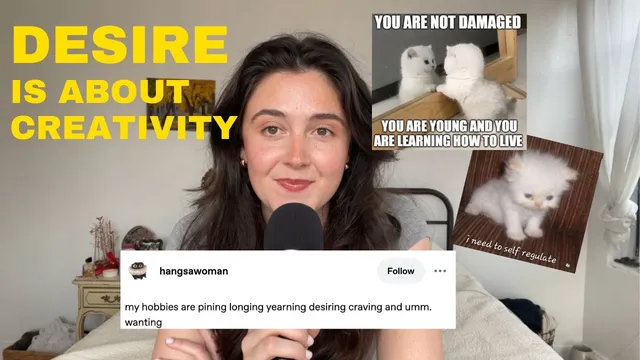
why are we afraid of LOVE? 🥀reflecting on creativity + eros 🌹
Based on Anna Howard's video on YouTube. If you like this content, support the original creators by watching, liking and subscribing to their content.
Erotic energy (“aeros”) is framed as life force and creative power, not merely sexual desire to be managed or feared.
Briefing
Love and eros aren’t treated as life-giving forces so much as distractions that can derail work, self-worth, and day-to-day presence. The core claim tying the episode together is that erotic energy—Audre Lorde’s “aeros,” the life force behind creativity and desire—doesn’t have to be feared or pathologized. When romantic obsession (including limerance) hijacks attention, the antidote isn’t self-punishment or endless self-diagnosis; it’s reclaiming that same intensity through art and creative practice.
The episode begins with a personal pivot: after a breakup, the host threw herself into New York City dating, chasing the rush of crushes and the “first moments” of attraction. That pursuit came at a cost—creative projects and even business marketing were sidelined. A ghosting experience becomes the turning point. A music producer she’d been corresponding with ghosted her after sending demos and asking her to write lyrics. The rejection triggered spiraling intrusive thoughts, but the lyric-writing itself also delivered something crucial: creative satisfaction. The moment she recognized that satisfaction, the story shifts from romance-as-ruin to romance-as-fuel.
Inspired by a producer’s advice on daily skill-building—one hour a day, every day—the host experiments with a similar structure for her own creative work. She dedicates one hour daily to restarting her podcast, explicitly aiming to transmute limerance-like obsession into something she controls. Limerance is defined as intrusive, melancholic thoughts driven by romantic longing and a desire for reciprocation; it steals attention from ordinary life. In her case, committing to the podcast quickly reduces the ghosting-related fixation. Instead of treating heartbreak as a problem to solve through “healing” perfectionism or detective work about attachment styles, she treats it as energy that can be redirected.
That redirection is reinforced by two critiques of mainstream relationship self-help. One comes from a TikTok creator arguing that limerance is bound up with art: obsessing over male validation often means abandoning creativity, and shaming oneself for heartbreak only deepens the spiral. The other comes from a Substack claiming attachment theory’s diagnostic categories function like moral judgments disguised as psychology—secure, anxious, avoidant, disorganized—encouraging people to police themselves inwardly. The episode doesn’t reject self-awareness; it objects to identity-labeling that hardens into “this is who I am,” making change harder.
From there, the episode broadens into a framework: creative energy and sexual/romantic energy are “two sides of the same coin,” both rooted in passion and the desire to bring something into existence. That overlap can confuse people into mistaking creative alignment for romance, or pouring life into a person at the expense of projects and community. The practical takeaway is to keep love and art working in tandem—using creativity to stay present when desire turns imaginative and obsessive.
The closing metaphor lands the point: limerance makes people “invent” scenarios in their heads and miss what’s right in front of them. Art helps reverse that—turning invention into seeing. Whether through writing, painting, or capturing the felt reality of love, creativity becomes a time capsule and a way to reclaim attention from longing, without denying the need for love itself.
Cornell Notes
The episode argues that erotic energy (eros/aeros)—the life force behind desire—shouldn’t be feared or treated as a defect. When romantic obsession turns into limerance, intrusive thoughts can crowd out daily life; the proposed fix is not self-shaming or endless self-diagnosis, but redirecting that intensity into creative practice. A personal example shows that dedicating one hour daily to restarting a sidelined podcast helped the ghosting-related fixation fade. The episode also critiques identity-labeling in attachment theory and frames limerance as closely tied to abandoning creativity and chasing validation. Overall, love and art are presented as compatible forces that can keep people present rather than stuck in imagination.
What does “aeros/erotic” mean in the episode’s framework, and why does it matter?
How does the episode define limerance, and what problem does it create?
What concrete strategy helped reduce the host’s limerance-like spiraling?
Why does the episode criticize attachment-style labeling and self-diagnosis?
How does the episode connect romantic intensity to creativity rather than romance-as-escape?
What does the “invent vs. see” metaphor add to the argument?
Review Questions
- How does the episode distinguish healthy self-awareness from harmful identity-labeling in attachment-style frameworks?
- What role does daily creative practice play in the episode’s explanation of limerance and recovery?
- Why does the episode claim that creative alignment can be mistaken for romance, and what does it recommend instead?
Key Points
- 1
Erotic energy (“aeros”) is framed as life force and creative power, not merely sexual desire to be managed or feared.
- 2
Limerance is characterized by intrusive, melancholic thoughts tied to romantic longing that steal attention from everyday life.
- 3
Redirecting obsession into a daily creative commitment (one hour a day) can reduce fixation and restore presence.
- 4
Self-shaming and “diagnose-and-police” approaches—especially identity labels like “anxious attachment”—can deepen spirals rather than help change.
- 5
Mainstream attachment categories are criticized as moral judgments disguised as psychology, encouraging inward surveillance and shame.
- 6
Creative energy and sexual/romantic energy are treated as overlapping forces; the intensity of alignment can be channeled into art rather than only into romance.
- 7
Love and art should work together: romance can be generative when it doesn’t require abandoning projects, community, or selfhood.