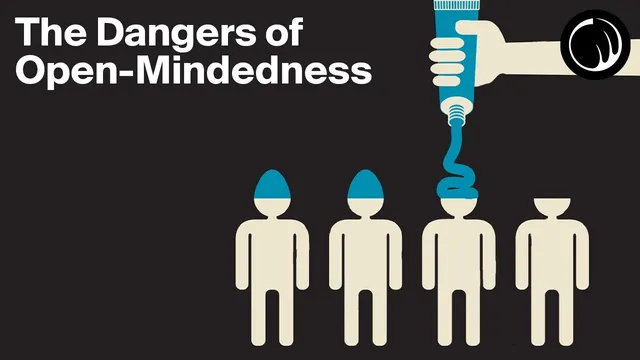
Why Being Open-Minded Is Ruining Your Life
Based on Pursuit of Wonder's video on YouTube. If you like this content, support the original creators by watching, liking and subscribing to their content.
Unlimited tolerance can enable intolerance to become dominant and destroy the conditions needed for tolerance to survive.
Briefing
Open-mindedness and tolerance are often treated as universal virtues—but unchecked, they can backfire badly by allowing intolerance, harm, and even violence to take over. A community thought experiment—an “antidiscrimination and tolerance” group that initially welcomes everyone—shows how quickly “inclusive” rules can be exploited when prejudiced members refuse to coexist and instead push others out. The central tension is simple: protecting a tolerant space sometimes requires setting limits on who gets to stay.
In the scenario, the group’s early meetings go well because members come from every major background. Then a faction starts openly disparaging others based on belief and identity. When organizers try to honor the mission by keeping everyone, the group’s internal culture deteriorates: more members leave, the intolerant faction demands exclusion of those who disagree, and the organization shrinks into a smaller, more hostile circle. Eventually the intolerant members escalate to threats and violence. The founders face a paradoxical choice—either enforce boundaries to preserve safety and cohesion, or keep “letting everyone in” until the tolerant mission collapses.
That dilemma is framed as the paradox of tolerance, first introduced by Austrian-British philosopher Karl Popper in 1945. The paradox holds that a society or organization that is completely tolerant may enable intolerance to become dominant, undermining the very goal of tolerance. The proposed resolution is not “tolerance for everything,” but “optimal tolerance” that includes degrees of intolerance toward those who would destroy the conditions for peaceful coexistence.
Yet the transcript stresses that the hard part isn’t the slogan—it’s the definitions. What counts as “intolerant”? What counts as “harm” or “threat”? Speech can be experienced as threatening even without explicit violence, and emotional distress can be real while still being difficult to measure. If emotional harm justifies restricting speech, who decides what qualifies as reasonable versus unreasonable distress? The discussion warns that this can slide into a slippery slope where subjective discomfort becomes a basis for censorship.
Popper’s own caution is cited: suppressing intolerant philosophies is unwise if they can be countered through rational argument and public opinion. Physical threats and violence are clearer triggers, but even then, groups may claim they are acting defensively based on their own perception of being attacked. That uncertainty is why democracies, governments, and enforcement agencies exist—to determine legitimate threats and justifiable responses—but the transcript argues that clarity is rarely complete and standards shift across time and cultures.
The paradox is then brought down to personal life. If someone stays so open-minded that they accept anything as fair, true, or acceptable, they can end up letting in beliefs and people that undermine their goals, values, and wellbeing. The message lands with a warning attributed to Walter M. Kotschnig: don’t keep minds so open that “your brains fall out.” Niceness, positivity, and tolerance are valuable, but they need boundaries—especially around how time, effort, and life direction are chosen—so that openness doesn’t become a lack of discernment.
Cornell Notes
The transcript argues that tolerance and open-mindedness can become destructive when treated as unlimited. A community thought experiment shows how a group meant to welcome everyone can be captured by intolerant members who push others out, eventually leading to threats and violence. This is linked to Karl Popper’s paradox of tolerance: a fully tolerant system may allow intolerance to dominate and destroy the conditions that make tolerance possible. The hardest challenge is deciding what counts as “intolerant,” “harmful,” or “threatening,” since even speech and emotional distress can be interpreted differently. The takeaway is that tolerance needs limits—both socially and personally—to protect safety, cohesion, and core values.
What does the “tolerance and antidiscrimination group” thought experiment demonstrate about unlimited inclusion?
How does Karl Popper’s paradox of tolerance connect to the scenario?
Why is defining “harm” or “threat” so difficult in practice?
What does Popper’s caution about suppression add to the discussion?
How does the transcript apply the paradox to individual life?
Review Questions
- What conditions, according to the transcript, justify limiting tolerance rather than extending it universally?
- Why does the transcript treat emotional distress from speech as a particularly complicated case for deciding what counts as harm?
- In the thought experiment, what specific sequence of events turns an inclusive group into an intolerant one?
Key Points
- 1
Unlimited tolerance can enable intolerance to become dominant and destroy the conditions needed for tolerance to survive.
- 2
A tolerant organization may need enforceable boundaries to prevent prejudiced members from pushing others out or escalating to violence.
- 3
The hardest part of applying tolerance limits is defining “intolerant,” “harm,” and “threat,” especially when harm is emotional or interpretive rather than physical.
- 4
Popper’s caution suggests suppression is especially risky when rational argument and public opinion can counter intolerant views.
- 5
Even when violence is involved, groups may claim they are acting defensively, so determining legitimate threats and justifiable responses remains uncertain.
- 6
On a personal level, excessive openness without discernment can allow harmful beliefs and relationships to undermine one’s goals and values.