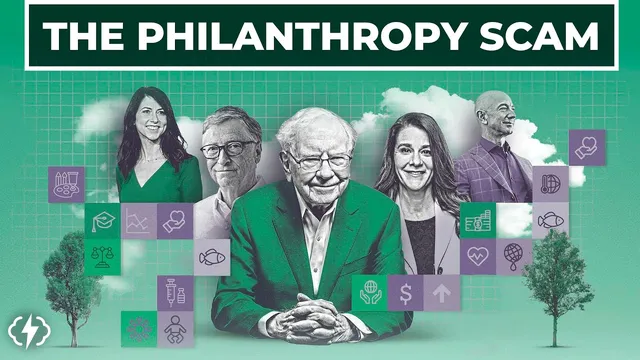
Why Billionaire Philanthropy Won't Solve Anything
Based on Second Thought's video on YouTube. If you like this content, support the original creators by watching, liking and subscribing to their content.
Charitable tax deductions can reduce the ultra-wealthy’s taxes far more than typical donors, shifting lost government revenue onto everyone else.
Briefing
Billionaire philanthropy functions less like charity and more like a reputation-management and tax-optimization system that drains public resources, keeps wealth concentrated, and shifts power away from democratic control. High-profile foundations can look like moral progress on the surface—especially when they rebrand wealthy industrialists as “saviors”—but the underlying incentives tie their giving to capitalism’s incentives rather than to public accountability.
The mechanism starts with how tax policy rewards large donations. Through charitable tax deductions, wealthy donors can reduce taxable income by giving to approved charities. For ordinary people, deductions typically cap around 60% of gross income, but the ultra-wealthy can use more favorable rules and non-cash assets—real estate, stock options, and capital gains—to cut taxes far more aggressively. The transcript cites research estimating that charitable deductions can reduce taxes by up to 74% for the ultra-rich, and it connects that to a major cost to everyone else: between 2010 and 2014, the public paid an estimated $246.1 billion in lost revenue tied to these deductions. The argument is that when the government collects less from billionaires, it either spends less on public goods or raises money elsewhere—meaning ordinary people effectively subsidize the “generosity” they’re told to admire.
Next comes where foundation money actually goes. Legal requirements for private foundations limit how much can be spent on charitable activities—often described as a minimum payout rate—so most funds are retained and invested. The transcript claims that only about 5% of money from major donors ends up in charitable work, while the rest goes into investment portfolios. Those portfolios, it argues, tend to mirror mainstream profit-seeking: holdings in fossil fuels, packaged food, mining, and weapons manufacturers. Even the “charitable” portion is framed as entangled with profit incentives—citing an example where the Gates Foundation held shares in Coca-Cola while also running a project training farmers in Kenya, with the claim that the training supported supply chains that benefited corporate profitability.
The third problem is political. Large donors decide where money flows and where it doesn’t, effectively creating a parallel decision-making system that bypasses democratic approval. If a billionaire funds charter schools or agricultural programs, local outcomes can be shaped by private priorities rather than public deliberation. The transcript acknowledges that government is imperfect, but argues that replacing public funding with private billionaire control is worse because it removes accountability and concentrates influence.
The conclusion ties these points together: philanthropy doesn’t dismantle the economic system that produces extreme inequality; it helps stabilize it. By laundering reputations, reducing taxes, investing in the same industries that benefit from inequality, and steering policy through private money, billionaire philanthropy becomes a tool for keeping capitalism running while presenting it as benevolent reform. The transcript closes by framing this as a “scam” that prolongs poverty rather than eliminating it, echoing a broader critique that charity offers partial relief without changing the structures that generate harm.
Cornell Notes
Billionaire philanthropy is portrayed as a system that converts concentrated wealth into public goodwill while preserving the underlying power and incentives of capitalism. The transcript argues that charitable tax deductions let the ultra-wealthy reduce taxes far more than typical donors, shifting the cost to everyone else through lost government revenue. It also claims that most foundation money is retained and invested rather than spent on direct aid, with investments often aligned with profitable industries. Finally, it argues that private donors gain outsized influence over policy and priorities without democratic accountability. Together, these dynamics make philanthropy look less like a cure for inequality and more like a mechanism that stabilizes it.
How do charitable tax deductions make billionaire giving cheaper for the donor and costlier for the public?
Why does the transcript claim most foundation money doesn’t reach charitable programs?
What kinds of investments does the transcript say foundations hold, and why does that matter?
How does the transcript use the Coca-Cola and Kenya farmers example to argue that charity can function like profit-making?
What democratic problem does the transcript claim billionaire philanthropy creates?
What is the transcript’s bottom-line claim about the purpose of philanthro-capitalism?
Review Questions
- What specific pathways does the transcript describe for shifting the cost of billionaire giving onto the public (tax policy and foundation investment structure)?
- How does the transcript connect foundation payout rules to the claim that most money supports investments rather than direct aid?
- In what ways does the transcript argue that philanthropy changes political power, and what accountability mechanisms does it say are missing?
Key Points
- 1
Charitable tax deductions can reduce the ultra-wealthy’s taxes far more than typical donors, shifting lost government revenue onto everyone else.
- 2
Non-cash donations (like real estate and capital gains) and special rules let billionaires structure giving to maximize tax benefits.
- 3
Private foundation payout rules limit how much money can be spent on charitable activities, so most funds are retained and invested.
- 4
Foundation investment portfolios are portrayed as overlapping with industries tied to fossil fuels, packaged food, mining, and weapons—industries philanthropy claims to oppose.
- 5
The transcript argues that “charitable” projects can still serve corporate profitability, using the Coca-Cola and Kenya farmers example as evidence.
- 6
Billionaire philanthropy is framed as undemocratic because private donors can set policy priorities without public approval or meaningful accountability.
- 7
Overall, philanthropy is presented as stabilizing capitalism rather than dismantling the conditions that produce extreme inequality.