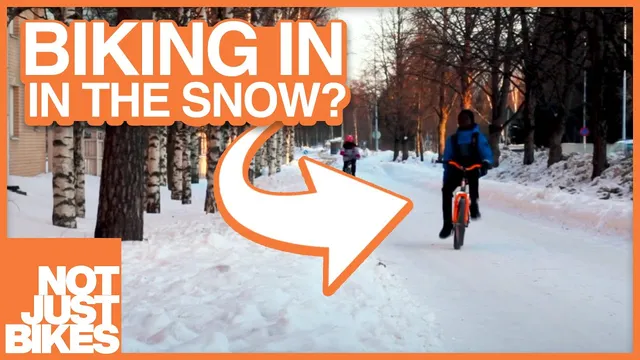
Why Canadians Can't Bike in the Winter (but Finnish people can)
Based on Not Just Bikes's video on YouTube. If you like this content, support the original creators by watching, liking and subscribing to their content.
Winter cycling rates don’t closely track temperature; safety and infrastructure design drive ridership more than cold weather does.
Briefing
Cold weather isn’t the barrier to winter cycling in Canada—unsafe, poorly maintained bicycle infrastructure is. Finland’s Oulu, often described as the “winter cycling capital,” shows that year-round bike ridership can stay high even in extreme cold when cities build separated, connected routes and keep them clear. The core takeaway is blunt: research finds almost no correlation between winter temperatures and how much people cycle during winter; the real determinants are safety and convenience.
Oulu’s results are backed by striking usage numbers: 22% of trips are made by bicycle, 77% of residents cycle at least occasionally, and over half ride all year. Even in January, school and university trips rely heavily on bikes—52%—and elderly riders appear on the roads at around -20°C. Tampere, another Finnish city with harsh winters, has far lower winter cycling than Oulu, underscoring that climate alone doesn’t determine behavior.
Studies cited in the transcript point to two practical requirements. First, cities need a network of safe bicycle paths that lets riders reach destinations without mixing with high-speed traffic or repeatedly crossing dangerous intersections. Oulu delivers this at scale: 875 km of separated bicycle paths connect the city, while painted lanes are comparatively rare (about 600 metres total), since snow can obscure paint. The network also includes design features that make cycling faster than driving—short cut routes—and more than 300 underpasses that help cyclists avoid major roads and traffic lights.
Second, winter maintenance must treat bike routes as critical infrastructure. In Toronto and other Canadian cities, bicycle paths often become snow dumping grounds: plows push snow into painted gutters, drivers run over the slush, and melt-refreeze cycles create jagged ice that forces cyclists back into traffic. Even where separation exists, only a small portion of the network gets winter service, with plowing sometimes delayed until snowfall exceeds about 5 cm.
Oulu’s approach is the opposite. Priority routes are plowed within roughly three hours of a 2 cm snowfall, multiple times per day when needed, and contractors keep snow depth under about 4 cm using hard-packed snow free of ice and debris. The transcript frames this as a policy decision: cities prioritize bike routes so riders don’t have to “compete” for space on transit or cars just because it snowed.
The transcript also pushes back on the cultural narrative that winter cycling is inherently extreme. A personal attempt to bike to work in winter is described as manageable, with studded tires presented as a tool for ice—though Oulu riders often don’t need them because maintenance prevents slipperiness. Data from Oulu’s bicycle detectors suggests winter ridership stays steady until temperatures drop below about -20°C, then falls only around 15%. The practical message is that cycling in cold weather can be comfortable, drivers tend to move slower, and riders warm up quickly.
Progress in Canada is portrayed as uneven but real: Edmonton has built protected lanes and plows them with road-level priority; Yellowknife’s new infrastructure is described as high quality; Montreal saw an 83% winter cycling increase in 2020, linked partly to more separated lanes and the use of ice-crushing equipment. Still, winter remains the default excuse for inaction. The transcript’s conclusion is that cold and snow aren’t the limiting factors—cities that design for safety and maintain bike routes can make winter cycling normal for people of all ages and abilities.
Cornell Notes
Winter cycling levels in cold climates don’t track temperature; they track whether cities build safe, connected bike networks and keep them clear. Finland’s Oulu illustrates the model: 22% of trips by bike, 77% of residents cycling at least occasionally, and over half riding all year—even around -20°C. Oulu’s separated network (875 km) connects the city, includes shortcuts faster than driving, and uses underpasses to avoid traffic lights and major roads. The decisive difference is maintenance: priority routes are plowed quickly after small snowfalls and kept under about 4 cm of hard-packed, debris-free snow. By contrast, Canadian cities like Toronto often let plows dump snow into bike gutters, creating ice and forcing riders onto unsafe roads.
What does the research say about winter temperature and winter cycling?
Why does Oulu have high winter ridership compared with other Finnish cities like Tampere?
What is the single biggest predictor of cycling levels, according to the transcript?
How does snow removal policy change what riders experience on bike routes?
Do riders in Oulu rely on studded tires to handle winter ice?
What does the transcript say about comfort and ridership trends as temperatures drop?
Review Questions
- What two conditions does the transcript identify as necessary for high winter cycling, and how do they address safety and convenience?
- How do Toronto’s and Oulu’s snow-removal practices differ in ways that directly affect cyclist safety?
- Why does the transcript argue that temperature is a poor predictor of winter cycling behavior?
Key Points
- 1
Winter cycling rates don’t closely track temperature; safety and infrastructure design drive ridership more than cold weather does.
- 2
A connected network of separated bicycle paths is the strongest predictor of how much people cycle, including in winter.
- 3
Oulu’s 875 km of separated bike paths connect the city and include shortcuts that can be faster than driving.
- 4
Snow removal quality is decisive: Oulu plows priority routes within hours of small snowfalls and keeps snow depth under about 4 cm.
- 5
Canadian cities often under-maintain bike routes in winter, letting plows dump snow into gutters and creating ice that forces cyclists into traffic.
- 6
Proper maintenance can reduce the need for studded tires because paths stay hard-packed and non-slippery.
- 7
Recent Canadian improvements—like Edmonton’s protected-lane plowing and Montreal’s winter cycling jump—suggest winter cycling can grow when cities invest in separation and maintenance.