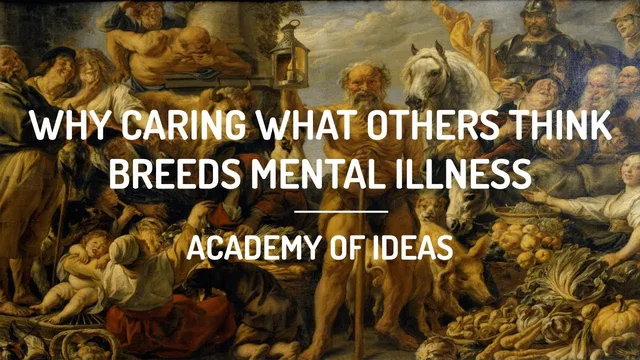
Why Caring What Others Think Breeds Mental Illness
Based on Academy of Ideas's video on YouTube. If you like this content, support the original creators by watching, liking and subscribing to their content.
Excessive concern for others’ opinions can damage mental health by making self-worth depend on external validation like status, money, and appearance.
Briefing
Caring too much about what other people think doesn’t just make life socially awkward—it can actively damage psychological health by outsourcing self-worth to external validation. In the modern West, approval is often tied to visible markers of success: job titles, money, physical appearance, fashion, and the social status of one’s circle. That arrangement keeps people perpetually “looking outward,” chasing the next improvement because the inner self never feels fully met. Carl Jung’s warning is central: when interests remain outside, outward achievements don’t bring lasting satisfaction, because the inner person “continues to raise his claim” and can’t be satisfied by possessions. The result is a specific kind of suffering—unexplained unhappiness that persists even when life looks like it should be going well.
The proposed cure starts with stepping off conformity. Conformity, in this framing, means living by reference to others—defrauding oneself of what is genuinely useful in order to make appearances match common opinion. Michel de Montaigne is used to sharpen the point: social comparison harms more than it helps because it shifts attention away from inner truth and toward how one is known publicly. But abandoning that path requires a practical psychological change: reducing fear of ridicule, rejection, and disapproval. As long as fear dominates, a person remains a conformist and stays vulnerable to the same “sickness” Jung described.
To shrink that fear, the transcript recommends a counterintuitive Stoic method: deliberately exposing oneself to the very reactions one fears. The Roman senator Cato—described as a follower of Stoicism—practiced actions likely to trigger others’ disdain, such as ignoring fashion, not for attention but to train himself to ignore low opinions of “other things.” Plutarch’s account frames the goal as learning to be ashamed only of what is truly shameful, while treating other people’s judgment as something to withstand rather than obey.
Diogenes the Cynic is offered as an even more extreme model of detachment. By repeatedly performing nonconforming acts that invited mockery—such as walking backward into theaters—Diogenes trained himself to treat ridicule as noise rather than danger. When questioned, he flipped the moral lens: the crowd was moving “in the wrong direction in life,” yet scolded him for walking backward. The transcript emphasizes that this freedom didn’t mean universal contempt; notable figures admired him, including Alexander the Great, who said he would have wanted to be Diogenes if not himself. Epictetus is invoked to underline the ideal: Diogenes was “free,” because other people’s opinions no longer constrained him.
The method comes with guardrails. The goal isn’t to become ridiculous for its own sake or to annoy others, but to practice “psychological observation”—learning about human nature and one’s own potential. When ridicule lands, Schopenhauer’s advice is to treat it as new information about humanity rather than something that should provoke distress. The transcript also adds a social diagnosis: people who insult most aggressively often have the least sound judgment, projecting their own misery outward. Over time, insults become “empty words” that pass without disturbing the mind. With that fear reduced, life can shift back toward the inner call, opening the possibility of a fuller existence—one not governed by the need to look good to others. The closing line frames the ultimate heroism as facing ridicule, even making oneself ridiculous without shrinking from it.
Cornell Notes
Excessive concern about others’ opinions can undermine mental health by tying self-worth to external validation—status, money, appearance, and social approval. Carl Jung’s critique is that outward success cannot satisfy the inner self, leading to persistent unhappiness. The proposed remedy is to live more authentically by stepping off conformity and reducing fear of ridicule and rejection. Stoic and Cynic practice offers a method: deliberately behave in ways likely to trigger disapproval so the mind learns that shame is survivable and other people’s judgments need not govern one’s actions. Over time, ridicule loses its power, enabling a life guided by inner values rather than public approval.
Why does caring about others’ opinions become psychologically harmful in this account?
What does “conformity” mean here, and why is it linked to fear?
How do Stoic practices aim to reduce fear of disapproval?
What role does Diogenes the Cynic play as a model?
What mindset prevents this practice from becoming mere attention-seeking or self-humiliation?
Review Questions
- How does the transcript connect outward success to inner dissatisfaction, and what does Jung’s critique add to that connection?
- What is the logic behind deliberately eliciting ridicule—how does it change behavior over time?
- How do Cato and Diogenes differ in their methods, and what shared goal makes their examples relevant?
Key Points
- 1
Excessive concern for others’ opinions can damage mental health by making self-worth depend on external validation like status, money, and appearance.
- 2
Jung’s warning is that outward success cannot satisfy the inner self; neglecting inner development turns external achievements into a source of unhappiness.
- 3
Authenticity requires stepping off conformity—living by inner truth rather than public approval.
- 4
Fear of ridicule and rejection is treated as the main psychological barrier to nonconforming living.
- 5
Stoic exposure is proposed as a remedy: intentionally act in ways likely to trigger disapproval so the mind learns ridicule is survivable.
- 6
Cato and Diogenes serve as examples of training detachment, with the aim of freedom from other people’s opinions.
- 7
Ridicule is reframed as information about human nature, and harsh critics are treated as unreliable judges whose opinions matter less.