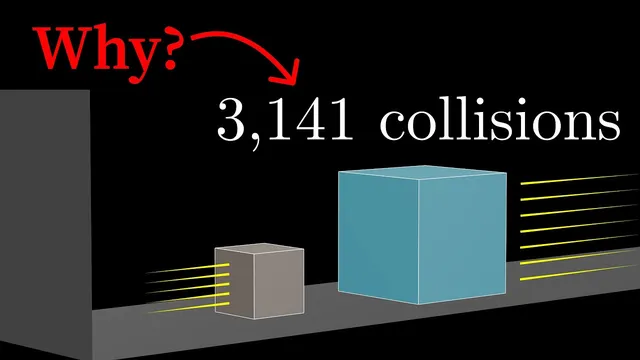
Why colliding blocks compute pi
Based on 3Blue1Brown's video on YouTube. If you like this content, support the original creators by watching, liking and subscribing to their content.
Model the two-block system using conservation of energy and momentum, then encode the changing velocities as coordinates in a rescaled state space.
Briefing
A pair of idealized, frictionless blocks can be tuned—by choosing a mass ratio—to produce a collision count whose digits match those of π, even though the setup is purely classical. The key mechanism is a geometric reformulation: conservation laws force the system’s evolving “state” into a circle, and each collision corresponds to stepping along that circle by equal angular arcs. When the mass ratio is a power of 100, the step angle becomes so close to a power-of-10 scale that the maximum number of steps before “overshooting” the circle’s circumference lands on the same integer digits as π (e.g., 100:1 gives 31 collisions; 10,000:1 gives 314; 1,000,000:1 gives 3,141).
The collision puzzle starts with a smaller block initially at rest and a larger block moving toward it on a frictionless plane, with a wall on the left. After each collision between blocks, and after each bounce off the wall, the system continues until both blocks move to the right. The total number of collisions grows with the mass ratio, and for ratios like 100:1 and 10,000:1 the final counts line up strikingly with 31 and 314. The analysis depends on ideal assumptions—perfectly elastic collisions, a fixed wall, and ignoring relativistic and practical effects—because the “action” compresses into a dense burst of impacts as the mass ratio increases.
To make the problem solvable, the analysis shifts from tracking velocities directly to tracking a point in a higher-dimensional “state space.” By encoding the two changing velocities into coordinates, conservation of energy becomes a circle (or a circle after a rescaling of axes), while conservation of momentum becomes a straight line in that same coordinate system. Each collision moves the state point from one intersection of the momentum line with the energy circle to the other, producing a zig-zag path. The experiment ends when the point enters a specific “end zone” region: both velocities must be positive and the smaller block’s speed must be less than the larger block’s.
Counting collisions becomes counting how many equal circular arcs fit before the zig-zag would overlap the end zone boundary. A geometry theorem about inscribed angles implies those arcs have equal angular size, so the collision count reduces to a “how many steps of size 2θ fit into 2π?” problem. The slope of the momentum line is tied to the mass ratio, and the step angle θ is determined through an arctangent relation. For small angles, arctan(x) is close to x (a small-angle approximation), making θ effectively behave like a power of 10 when the mass ratio is a power of 100—hence the shared digits with π.
There’s a caveat: turning “close” into “exact digits” is delicate. The approximation error scales like θ³, and an off-by-one mismatch would require an unlikely pattern in the known digits of π (such as a run of nines). A fully rigorous proof that the digits always match is beyond current math tools, so the statement that these tuned classical collisions compute π is described as an unsolved problem. Still, the puzzle remains valuable as a demonstration of how stripping away messy physics can reveal hidden connections—connections that, in this case, also echo inside quantum computing via Grover’s algorithm.
Cornell Notes
Idealized collisions between two blocks can be converted into a geometry problem by using conservation of energy and momentum. In a rescaled “state space,” energy conservation forces the system onto a circle, while momentum conservation forces it onto a line; each collision moves the state point to the other intersection of that line with the circle. The zig-zag path continues until the point reaches an “end zone” where both blocks move right and the smaller block is slower. Equal-angle arcs on the circle correspond to equal collision steps, so the total number of steps becomes a “how many arcs fit around 2π?” calculation. When the mass ratio is a power of 100, the resulting step angle is small enough that small-angle approximations make the collision count share the digits of π—though a fully rigorous proof of exact digit agreement remains unsolved.
How do conservation laws turn the block-collision process into a circle-and-line geometry problem?
Why does each collision correspond to “hopping” between two intersection points on the circle?
How does the inscribed angle theorem make the arc segments equal, and why does that matter for counting collisions?
What role does the mass ratio play in determining the step angle θ?
Why is the “digits of π” claim described as unsolved rather than fully proven?
How does the analysis justify ignoring real-world complications like inelasticity and relativity?
Review Questions
- In the rescaled state-space coordinates, what do conservation of energy and conservation of momentum become (circle vs line), and how does that determine the state point’s motion after each collision?
- Why does equal slope imply equal arc angles on the circle, and how does that reduce collision counting to a “fit 2θ steps into 2π” problem?
- What small-angle approximation is used to connect the mass ratio to θ, and what kind of rare decimal pattern would be required for an off-by-one digit mismatch with π?
Key Points
- 1
Model the two-block system using conservation of energy and momentum, then encode the changing velocities as coordinates in a rescaled state space.
- 2
After rescaling by √m1 and √m2, energy conservation becomes a circle, while momentum conservation becomes a straight line with slope determined by the mass ratio.
- 3
Each collision corresponds to moving the state point from one intersection of the momentum line with the energy circle to the other intersection, creating a repeating zig-zag path.
- 4
The zig-zag hits the circle at points separated by equal angular arcs; the inscribed angle theorem links the fixed segment slope to a constant arc angle of 2θ.
- 5
The collision count becomes a step-counting problem around a full 2π radians, with the end condition set by an “end zone” region in the state space.
- 6
When the mass ratio is a power of 100, θ = arctan(√(m2/m1)) is small enough that arctan(x) ≈ x makes the step size effectively behave like a power of 10, producing π-like digits.
- 7
Exact digit agreement is not fully proven because approximation error could, in principle, shift the integer count; ruling that out rigorously is beyond current methods.