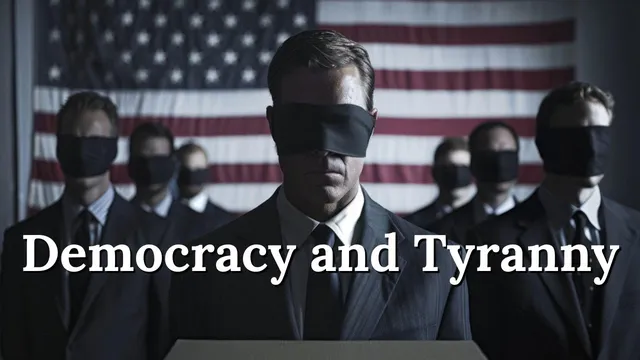
Why Democracy Leads to Tyranny
Based on Academy of Ideas's video on YouTube. If you like this content, support the original creators by watching, liking and subscribing to their content.
The transcript argues that modern democracy often undermines the institutions that enable freedom and prosperity, including markets, rule of law, families, education, and truth-seeking media.
Briefing
Modern democracy, as practiced, is portrayed as a pipeline to tyranny: elections and “rule by the people” function less as safeguards than as a veil that lets politicians and bureaucrats expand power while eroding the institutions that make freedom possible. The central claim is that democratic societies increasingly generate governments that corrode or destroy key pillars of social flourishing—free markets, division of labor, rule of law, strong families, sound money, education that teaches rather than indoctrinates, and a media oriented toward truth. When those institutions are systematically undermined, democracy’s promise of liberty loses credibility.
A major part of the diagnosis hinges on a distinction between direct and indirect democracy. Direct democracy—citizens voting on issues via referendums—can be dismissed as “tyranny of the masses,” since majority rule can coerce minorities. Benjamin Franklin’s “two wolves and a lamb” analogy and Auberon Herbert’s argument about compulsion frame the moral problem: numerical superiority does not magically grant authority over those outvoted.
Yet the more urgent threat, the transcript argues, arises in indirect or representational democracy, where voters choose politicians who are supposed to represent them. In practice, political parties preselect candidates and monopolize access to office, so elections become a choice among prefiltered options rather than a genuine mechanism of accountability. Once in power, politicians are said to serve their own interests and those of lobbyists, interest groups, and activists rather than the public. Even the usual remedy—voting out corrupt officials—is portrayed as ineffective because corrupt replacements are likely to come from the same ecosystem, while large bureaucracies implement policy without being directly elected.
Several forces are offered to explain why the worst rise to the top. Power itself is described as corrupting, with quotations from Aleksandr Solzhenitsyn and Mikhail Bakunin emphasizing domination’s structural tendency. A second mechanism is selection: the transcript claims that the most ruthless and power-hungry are drawn to state power, and that election incentives reward demagoguery and morally uninhibited ambition. Hans Hermann Hoppe is used to argue that popular elections make it difficult for “harmless or decent persons” to reach leadership, producing a leadership class optimized for winning rather than serving.
The transcript then argues that democratic ideology blunts resistance. Many citizens assume they rule collectively, so blame and responsibility for policy damage diffuse away from the actual decision-makers. Hoppe’s point about blurred lines between rulers and ruled is used to claim that public opposition to expanding state power weakens.
From there, the argument shifts to “soft totalitarianism.” Western democracies are said to centralize power less brutally than 20th-century regimes, but still to mold citizens through networks of rules and bureaucratic control rather than overt terror. Tocqueville’s warning about a sovereign power that “softens” and “directs” people is paired with Robert Nisbet’s claim that totalitarianism targets autonomous social relationships—especially institutions independent of the state such as family, churches, guilds, universities, and charities. In the West, the transcript claims, the same erosion occurs more slowly through propaganda, education, laws, regulations, and red tape.
The conclusion is stark: if democracies cannot prevent corrupt leadership, cannot stop soft totalitarian drift, and cannot protect independent institutions, then democracy as currently practiced is treated as a failed framework. The transcript calls for exploring and debating alternative institutions and political arrangements rather than waiting for a savior who may never arrive.
Cornell Notes
The transcript argues that modern democracy, despite its rhetoric of liberty and popular rule, tends to produce tyranny by enabling the growth of state power. It distinguishes direct democracy (majority voting on issues) from indirect democracy (electing representatives), claiming that indirect systems become dominated by party preselection, lobby influence, and unelected bureaucracies. It further claims that incentives in politics reward demagogues and power-seekers, while democratic ideology creates an “illusion” that weakens public resistance. Over time, this dynamic is described as “soft totalitarianism,” where citizens are managed through rules, propaganda, and the gradual destruction of independent institutions—especially the family and other autonomous associations. The stakes are that once social order depends on a terminally corrupt administrative state, society deteriorates rapidly.
Why does the transcript treat direct democracy as morally unstable?
What makes indirect democracy—elections and representation—less accountable in practice?
Why does the transcript claim that voting out corrupt officials doesn’t fix the problem?
What mechanisms are offered for why “the worst” rise to the top in politics?
How does democratic ideology, in this account, weaken resistance to state expansion?
What is “soft totalitarianism,” and how does it differ from older totalitarianism?
Review Questions
- How does the transcript connect party preselection and lobbying to the claim that indirect democracy fails at representation?
- Which incentives and character traits does the transcript say elections reward, and how does that shape leadership quality?
- What role do independent institutions—especially the family—play in the transcript’s explanation of soft totalitarianism?
Key Points
- 1
The transcript argues that modern democracy often undermines the institutions that enable freedom and prosperity, including markets, rule of law, families, education, and truth-seeking media.
- 2
A key distinction is drawn between direct democracy (issue referendums) and indirect democracy (electing representatives), with indirect systems portrayed as more vulnerable to capture.
- 3
Party preselection and lobbying are presented as mechanisms that turn elections into a limited choice rather than genuine public control.
- 4
Bureaucracies are described as a major accountability gap because many policy actors are not elected and therefore not directly answerable to voters.
- 5
The transcript claims political power attracts and rewards demagogues and morally uninhibited personalities, making “good” leadership less likely under election-based selection.
- 6
Democratic ideology is said to create an illusion of collective rule that diffuses blame and weakens resistance to expanding state power.
- 7
The end-stage is framed as “soft totalitarianism,” achieved through gradual erosion of autonomous institutions via propaganda, education, regulation, and red tape rather than mass violence.