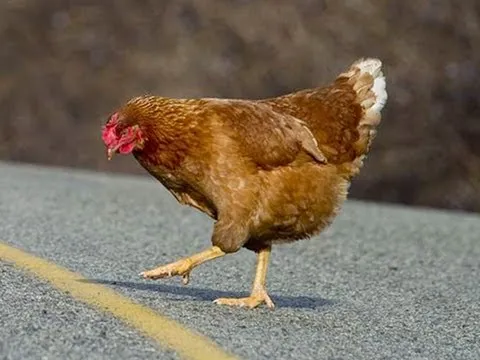
Why Did The Chicken Cross The Road?
Based on Vsauce's video on YouTube. If you like this content, support the original creators by watching, liking and subscribing to their content.
“To get to the other side” works as humor because it’s an anti-joke payoff—too obvious to be a typical punch line.
Briefing
“Why did the chicken cross the road?” endures not because it’s the oldest or best joke, but because it functions as an anti-joke: it withholds the usual surprise and instead delivers an answer so obvious it becomes the punch line. The classic “to get to the other side” is mundane on purpose, flipping expectations about what a joke should do. That mismatch—between what the brain predicts a joke will deliver and what it actually receives—helps explain why the line became shorthand for comedy even as it stopped being reliably funny for people who’ve heard it too many times.
The chicken line also sits inside a broader category of humor that plays with structure rather than content. Anti-jokes don’t rely on wordplay or a twist; they frustrate the expectation of a “real” punch line. Examples like “What’s blue and smells like red paint? Blue paint” and “Knock knock… Lettuce… That’s impossible” show the same pattern: the setup promises something joke-like, but the payoff is either literal, nonsensical, or deliberately underwhelming. The transcript even describes how anti-jokes can be used for psychological experiments at home through peer pressure—using a nonsense joke (“no soap, radio”) to see whether an outsider will laugh despite not understanding.
Historically, the chicken conundrum is far from ancient. It first appeared in print in The Knickerbocker roughly 160 years ago as a conundrum that wasn’t really a joke—again, closer to an anti-joke than a traditional punch line. If the goal is the oldest joke ever printed, the discussion points much further back to ancient Sumerian proverbs, where an “earliest known joke” involves a young woman not farting in her husband’s embrace—an example that’s crude by modern standards and underscores how humor has always been tied to social taboos.
The transcript then pivots from comedy mechanics to darker speculation: maybe the chicken crossed because it knew the road was dangerous, or because it was sad, lonely, or facing a grim fate. That interpretation is framed as morbid possibility rather than fact, but it highlights how the same line can be pulled into radically different meanings depending on what listeners bring to it.
A more practical question follows: why wouldn’t chickens cross roads? The answer is partly statistical and partly biological—there are far more chickens than humans or cats, and the transcript even estimates that if all chickens were cooked at once, their meat could fill enough KFC buckets to reach the Moon and back multiple times. Yet the “why” remains unknowable because the chicken is hypothetical. Unlike “Mary Had a Little Lamb,” where Mary Sawyer and the lamb were real and documented, the chicken exists only as a narrative device.
Finally, the transcript offers a computational-neuroscience explanation for why the joke still matters. Brains predict likely outcomes a few steps ahead; humor arrives when the prediction fails—when the listener realizes the joke is being delivered in a way that doesn’t match the expected path. That prediction error can trigger laughter via downstream effects in motor areas. The catch is repetition: once people know the ending, the brain’s surprise collapses, so the joke stops landing—yet its structure remains a useful demonstration of how intricate and adaptive human comedy can be.
Cornell Notes
“Why did the chicken cross the road?” survives because it’s less a traditional joke and more an anti-joke. The expected surprise or twist never arrives; “to get to the other side” is so obvious that the mundanity becomes the punch line. The line’s fame isn’t tied to age—its printed appearance is about 160 years old in The Knickerbocker—nor to being the “oldest joke,” which the transcript traces back thousands of years to ancient Sumerian proverbs. Humor mechanics are linked to prediction: brains anticipate how a joke will unfold, and laughter can follow when the actual outcome breaks those expectations. Even when the joke stops being funny through repetition, its structure still illustrates how complex humor processing is.
What makes “Why did the chicken cross the road?” an anti-joke rather than a standard joke?
How does the transcript connect anti-jokes to psychological experiments?
How old is the chicken conundrum, and what’s offered as an older alternative?
Why can’t anyone truly answer the chicken’s motivation?
What neurological idea is used to explain why the joke can still trigger laughter?
Review Questions
- How does an anti-joke change the listener’s expectations compared with a traditional joke?
- What evidence does the transcript use to argue the chicken conundrum isn’t the oldest joke, and what older example is given?
- Explain, in prediction-error terms, why repetition can make “Why did the chicken cross the road?” stop working as humor.
Key Points
- 1
“To get to the other side” works as humor because it’s an anti-joke payoff—too obvious to be a typical punch line.
- 2
Anti-jokes rely on structural expectation failure rather than clever twists or wordplay.
- 3
The chicken conundrum’s printed origin is placed around 160 years ago in The Knickerbocker, not thousands of years back.
- 4
The transcript contrasts the fictional chicken with documented real-life origins of “Mary Had a Little Lamb.”
- 5
A peer-pressure experiment is described using the nonsense “no soap, radio” joke to show conformity can drive laughter.
- 6
A prediction-based neuroscience model links humor to when actual outcomes break the brain’s expected paths, triggering laughter—until repetition removes the surprise.