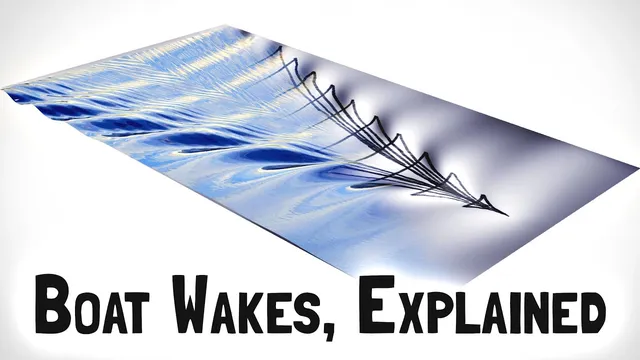
Why Do Boats Make This Shape?
Based on minutephysics's video on YouTube. If you like this content, support the original creators by watching, liking and subscribing to their content.
Water wakes owe their characteristic shape to dispersion, where wave speed depends on wavelength.
Briefing
Boat wakes look deceptively simple at first glance—there’s a clear V-shaped structure, plus a feathery, repeating ripple pattern along the edges. The key reason that pattern stays so consistent across ducks, kayaks, and ships is dispersion: in water, wave speed depends on wavelength. Unlike light and sound, where wave speed is effectively fixed, water waves separate by size—longer wavelengths travel faster, while shorter wavelengths lag behind. That wavelength-dependent speed forces different parts of the wake to spread out at different angles and spacings, producing the characteristic geometry.
Start with a simplified case: imagine a boat moving through water while generating waves of only one wavelength. If the water waves move faster than the boat, the boat stays ahead of the wavefronts, so the circular wave crests wrap around it without forming a trailing wake. If the waves move slower than the boat, the boat outruns the crests, and the overlapping circles build a V-shaped wake. Make the waves even slower and the V narrows further—so slower waves yield a tighter wake, while faster waves yield a wider one.
Real wakes don’t come from a single wavelength. A moving boat continually generates a repeating sequence of wavefronts, and because water disperses, each wavelength component travels at its own speed. Longer, faster components create wider V-shaped wakes whose repeating features sit farther apart. Shorter, slower components create narrower V-shaped wakes packed more closely together. The wake becomes the sum of these many V-shaped “trains,” each offset by the wavelength-specific spacing and angle dictated by water’s dispersion relation.
That superposition explains the distinctive interior arcs and the feathered ripples along the edges. When the different wavelength components align, the edges sharpen into repeating patterns, while the interior shows broader, overlapping arcs. In practice, the wake is even more convincing because real boats generate a spectrum of wavelengths rather than a single idealized one. Extending the same logic into three dimensions yields the realistic, volumetric structure seen behind moving objects.
Bottom line: the signature shape of a water wake isn’t a mysterious property of boats—it’s a direct consequence of how water waves of different wavelengths travel at different speeds. Dispersion turns a simple repeating wave source into a structured interference pattern, and adding all those wavelength-dependent V-shaped contributions produces the familiar, repeatable wake geometry.
Cornell Notes
Water wakes form a consistent V-shaped, feathery pattern because water waves disperse: wave speed depends on wavelength. With a single wavelength, a boat moving faster than that wave outruns the crests and produces a V-shaped wake; slower waves make a narrower V, faster waves a wider one. Real boats generate many wavelengths at once, and dispersion makes each wavelength component travel at its own speed. Longer, faster components create wider V-wakes spaced farther apart, while shorter, slower components create narrower V-wakes packed closer together. Superimposing all these wavelength-specific patterns at the angles and spacings set by water’s dispersion relation yields the characteristic wake edges and interior arcs.
What is dispersion, and why does it matter for water wakes?
How does the wake look in the idealized single-wavelength case?
Why does a moving boat produce a “train” of V-shaped wakes even for one wavelength?
How do multiple wavelengths combine to create the feathery edge and interior arcs?
What determines the exact angles and spacing of the wake features?
Review Questions
- If water waves did not disperse (all wavelengths traveled at the same speed), what would happen to the wake’s repeating feathery structure?
- How would the wake change if the boat generated only long wavelengths rather than a broad spectrum?
- Explain why slower wave components produce narrower V-wakes and why that also affects how closely the repeating features appear.
Key Points
- 1
Water wakes owe their characteristic shape to dispersion, where wave speed depends on wavelength.
- 2
Longer water waves travel faster; shorter water waves travel slower, forcing different wavelength components to separate in angle and spacing.
- 3
In a single-wavelength idealization, a boat moving faster than the wave produces a V-shaped wake; slower waves make the V narrower and faster waves make it wider.
- 4
Because waves repeat, a moving boat generates a repeating train of V-shaped wake contributions even when only one wavelength is present.
- 5
Real wakes combine many wavelengths: wide, widely spaced V-wakes from long components overlap with narrow, closely spaced V-wakes from short components.
- 6
Superposition of all wavelength-dependent V-patterns at dispersion-determined angles produces the familiar feathered edges and interior arcs.
- 7
Extending the same wavelength-plus-dispersion logic into three dimensions yields the realistic volumetric wake structure behind moving objects.