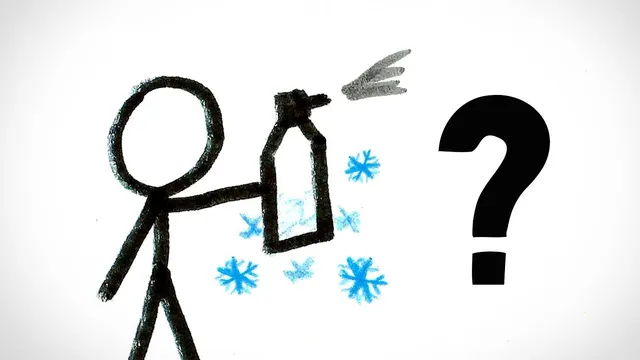
Why Do Compressed Air Cans Get Cold?
Based on minutephysics's video on YouTube. If you like this content, support the original creators by watching, liking and subscribing to their content.
Compressed-air cans cool mainly because liquefied 1,1-difluoroethane boils when pressure drops, not because of ordinary gas expansion alone.
Briefing
Compressed-air cans get dangerously cold because they aren’t just releasing expanding gas—they’re rapidly lowering pressure on a liquefied chemical, forcing it to boil and steal heat from the can and surroundings. The familiar idea that cooling comes from gas expansion is incomplete: “normal” expansion through a valve would predict far colder temperatures than what actually comes out, meaning the cooling mechanism must be different.
The key difference is how the gas leaves. When gas flows through a nozzle or valve, it doesn’t behave like a container suddenly vented into open space. The gas is pushed along by the higher-pressure material behind it, so the pressure drop and volume increase partially offset each other. In thermodynamic terms, pressure times volume stays roughly constant for the relevant process, keeping temperature nearly steady—though not perfectly. Even a bike-tire valve gets colder when air escapes, but nowhere near the frostbite-level chill of a compressed-air can.
That’s only a small part of the story. The real cooling power comes from phase change: inside the can is liquid 1,1-difluoroethane (a refrigerant-like compound), not just gas. At room temperature and normal pressure it would be a gas, but the can pressurizes it to about six atmospheres—high enough that most of it remains liquid. The can contains liquid and vapor in equilibrium, with just enough liquid boiling off to maintain the target pressure.
When the valve is opened, the pressure inside the can drops below what’s needed to keep the liquid stable. More 1,1-difluoroethane immediately boils to rebuild the six-atmosphere equilibrium. Boiling requires a large energy input—latent heat—which the system pulls from the remaining liquid and the can itself. The result is dramatic cooling: spraying away roughly 10% of the contents can cool the rest of the can by about 20°C.
The same principle explains why pressure cookers can cool down during steam release. Sealed steam raises pressure and allows water to remain liquid above its usual boiling point; when steam escapes, pressure falls, more water boils, and the remaining water cools. Keep venting and the temperature trends back toward the normal boiling point. For difluoroethane, the “normal” boiling point is around −25°C, matching the idea that continued spraying drives the can toward that temperature.
This also clarifies why shaking or spraying upside down is dangerous. If the can is tilted, liquid can be expelled instead of vapor. Liquid that was held in place only by high pressure flashes into gas upon leaving, instantly vaporizing and cooling whatever it hits—creating “instant ice.” Because 1,1-difluoroethane can dissolve in water and is poisonous, that ice is not safe for food use.
In short: a compressed-air can is effectively a 1,1-difluoroethane pressure cooker. The cold comes from pressure-driven boiling, not from ordinary gas expansion alone.
Cornell Notes
Compressed-air cans cool because they release liquefied 1,1-difluoroethane under high pressure, not just compressed gas. Inside the can, the compound exists as liquid and vapor in equilibrium at about six atmospheres. Opening the valve drops the pressure, triggering more boiling; the latent heat required for vaporization is drawn from the remaining liquid and the can, producing large temperature drops. Gas expansion through a valve contributes only modest cooling, which is why a valve on a bike tire gets colder but not frostbite-cold. Shaking or inverting the can can eject liquid directly, causing rapid flashing into gas and extreme localized cooling.
Why doesn’t ordinary gas expansion through a valve fully explain the extreme cold from compressed-air cans?
What’s actually inside a compressed-air can?
How does opening the valve lead to cooling?
Why is phase change (boiling) such a powerful cooling mechanism?
Why do shaking or spraying upside down cause “instant ice”?
What temperature does the process trend toward if spraying continues?
Review Questions
- What thermodynamic reason makes valve flow less cooling than free expansion into open space?
- How does the liquid–vapor equilibrium at ~six atmospheres determine the can’s spray consistency?
- Why does ejecting liquid (from shaking or inversion) cool surfaces far more than ejecting vapor?
Key Points
- 1
Compressed-air cans cool mainly because liquefied 1,1-difluoroethane boils when pressure drops, not because of ordinary gas expansion alone.
- 2
Valve/nozzle expansion produces only modest cooling since the leaving gas is pushed by higher-pressure gas behind it, keeping temperature nearly steady.
- 3
Inside the can, 1,1-difluoroethane exists as liquid and vapor in equilibrium at about six atmospheres.
- 4
Opening the valve lowers internal pressure, causing additional boiling that draws latent heat from the can and remaining fluid.
- 5
Spraying away a fraction of the contents can cool the rest of the can substantially (about 20°C for ~10% sprayed).
- 6
The same physics appears in pressure cookers: venting lowers pressure and triggers more boiling, cooling the remaining liquid.
- 7
Shaking or inverting can eject liquid directly, leading to rapid flashing into gas and extreme localized cooling (and the resulting “ice” is unsafe).