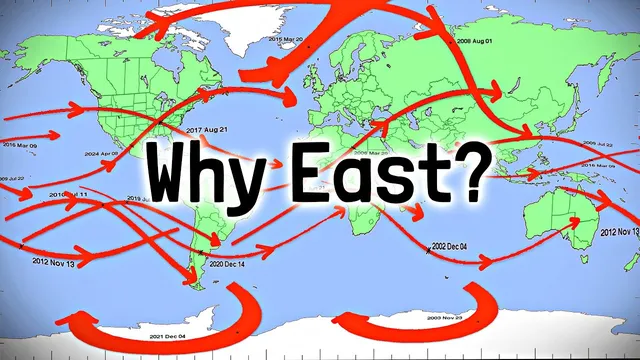
Why Do Eclipses Travel WEST to EAST?
Based on minutephysics's video on YouTube. If you like this content, support the original creators by watching, liking and subscribing to their content.
Eclipse tracks are determined by where the Moon’s shadow lands on Earth, not by the Moon’s apparent rise-and-set path.
Briefing
Eclipses don’t track across Earth the way the Sun and Moon rise and set because an eclipse is governed by the Moon’s shadow racing over the planet—not by the Moon’s apparent path in the sky. While the Sun and Moon both appear to move eastward due to Earth’s rotation, the Moon’s shadow can outrun Earth’s surface in the eastward direction, making total eclipses seem to travel from west to east.
From the north pole, Earth rotates counterclockwise (toward the east). That rotation controls the Moon’s *sky* path: at moonrise, the line of sight from a rotating Earth surface point to the Moon points eastward, so the Moon appears to start in the east. As Earth keeps turning, the Moon’s apparent position shifts overhead and then toward the west—even though the Moon itself is orbiting eastward the whole time.
An eclipse, however, depends on a different geometry. The key is where the Moon’s shadow falls on Earth. The shadow points away from the Sun, and its motion is tied to the Moon’s orbital speed around Earth. The Moon travels eastward at just over 2,000 miles per hour relative to Earth’s center, and its shadow moves at essentially the same eastward rate. Earth’s surface also moves eastward, but much more slowly: about 1,000 miles per hour at the equator, decreasing toward the poles. Because the shadow’s eastward speed exceeds the surface’s eastward speed, the shadow sweeps across Earth in a way that makes eclipses appear to move west to east.
A simple scale comparison makes the timing intuitive. Earth’s diameter is roughly 8,000 miles, so the Moon’s shadow crosses a given width of Earth in about 3.5 hours (less near the poles). By contrast, any single point on Earth takes about 12 hours to move halfway around the planet due to rotation. The eclipse’s apparent direction is therefore a speed contest: the shadow wins.
The “weirdness” deepens near the poles. Earth’s rotation axis is tilted, so the Moon’s shadow can still be moving eastward while striking regions that are on Earth’s night side. That tilt can produce eclipse tracks that briefly head west before turning back east, especially for high-latitude eclipses.
The explanation also highlights how sensitive eclipse direction is to relative speeds. There’s no special cosmic rule forcing west-to-east motion; it’s largely a coincidence of the current Earth–Moon system. If Earth were larger or the Moon were closer (changing orbital circumference and thus orbital speed), the balance between the Moon’s shadow speed and Earth’s surface speed could shift. In extreme hypothetical adjustments, eclipse motion could even reverse during the day—east, then west, then east again—showing that the direction is ultimately a geometric consequence of relative linear velocities.
Overall, the Moon’s orbit is “eastward” in two senses: a month is longer than a day (so the cycle takes longer), but the Moon’s actual eastward linear speed is faster than Earth’s surface at most latitudes. That faster shadow motion is what sets eclipse tracks, including their occasional polar oddities.
Cornell Notes
Eclipses appear to move west to east because the Moon’s shadow sweeps across Earth faster eastward than Earth’s surface itself. Earth’s rotation controls the Sun and Moon’s apparent rise-and-set paths, but eclipse tracks depend on where the shadow lands on the ground. The Moon orbits eastward at just over 2,000 miles per hour, while the equator moves eastward at about 1,000 miles per hour (slower near the poles), so the shadow “outpaces” the surface. Near the poles, Earth’s axial tilt can make the shadow hit Earth’s night side in ways that produce brief westward segments in eclipse paths. The direction is therefore a speed-and-geometry coincidence, not a fundamental law.
Why do the Sun and Moon rise in the east while eclipses often travel west to east?
What speed comparison determines eclipse direction?
How do the rough time scales (3.5 hours vs 12 hours) connect to the direction?
Why do some eclipse paths near the poles briefly head west before turning east?
What would have to change for eclipses to move east to west instead?
Review Questions
- If eclipse tracks depend on the Moon’s shadow rather than the Moon’s apparent sky path, what observational difference would you expect compared with the Moon’s rise/set direction?
- How does changing latitude affect Earth’s eastward surface speed, and why does that matter for eclipse track direction?
- What role does Earth’s axial tilt play in producing westward segments of eclipse paths near the poles?
Key Points
- 1
Eclipse tracks are determined by where the Moon’s shadow lands on Earth, not by the Moon’s apparent rise-and-set path.
- 2
The Moon’s shadow moves eastward at roughly the Moon’s orbital speed (just over 2,000 miles per hour).
- 3
Earth’s surface also moves eastward due to rotation, but more slowly—about 1,000 miles per hour at the equator and less toward the poles.
- 4
Because the shadow’s eastward speed exceeds the surface’s eastward speed, eclipses typically appear to move from west to east.
- 5
Near the poles, Earth’s axial tilt can make the shadow intersect Earth’s night side in ways that produce brief westward segments in eclipse paths.
- 6
There is no inherent rule that eclipses must go west to east; the direction is a coincidence of the current Earth–Moon relative speeds and geometry.
- 7
Changing Earth’s size or the Moon’s distance could alter relative speeds enough to flip eclipse direction or even make it reverse during the day.