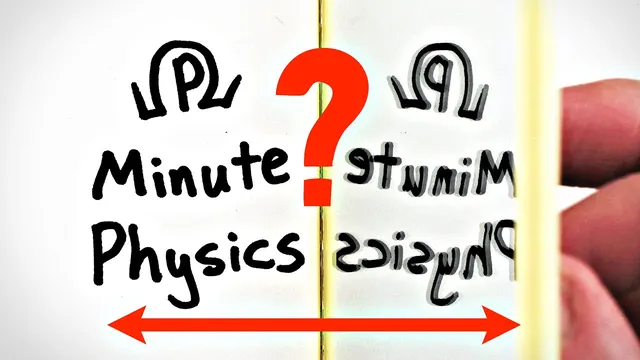
Why Do Mirrors Flip Left & Right (but not up & down)?
Based on minutephysics's video on YouTube. If you like this content, support the original creators by watching, liking and subscribing to their content.
A single mirror inverts depth (in/out), not left-right or up-down.
Briefing
Mirrors don’t swap left and right—or up and down—when they form an image. What they actually reverse is depth: the direction “into” the mirror becomes “out of” it, so objects appear as if the mirror were a window into a parallel space where in-and-out are flipped. That depth inversion comes directly from specular reflection: light rays bounce off a mirror at equal angles, so the outgoing light behaves exactly like it would if it came from a parallel universe behind the mirror, with only the in/out direction reversed. The result is a scene that keeps left-right and up-down positions aligned, while swapping near and far.
The left-right “flip” people notice with words has a different cause: humans typically rotate text-bearing objects to face a mirror. If a word is printed normally on a flat surface, the surface is turned so the mirror can see it. That rotation is what flips the word in the mirror—usually left-right—because the object is turned horizontally relative to the viewer. A key check is to use transparent material: if the word is readable left-to-right on the transparent sheet, its mirror image is also readable left-to-right. That shows the mirror itself isn’t reversing left and right; the apparent reversal comes from how the word was oriented before the light ever reached the mirror.
The “outside-the-mirror” idea explains why the mirror’s effect seems to match what happens to the word in real life. If a word appears flipped in a mirror, it’s also flipped on the side of the object facing the mirror. People usually don’t notice this because they can’t see through solid objects. To see the word without using the mirror, you’d have to walk around to the other side of the object and view it from behind—where the flip becomes obvious.
Multiple mirrors can produce the classic left-right swap, but only through geometry. With two mirrors, the in-and-out reversal happens along two different directions; combined, that can make left appear as right and right appear as left. If the mirrors are rotated relative to each other, the same multi-mirror setup can instead swap up and down. In short: a single mirror inverts depth (in/out), while the familiar left-right reversal of text is mostly a consequence of how we orient printed objects—and multiple mirrors can combine depth inversions into apparent left-right or up-down swaps.
Cornell Notes
A single mirror doesn’t flip left-right or up-down. It inverts depth: what’s near becomes far and what’s far becomes near, because specular reflection sends light back out at the same angle it came in. That makes mirror images behave like light from a parallel universe where “in” and “out” are reversed. The common left-right reversal of words happens because people rotate the text-bearing object to face the mirror, and that rotation is usually left-right. With two mirrors, two depth inversions can combine to produce an apparent left-right (or up-down) swap depending on mirror orientation.
What does a mirror actually reverse in a single reflection?
Why do words look like they’re flipped left-right in a mirror?
How can transparent material reveal whether the mirror flips left-right?
Why does the “outside the mirror” flip matter?
How can two mirrors create a left-right swap?
Review Questions
- If a mirror preserves left-right and up-down, what specific relationship between near and far objects must be reversed in the image?
- How would the apparent “flip” of a word change if the text-bearing object were turned vertically instead of horizontally before facing the mirror?
- What role does using two mirrors play in producing an apparent left-right (or up-down) swap?
Key Points
- 1
A single mirror inverts depth (in/out), not left-right or up-down.
- 2
Specular reflection explains the depth inversion: light returns at the same angle it entered.
- 3
Mirror images behave like light from a parallel space where only “in” and “out” are reversed.
- 4
The left-right reversal of words usually comes from how people rotate printed objects to face the mirror.
- 5
Transparent-material tests show the mirror preserves left-right ordering for readable text.
- 6
The “flip” is often present on the side of the object facing the mirror, but it’s hidden because solids block viewing.
- 7
Two mirrors can combine two depth inversions into an apparent left-right or up-down swap depending on mirror orientation.